Friday, February 18, 2022

David Garfield - 2018 "Jazz Outside The Box"


Well known as musical director of George Benson keyboardist David Garfield pursues his own dream as a solo artist. His debut album was a homage to the late drummer Jeff Pocaro Tribute to Jeff (1997).

Next albums were I Am The Cat...Man (1997), Music From Riding Bean (2001), Giving Back (2003), Seasons Of Change, The State of Things, Tribute To Jeff Revisited (2005). His newest project is Jazz Outside The Box (2018).

Garfield performs on the new album piano, Fender Rhodes and synthesizers. Further players are trumpeter Wallace Roney, percussionist Poncho Sanchez and drummer Steve Jordan. Guest musicians are Randy Brecker, Michael McDonald, Tom Scott, Eric Marienthal, Pete Christlieb, Bennie Maupin, Brian Auger, Will Lee, Airto Moreira, the Charlie Bisharat String Quartet, an orchestra conducted by John Clayton, the late guitarists Chuck Loeb and Larry Coryell, and John Densmore, who plays drums and orates on a spoken word segment.

Sting has written with Fragile from his album Nothing Like the Sun (1988) an emotional highlight of music history. Garfield creates with great passion to the affecting structure of the theme an arrangement which is an outstanding example of musicianship. Harvest Time evokes associations with the homeland of the Midwest with its infinite expanses.

In a Sentimental Mood, a jazz composition by Duke Ellington (1935), has inspired generations of musicians. Garfield adds some Latin flavor to his version which revels in a rich horn arrangement with Walt Fowler on trumpet in the lead. Garfield gives the song Roxanne by the group Police a jazzy finish.

Song for My Father by the Horace Silver Quintet (1965), is re-interpreted by Garfield in a sophisticated way.  John Densmore cites the original lyrics by Horace Silver. The bass line was used by Steely Dan for the song Rikki Don’t Lose That Number, Garfield quotes Rikki on his cover in returned tribute and merges it with motifs of The Doors and other composers.

Late keyboardist Joe Sample (The Crusaders) wrote Rainbow Seeker in 1978. This rendition features late guitarist Chuck Loeb and Steve Jordan on drums. Oliver Nelson created Stolen Moments for the 1960 album Trane Whistle by Eddie "Lockjaw" Davis and replayed it on his album The Blues and the Abstract Truth in 1961. Since then a jazz standard Garfield continues this tradition of bebop.

Voodoo Gumbo/Citizen Coryell features guitarist Larry Coryell, to whom Garfield has dedicated this tune. The jazz fusion piece East Lou Brew is inspired by Miles Davis and features Wallace Roney on trumpet, Bennie Maupin on sax and Larry Coryell on guitar.

Sophisticated Lady is a jazz standard, composed as an instrumental in 1932 by Duke Ellington. Irving Mills wrote later the lyrics, whose words were added to the song by Mitchell Parish. On this rendition vocalist Leslie Smith delivers with his timbre an authentic feeling.

Drummer Billy Cobham wrote Red Baron for his solo debut album Spectrum in 1973. A milestone in the fusion jazz genre it surely deserves Garfield's revisit featuring an all star band with Randy Brecker (trumpet, flugelhorn), Brian Auger (organ), Oz Noy & James Harrah (guitars), Leland Sklar (bass) and more.

The visits to the Saturday Mass of Operation Breadbasket inspired Joe Zawinul to write Country Preacher, which is explicitly dedicated to Jesse Jackson. From this developed finally the idea for the album of the same name by the Cannonball Adderley Quintet in 1969. Mike Finnigan excels on organ and Eric Marienthal on sax on this perfectly arranged interpretation.

Prophecy is a composition that David Garfield developed quite melody consciously, but also with the impetus to create as much space as possible for expansive solos. David is not the only one to grab his keys. Vinnie Colaiuta sets stimulating accents on his drum set. The recognizable Arabic structure in rhythm and melody structure intensifies towards the end of the piece before it rises in the final chord.

My Favorite Things is a show tune from the 1959 Rodgers and Hammerstein musical The Sound of Music. In the same named 1965 musical drama film the main actor and singer was Julie Andrews. Garfield mingles in his orchestral and heavily instrumented version genially elements of musical, jazz and Latin to an inspiring and lasting musical experience.

Final tune on this album is an abbreviated version of Song for My Father. Alternate versions of Red Baron and Harvest Time are available as download. According to reports from well-informed sources Garfield expects this project to be expanded into a trilogy with the album Jamming Outside the Box and the upcoming album Vox Outside the Box. If Garfield's creative power allows it, Outside The Box could even become an ongoing series. Garfield has already hinted that on Facebook.

David Garfield's Jazz Outside The Box is without no doubt worthy of a Grammy Award. Musical performance, artistic expressiveness, sophisticated arrangements down to the last detail, the overall stylistic concept, a superior grasp of the intricacies of melody, to summarize in short a reference project of contemporary music.

Personnel:

    Acoustic Bass – Carlitos Del Puerto
    Acoustic Guitar – Diego Figueiredo
    Alto Saxophone, Alto Flute, Soprano Saxophone – Marty Ehrlich
    Backing Vocals – Lisa Branly
    Bass – Chuck Berghofer, Darryl Jones, Jimmy Earl, Jimmy Johnson (5), John Peña, Leland Sklar, Neil Stubenhaus
    Congas – Poncho Sanchez
    Drums – Curt Bisquera, Jimmy Branly, Joe Porcaro, Steve Ferrone, Steve Jordan, Vincent Wilburn, Vinnie Colaiuta
    Drums, Drum Programming – Bennie Rogers III
    Drums, Voice – John Densmore
    Guitar – Chuck Loeb, Dean Parks, Denny Dias, James Harrah, Larry Coryell, Marvin Home, Michael Landau, Michael Thompson, Oz Noy, Steve Sykes, Tony Pulizzi
    Keyboards – David Garfield
    Organ – Brian Auger, Mike Finnigan (2)
    Organ, Vocals – Bill Champlin
    Percussion – Airto Moreira, Joey De Leon, Jr., Kevin Ricard, Lenny Castro, Luis Conte, Richard Tokatz, Richie Gajate-Garcia
    Piano – Terry Trotter
    Saxophone – Eric Marienthal, Jim Stevens (7), Larry Klimas, Pete Christlieb, Steve Tavaglione, Tom Scott
    Saxophone, Bass Clarinet – Bennie Maupin
    Steel Drums – Robert Greenidge
    Strings – Charlie Bisharat
    Strings [Arrangement] – John Clayton
    Tres – San Miguel Perez
    Trombone – Francisco Torres (3), Nick Lane
    Trumpet – Chuck Findley, Dan Fornero, Wallace Roney, Wayne Bergeron
    Trumpet, Flugelhorn – Randy Brecker, Walt Fowler
    Vibraphone – Emil Richards
    Violin – Dayren Santamaria
    Vocals – Bruce Hamada, Carmen Grillo, Leslie Smith, Michael McDonald, Robbie Wyckoff
    Vocals, Bass – Jason Scheff, Will Lee

Track listing:
 
01 Fragile (feat. Michael McDonald, Bruce Hamada & Diego Figueiredo) 5:40
02 Harvest Time (feat. Eric Marienthal & Airto Moreira) [Acoustic] 5:51
03 In a Sentimental Mood (feat. Poncho Sanchez & Larry Klimas) 5:53
04 Roxanne (feat. Robbie Wyckoff & Joe Porcaro) 4:25
05 Song for My Father (feat. John Densmore, Denny Dias & Randy Brecker) [Full-Length] 7:13
06 Rainbow Seeker (feat. Chuck Loeb & Steve Jordan) [Acoustic] 5:47
07 Stolen Moments (feat. Tom Scott & Joe Porcaro) 4:55
08 Voodoo Gumbo/Citizen Coryell (feat. Larry Coryell & Airto Moreira) 2:24
09 East Lou Brew (feat. Bennie Maupin, Wallace Roney & Larry Coryell) 5:46
10 Sophisticated Lady (feat. Poncho Sanchez, Leslie Smith & Pete Christlieb)6:16
11 Red Baron (feat. Randy Brecker & Brian Auger) 4:08
12 Country Preacher (feat. Eric Marienthal & Mike Finnigan) 4:59
13 Prophecy (feat. Michael Landau & Vinnie Colaiuta) 4:33
14 My Favorite Things (feat. Robert Greenidge & Terry Trotter) 5:33
15 Song for My Father (feat. John Densmore, Denny Dias & Randy Brecker) [Radio Version] 4:41
16 Red Baron (feat. Oz Noy & James Harrah) [Alternate Version] 4:07
17 Harvest Time (feat. Eric Marienthal & Airto Moreira) [Extended Version] 6:52

Monday, February 7, 2022

Jimi Hendrix - 2002 "Blue Wild Angel" - Live at the Isle of Wight


In 1970, Jimi Hendrix returned to the country where he'd skyrocketed to fame and gave his first performances in almost two years when he headlined the Isle of Wight festival. Sadly, it was also to be his last major public appearance: less than three weeks later, he would be dead. Compiled from that performance (also available in its entirety as a limited-edition double disc), these recordings reveal a guitar legend in good humor, yet restlessly exploring the broader musical directions he'd just laid down on sessions for what would become First Rays of the New Rising Sun (initially released posthumously as The Cry of Love). Backed by Experience drummer Mitch Mitchell and Band of Gypsys bassist Billy Cox, Hendrix ranges from the improvisatory cacophony of "Machine Gun" and a retooling of his standard blues workout "Red House" to renditions of "Dolly Dagger," "Freedom," and "Hey Baby" that trade on the more rhythmic R&B and jazz influences he'd diligently worked into his music. At times jagged, and straining the limitations of the trio format (Hendrix had publicly mused about working with a big band shortly before his death), it's nonetheless a passionate, intriguing clue as to Hendrix's true ambitions and potential beyond his initial hype and stardom.

Blue Wild Angel: Live at the Isle of Wight is a posthumous live album by Jimi Hendrix released on November 12, 2002. The album documents Hendrix's last U.K. live performance at the Isle of Wight Festival on August 31, 1970, three weeks before his death. The set list for the concert contained songs from the original Experience albums, as well as new songs. Some were previously available on Isle of Wight (1971) and Live Isle of Wight '70 (1991). "Power to Love (Message of Love)", "Midnight Lightning", and "Foxy Lady" released in the US on the three record set The First Great Rock Festivals of the 70s: Isle of Wight/Atlanta Pop Festival" released on Columbia Records in 1971.

"Isle of Wight" is one of Jimi Hendrix' last recorded live sets and it's a winner! There has been some restoration from roadie tapes to fill in some bad sound, but you'd never know it. All Music Guide has savaged this performance (as well as the excellent Woodstock set), but don't let that discourage you. I prefer this set over "Band of Gypsies" and it even includes a killer version of "Machine Gun" minus Buddy Miles' whooping and hollering. Subtle he was not. Mitch Mitchell is back on drums along with Billy Cox on bass (his main instument is bass, unlike doubler Noel Redding). All the fire and energy we all love from Jimi and company are on display here. What more could the Hendrix fan want?

Track listing:

01 God Save The Queen     
02 Sgt. Pepper's Lonely Hearts Club Band     
03 Spanish Castle Magic     
04 All Along The Watchtower     
05 Machine Gun     
06 Lover Man     
07 Freedom     
08 Red House     
09 Dolly Dagger     
10 Hey Baby (New Rising Sun)    
11 In From The Storm     

Personnel:

Jimi Hendrix - Guitar
Billy Cox - Bass
Mitch Mitchel - Drums

Monday, December 27, 2021

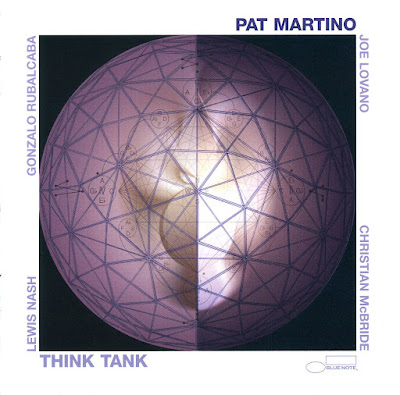
Pat Martino - 2003 "Think Tank"


Guitarist Pat Martino has tempered his serpentine, machine-gun improvisational style over the years into a soft-focus, graph paper stencil. His playing, at once mathematically dense and puritanical in its economy, can impress with long bursts of harmonic complexity and stylistic flourishes that cross rockabilly-esque chicken scratch with ECM-style repetition. All of this is on display on his cerebral, blues-tinged 2003 album Think Tank. His third album for Blue Note since 1997's All Sides Now, it finds him paired with the equally protean talents of saxophonist Joe Lovano, pianist Gonzalo Rubalcaba, bassist Christian McBride, and drummer Lewis Nash. Together, they play with a thoughtful intensity that's both meditative and exploding with improvisational ideas. Lovano is an especially intuitive foil for the guitarist with a floating, kinetic style that's well-suited to these flowing compositions. They both spiral through the title song, an intriguing scientific theorem of a tune that Martino built out of the letters in John Coltrane's name. The track, as with much of Think Tank, finds them dancing around drummer Lewis Nash's ever-present swinging groove and bassist Christian McBride's funky drones. Equally engaging is the ballad "Sun on My Hands," in which pianist Gonzalo Rubalcaba and Martino delicately play off each other in a kind of plaintive call-and-response that brings to mind Martino's dusky, reflective 1976 album We'll Be Together Again. Elsewhere, Martino offers up the sinister, Middle Eastern-tinged modality of "Africa," the driving post-bop exuberance of "Earthlings," and the sun-dappled haze of "Before You Ask." Think Tank is a deep album, but never cold.

In the sense that a think tank is a collection of bright thinkers, guitarist Pat Martino’s characterization for his new CD really does hold up for this one-off session. Martino shares the front line with tenorman Joe Lovano, pianist Gonzalo Rubalcaba, bassist Christian McBride and drummer Lewis Nash to form a very strong mainstream band.

Since reemerging in 1994 after a brain aneurysm effectively made it necessary to relearn how to play his instrument, Pat Martino has found himself in a variety of recording situations. Most of his recent albums as a leader have been made for Blue Note, but even a brief survey of those reveals Martino as a restless spirit, constantly shifting styles and bandmates to pursue his ever-evolving muse. Recent years have seen the guitarist largely abandoning the slightly trippy modal workouts that informed his best Prestige LPs from the late ’60s in favor of getting back to his soul jazz roots, as on 2001’s Live at Yoshi’s and his guest spot on The Philadelphia Experiment project. For this reason alone, his new release Think Tank is likely to raise more than a few eyebrows, as it marks a return to the modal-flavored hard bop upon which his reputation is largely based.

Martino doesn’t pull any punches, either, as one look at the lineup he’s assembled for his journey quickly proves. The band is as close to all-star as it gets in jazz these days, featuring saxophonist Joe Lovano (himself a Blue Note regular), pianist Gonzalo Rubalcaba, bassist Christian McBride, and drummer Lewis Nash. As is so often the case (Lakers fans, back me up here), putting together a collection of ringers doesn’t necessarily translate into the uncompromising brilliance that can be achieved by a working group, but the results of their meeting as collected on Think Tank are certainly worth checking out.

The band is at its most effective on a trilogy of spiritually inclined pieces: “Think Tank”, “Africa”, and “Quatessence”. According to Martino, the CD became sort of an unintentional tribute to John Coltrane, particularly after Martino composed the title track using a mathematical system based on the letters of the saxophonist’s name. Beyond its academic construction, though, it’s easily the disc’s highlight, balancing the guitarist’s jittery arpeggios, Nash’s exquisite snare work, and Lovano’s heated restraint to effectively capture the spirit of its tributee. Their take on Coltrane’s “Africa” is also worth mentioning, if only for the utter genius of Rubalcaba’s playing (which, incidentally, is on display throughout the CD). The pianist exposes himself as a highly adept accompanist, whether reserving himself with a spatial economy that’s the perfect antithesis to Martino’s voluminous runs, or striking the ideal combination of rhythm and harmony to bridge the soloist and rhythm section.

 Track listing:

1. The Phineas Trane     6:36
2. Think Tank     12:07
3. Dozen Down     7:54
4. Sun On My Hands     9:16
5. Africa     11:43
6. Quatessence     9:56
7. Before You Ask     6:51
8. Earthings     5:32

Personnel:

Guitar, Producer, Artwork By [Cover] – Pat Martino
Tenor Saxophone – Joe Lovano
Bass – Christian McBride
Drums – Lewis Nash
Piano – Gonzalo Rubalcaba
Liner Notes – Bela Fleck*


Thursday, November 25, 2021

Pat Martino - 2000 "Live at Yoshi's"


 Live at Yoshi's is an album recorded by jazz guitarist Pat Martino in 2001. It was nominated for the 2002 Grammy Award for Best Jazz Instrumental Album.

That Pat Martino's new Live at Yoshi's is a stunning display of jazz-guitar prowess should come as no surprise to anyone familiar with the six-string legend. That the disc is one of those lucky live albums that captures a night when everything seemed to be falling into place for Martino and his trio of organist Joey DeFrancesco and drummer Billy Hart is perhaps more than even the guitarist's most ardent admirers could have hoped for. DeFrancesco and Hart are both predictably awe-inspiring, but it's the telepathic chemistry between the three band members and the understandably thrilled audience that really blasts Live at Yoshi's into a higher realm of live jazz albums. The trio's interplay on the laid-back version of "All Blues" seems to reach a new peak with each chorus, culminating in Martino's beautiful closing unaccompanied cadenza, and the guitarist and DeFrancesco seem to inspire each other to ever greater heights on the ballad "Welcome to a Prayer." Those enamored of Martino's fleet-fingered heroics will have plenty to feast on here--from the breakneck tempo of the opening "Oleo" to the hard-swinging "El Hombre," Martino and DeFrancesco trade lines with an assurance that few musicians can muster. Martino has one of the more inspirational personal stories in music. A guitar legend in the '70s, he had to completely relearn the instrument after a near-fatal brain aneurysm in 1980--and he can now lay claim to one of the more inspirational live albums released in years.

With Live at Yoshi's, his 20th recording as a leader and third release for the Blue Note label, the legendary Pat Martino has come full circle. Accompanied by Joey DeFrancesco on Hammond B-3 and Billy Hart on drums, the hard bop and funky soul-jazz of this trio are sure to please enthusiasts of the guitar, organ, and drum trio. Martino, heir to Wes Montgomery's warm, bluesy guitar style, plays eight great compositions, including two great extended versions of the classic Miles Davis compositions "All Blues" and "Blue in Green." On "All Blues," creative guitar voice plays the melody with soulful interpretations and subtle musical resonance. Martino's version of "Blue in Green" creates a world of melancholy and the guitarist plays his guitar with the same sweet sadness as Miles did with the support of DeFrancesco's organ solo adding additional shades of emotion. The songs selected for this "live" performance recording also appear on previously recorded Martino projects, including his 1970 Desperado album and his 1998 Stone Blue CD. However, listeners now receive the benefit of having the set performance available in real time. From the sound of the audience on Live at Yoshi's, the guitar sage's head-spinning dexterity and cool tones on "Catch" are more spirited than ever, and after listening to this CD, you'll be inclined to agree. 

R.I.P. Pat Martino.

Track listing:

All compositions by Pat Martino except as indicated

    "Oleo" (Sonny Rollins) (7:02)
    "All Blues" (Miles Davis) (12:05)
    "Mac Tough" (10:05)
    "Welcome to a Prayer" (10:33)
    "El Hombre" (10:32)
    "Recollection" (8:00)
    "Blue in Green" (Bill Evans, Miles Davis) (7:21)
    "Catch" (11:06)

Personnel:

    Pat Martino - guitar
    Billy Hart - drums
    Joey DeFrancesco - organ

Tuesday, November 16, 2021

Pat Martino - 1998 "Stone Blue"


Guitarist Pat Martino exhibits his long-standing appreciation for the urban lifestyle of New York City and Philadelphia on his latest album Stone Blue. That cocky feeling of self-assurance one develops from living and working in the city gives rise to strutted rhythms, deliberate tempos, and melodies that range from sixteenth-note-laden confetti clusters to dreamy skyborne shouts. Sharing the front line with tenor saxophonist Eric Alexander, Martino presents nine of his compositions with the support of keyboardist Delmar Brown, bassist James Genus and drummer Kenwood Dennard. You can find complete biographical information about guitarist Pat Martino at http://www.patmartino.com/ .


Genus' six-string electric bass and Dennard's cymbal ride drive the album; all but one piece are presented up-tempo with an emphasis on deliberate rhythms and front line conversation. Alexander's tenor saxophone voice is earthy and confident, while Martino's guitar enthuses with its desire to speak out. Together, they gel as one voice. The ballad "Never Say Goodbye" is a tearful dedication to guitarist Michael Hedges, who passed away last November in a tragic automobile accident at the age of 43. Over twenty years ago, while Martino was recovering from brain surgery, Hedges visited him in the hospital and played for him at his bedside.

Other dedications on the album include nods to Wes Montgomery and Jack McDuff. "13 To Go" and "Mac Tough" include organ romps from Brown. "Joyous Lake" is a happy tune that was originally recorded in 1977 just before Martino's ten-year hiatus. Adhering to the album's urban theme, the arrangement juxtaposes a Brazilian carnival backdrop with lyrical offerings from guitarist, saxophonist, and keyboardist. An overt enthusiasm and hearty front line drive Martino's latest album through timeless city streets. Recommended.

Few musicians in any genre or on any instrument can boast guitarist Pat Martino's combination of supple, fast mobility and rich, tight control. In the 1960s, Martino earned his chops playing in a number of organ combos with Jack McDuff, Richard "Groove" Holmes, and Jimmy Smith, so the overall concept of hard-hitting, funky music has been familiar to the guitarist for decades. On Stone Blue, he pushes the concept with his usually rotund sound and lightspeed dexterity, drawing off James Genus's sinuous electric bass and Eric Alexander's ultra-tight tenor saxophone execution. Martino takes many of the tunes off into the realm of jazz fusion circa mid-1970s, thanks in part to the keyboards of Delmar Brown. The music is always explorative, tossing together the group's funky collective feel and Martino's tense lines, where he runs parallel phrases at astonishing paces, and then lets his guitar sing in the background while his accompanists blast off funky solos. A rare longtimer in jazz, Martino shows stone cold genius on Stone Blue.

"The guitar master is at it again on this collection of original tunes. Mixing up bop and funk with heavy doses of pop, he offers up a very listenable album with lots of character". Jim Santella from All About Jazz noted: "Guitarist Pat Martino exhibits his long-standing appreciation for the urban lifestyle of New York City and Philadelphia on his latest album Stone Blue. That cocky feeling of self-assurance one develops from living and working in the city gives rise to strutted rhythms, deliberate tempos, and melodies that range from sixteenth-note-laden confetti clusters to dreamy skyborne shouts".

This recording resurrects a superb band from some years ago, Joyous Lake. The inimitable Pat Martino is the featured soloist on electric guitar, but does not dominate the disc.

The tunes tend to have a bit of a funk or rock feel to them, but vary in tone and texture. The first track blast off high into the stratosphere of tight, swinging, jumping jazz--with an unforgettable head. Of course, every solo by Mr. Martino is excellent, given his tone, speed, phrasing, octaves, and accompanying. The drummer, Mr. Dennart is quite a marvel--endlessly inventive with a magical left hand on the snare. Mr. Alexander on tenor saxophone knows how to go inside and outside with deftness. You hear a bit of Coltrane and Bird in this playing, but he is his own man.

The keyboard playing is fine, but uses more special effects than I would prefer. Give me the Hammond B-3 with a gifted player anytime, such as Pat Bianci, who is now touring with Pat Martino's trio. One should be grateful for music of this caliber. There is objective beauty in the universe, as manifested by these gifted creatures.

The All About Jazz critic Josef Woodard commented: "What sounds timeless here is the leader, wailing with a kind of concurrent wisdom and go-for-broke commitment to improvisational abandon. The truth is that Martino stands up every time he plays. Hints of Martino's unique power is contained in each episode of his work, this latest chapter included".

R.I.P. Pat Martino

Track listing:

All compositions by Pat Martino

    "Uptown Down" – 4:25
    "Stone Blue" – 6:46
    "With All the People" – 9:15
    "13 to Go" – 7:27
    "Boundaries" – 8:09
    "Never Say Goodbye" – 3:40
    "Mac Tough" – 6:13
    "Joyous Lake" – 13:26
    "Two Weighs Out" – 0:33

Personnel:

    Pat Martino – guitar
    Eric Alexander – tenor saxophone
    Delmar Brown – keyboards
    James Genus – bass
    Kenwood Dennard – drums, percussion

Monday, November 8, 2021

Charles Mingus - 1979[2002] "Me, Myself an Eye"


Charles Mingus did not perform on the final sessions he made for Atlantic toward the end of his life. Too ill with ALS to pick up his bass, he nonetheless was a powerful presence in the studio. The arrangements and orchestrations were realized by trumpeter Jack Walrath based on Mingus's tapes and piano sketches. The huge band can get a bit unwieldy, and the arrangements, which feature a solo from Larry Coryell, do tend to pander a bit to the fusion audience. In spite of these drawbacks, the half-hour "Three Worlds of Drums" is great.

Among jazz's all-time greats, Charles Mingus made seminal contributions to the music as a bassist, bandleader and composer. Released 40 years ago this month, ME MYSELF AN EYE was recorded near the end of Mingus' career, when the ravages of ALS left him unable to play. But his forceful personality was ever-present in the studio, bringing the best out of the big band assembled for these sessions, and his tapes and piano sketches provided the basis for Jack Walrath's arrangements. Opening the set is the side-long “Three Worlds Of Drums,” on which longtime Mingus band member Danny Richmond is joined by fellow drummers Steve Gadd and Joe Chambers. With guitar and electronic instrumentation in places, the Atlantic collection touches on fusion, and axeman Larry Coryell is another luminary heard on the superb ME MYSELF AN EYE.

The following was published in Chords and Dischords section of the Downbeat magazine in June 21, 1979:

    In the review of the Charles Mingus record Me, Myself An Eye the reviewer was understandably vague as to what my contribution was in regard to the writing credits on the album. The quote, "all arrangements and orchestrations were realized by Jack Walrath under the supervision of and as dictated by Charles Mingus, in person and through the use of tapes and piano sketches," seems to imply that I was simply the copyist. In view of such descriptions of the music in media as "lasting work of genius," "monumental," etc., I think I should set the record straight as to what I actually did.

    I told Mingus that all I wanted was credit for arranging and orchestration.

    For Three Worlds Of Drums, Charles gave me a tape of himself noodling on a Moorish-sounding scale and said to me, "Pick out some of my notes, organize a melody and write an arrangement on it." This I did, plus wrote an introduction of my own invention, a background which is a four-part fugue, set the form and wrote the ensembles for the drum solos. The shout chorus was a melody which Mingus wrote and to which I kept adding counter lines until at one point the music breaks into five-part counterpoint. The trumpet-soprano melody near the end was organized the same as the initial melody, "take some of my notes...", etc., the funeral ending I transcribed from a piano tape. He visualized the work as a bebop tune, which when played in rehearsal was a disaster, so I had the band play the quasi-Latin-rock-bellydance rhythm as is heard. All in all Mingus supplied me with one lead line, loose sketches for two more, a six bar ending and a basic chord consisting of two perfect 5th's a half-step apart sounded simultaneously. I wrote 75 score pages of music or approximately 95% of the compositon.

    Carolyn "Keki" Mingus was orchestrated practically verbatim from his piano score except the out chorus which are my voicings and arrangement.

    Wednesday Night Prayer Meeting was written according to his instructions except the out chorus which are my voicings and arrangement.

    Devil Woman was totally my arrangement and was written while Charles was in Woodstock and I was in Manhattan. He said he wanted a slow blues. Neither did he hear the arrangement nor did he even know that I picked Devil Woman until two days before the session.

    I am in no way trying to discredit the talent of one of the great composers of any kind of music of any era, but I think that I have shown more fairness to Mingus, his executors, and the record company than they did to me. I was denied entrance to the mix, which would probably have been better had I been there, since I was the only one who really knew what was happening in the music.

    Jack Walrath, New York City.

Track listing:

1. Three Worlds Of Drums    30:21
2. Devil Woman    9:24
3. Wednesday Night Prayer Meeting    9:50
4. Carolyn ''Keki'' Mingus    7:44

Personnel:

    Alto Saxophone – Akira Ohmori, Lee Konitz (tracks: B1 to B3), Yoshiaki Malta* (tracks: B1 to B3)
    Alto Saxophone, Soprano Saxophone – Ken Hitchcock
    Baritone Saxophone – Craig Purpura, Pepper Adams, Ronnie Cuber
    Bass – Eddie Gomez, George Mraz (tracks: A)    
    Drums – Dannie Richmond, Joe Chambers, Steve Gadd (tracks: A)
    Guitar – Jack Wilkins, Larry Coryell, Ted Dunbar
    Percussion – Ray Mantilla (tracks: A), Sammy Figueroa (tracks: A)
    Piano – Bob Neloms
    Tenor Saxophone – Daniel Block, George Coleman (tracks: A), John Tank (tracks: B1 to B3), Michael Brecker, Ricky Ford
    Trombone – Jimmy Knepper, Keith O'Quinn (tracks: B1 to B3), Slide Hampton (tracks: A)
    Trumpet – Jack Walrath, Mike Davis (49), Randy Brecker

Wednesday, October 20, 2021

Frank Zappa - 1976 [1990] "Zoot Allures"


Zoot Allures is the 22nd album by the American rock musician Frank Zappa, released in October 1976 and his only release on the Warner Bros. Records label. Due to a lawsuit with his former manager, Herb Cohen, Zappa's recording contract was temporarily reassigned from DiscReet Records to Warner Bros.

The title is a pun on the French expression "Zut alors!", which conveys mild surprise.

The album was originally conceptualized as a double LP, but Zappa rearranged, edited, and shortened the track listing to what was eventually released as a single album. Zappa played a test pressing of the original album for Circus magazine in 1976, which reported a radically different, though slightly erroneous track listing that included "Sleep Dirt", "The Ocean Is the Ultimate Solution", "Filthy Habits", and "Night of the Iron Sausage". The former three tracks eventually surfaced on the 1979 Sleep Dirt and the posthumous Läther; "Night of the Iron Sausage" remains unreleased, but was seemingly intended to be a guitar solo of fair length. "Wind Up Workin' in a Gas Station" and "Zoot Allures" were absent from test pressings.

Zappa recorded the album after completing a world tour with a band including Napoleon Murphy Brock on tenor sax and vocals, Andre Lewis on keyboards, Roy Estrada on bass and Terry Bozzio on drums. However, this band appeared only on the live track "Black Napkins" with only Bozzio retained to play on the sessions, although Lewis and Estrada contributed backing vocals. After Zappa's death, one of the band's 1976 concerts was released as FZ:OZ. By the time Zoot Allures was finished, Zappa had begun forming a new live band, including Bozzio, Patrick O'Hearn and Eddie Jobson, who were pictured on the cover with Zappa, although the latter two did not perform on the album.

"Black Napkins", one of several guitar-driven pieces on Zoot Allures, began life accompanied by themes that would later make up "Sleep Dirt".[5] The performance heard on the album was culled from Zappa's February 3, 1976 performance in Osaka, Japan, though it was edited for the official release.[6] Along with "Zoot Allures" and "The Torture Never Stops", "Black Napkins" became a signature piece for Zappa, featuring heavily in nearly every subsequent tour and several official releases.

"Wonderful Wino" was originally released on Jeff Simmons' 1970 album, Lucille Has Messed My Mind Up. The album, produced partially by Zappa (though credited as "La Marr Bruister"), also included the title track, which later appeared on 1979's Joe's Garage.

On the liner notes to 1979's Sheik Yerbouti, Zappa notes that "Friendly Little Finger" (from Zoot Allures) was created using xenochrony.

The album's sound is influenced by heavy metal music, particularly that on the song "Ms. Pinky".

Zoot Allures, released in October 1976, is mostly a studio album (there are some basic live tracks, as in the title track and "Black Napkins") featuring a revolving cast of musicians who, oddly, do not correspond to the ones pictured on the album cover (for instance, Patrick O'Hearn and Eddie Jobson did not contribute). Compared to previous releases like One Size Fits All, Roxy & Elsewhere, or even Over-Nite Sensation, and to upcoming ones such as Zappa in New York, Studio Tan, or Sheik Yerbouti, Zoot Allures sounds very stripped down to bare essentials.

Zappa focused on limited instrumentation, lots of bass, and whispered vocals to create a masterpiece of dark, slow, sleazy rock. Except for the opening and closing numbers ("Wind Up Workin' in a Gas Station" and "Disco Boy"), all the material is slow to medium tempo with Zappa delivering the closest he'll ever get to a crooner vocal performance. "The Torture Never Stops" is the highlight, ten minutes of suggestive lyrics, crawling riffs, searing solos, and female screams of pain. That song and "Disco Boy" became classic tracks; "Black Napkins" and "Zoot Allures" rate among the man's best guitar solos. Historical note: The album was first devised as a two-LP set and would have included "Sleep Dirt," "Filthy Habits," and "The Ocean Is the Ultimate Solution," which all also fit the mood.

Although humor has not been completely evacuated, Zoot Allures comes through as a much more serious rock record. Yet, it is more than a transitional album; it represents one of Zappa's strongest accomplishments.

Frank Zappa was a hugely prolific artist, but it’s still worth marveling at the fact that 1976’s Zoot Allures was his 22nd. The album saw Zappa once again welcoming Captain Beefheart into the fold. Donnie Vliet added his harmonica to a pair of cuts – “Ms. Pinky” and “Find Her Finer.” As always with Zappa, there’s a bit of strangeness to grapple with. The album artwork pictures Zappa sidemen Patrick O’Hearn and Eddie Jobson, though they don’t play here. Zoot Allures also has a typically punning Zappa title, parodying the hackneyed exclamation “Zut alors!” while also – intentionally or not – referencing the post-war zoot suit.

Overall, Zoot Allures satisfies on every Zappa count. The man himself remastered it for CD later at his home studio, UMRK (Utility Muffin Research Kitchen), while the Zappa Family Trust’s arrangement with Universal Music Enterprises later found it a new home – on both CD and vinyl, no less. Over 40 years later, Zoot Allures still shines.

Personnel:

    Frank Zappa – guitar (all tracks), bass (1, 3–7, 9), lead vocals (1, 3, 4, 5, 7, 9), synthesizer (1, 4, 5, 9), keyboards (3, 5, 7, 9), director of recreational activities (3)
    Terry Bozzio – drums (all tracks), backing vocals (5, 9)

Also featuring

    Davey Moiré – lead vocals (1), backing vocals (1, 9), engineer
    Andre Lewis – organ (2), vocals (2), backing vocals (5, 9)
    Roy Estrada – bass (2), vocals (2), backing vocals (4, 5, 9), drone bass (6)
    Napoleon Murphy Brock – vocals (2)
    Ruth Underwood – synthesizer (4, 6, 7), marimba (6, 8)
    Captain Beefheart – harmonica (4, 5) (credited as "Donnie Vliet")
    Ruben Ladron de Guevara – backing vocals (5)
    Ian Underwood – saxophone (6, 7)
    Bruce Fowler – trombone (6, 7)
    Sal Marquez – trumpet (6, 7)
    Dave Parlato – bass (8)
    Lu Ann Neil – harp (8)
    Miss Sparky [Linda Sue Parker] (credited as "Sharkie Barker")[7] – backing vocals (9)

Keyboardist Eddie Jobson and bassist Patrick O'Hearn, who by the time of Zoot Allures' release were members of Zappa's band, appear on the album's cover but do not perform on any tracks.

Tony Williams - 1996 "Wilderness"


A full orchestra joins Tony Williams, Herbie Hancock, Michael Brecker, Pat Metheny and Stanley Clarke in this collection of tone poems that compare and contrast several takes on the meaning of wilderness. The leader provides a glimpse of the moods being portrayed through his choice of titles, as well as by supplying in the liner notes several familiar quotations about mankind and the natural world. Drummer Williams, who led the fusion band Lifetime in decades past, opts to contrast the natural sounds of an orchestra with the electronic sounds from keyboard synthesizers, electric bass, and electric guitar. Three distinct thoughts on wilderness present themselves through the musical moods being portrayed. The full orchestra, with its natural sounds, supplies pastoral scenes of the outdoors. The fusion quintet, through its "China Town" trilogy, expresses the brash rhythmic attitude of city life. Several pieces are special in that they employ thoughtful and soulful improvisation, which of course comes from that other wilderness lying deep within the mind.

One of drummer Tony Williams' final studio projects, this adventurous effort alternates selections by an all-star quintet (which includes tenor saxophonist Michael Brecker, guitarist Pat Metheny, pianist Herbie Hancock and bassist Stanley Clarke) with string orchestra tracks (usually using the rhythm section). Williams wrote most of the music (there is one song apiece from Metheny and Clarke), and despite the general unpredictability of the music (which ranges from melancholy to fiery), there is a surprising unity throughout the CD. Highlights include the pretty opener for strings "Wilderness Rising," a lyrical quintet number, "The Night You Were Born," the rockish freakout "China Moon" and the heated "Gambia"; only guitarist Lyle Workman's guest spot on his droning "Machu Picchu" is a minus. Otherwise, this is intriguing music that rewards repeated listenings, making one further appreciate the great loss suffered as a result of Tony Williams' premature death.

"The Night You Were Born" features Michael Brecker with a challenging tenor sax outing that shows off his technique and deep, ringing tone. Hancock on piano and Metheny on guitar blend to produce an image of some smoky dance hall late at night with only a few customers left standing around. Hancock stretches out in "Gambia" to share his unique mix of energetic and blues-based piano stylings; Metheny follows that with some of his delicate and fluid solo guitar work. Finally, "Cape Wilderness" sums it all up with fine solo work and group interplay from the quintet. Recommended.

This is the Tony's authoral last work, if i'm not wrong.
As he said in a 1997 interview to modern drummer, he was very proud with this album. He composed almost all musics. He was feeling himself more mature as a composer. This album is about a travel. Something like an imigrant in the new world travelling across the new land by train. This work is a movie in music format. The arrangement have an harmonic orchestration. For him, one album is a complete history, not a fragmented number of peaces. This songs are linked, musical, peacefull, not a drum show in first plane (this he made as a master in all his life). It's a beautyfull and poetical goodbye from one of the greatest master of the music. And, defying simple categorization, right to the end. Tony William's last album (?) and in many ways a synthesis of more new beginnings for him - jazz meets the orchestra - neo-fusion - funk - latin - swing - classical. If anything, I was only disappointed he didn't throw in some hard bop - but his own compositional leanings were more toward jazz-rock-fusion, and in some ways that has become mainstream - only because Mr Williams was one of the key innovators of these genre, and we are appreciating his work from a post-Williams, post-Zappa perspective, if you get my drift. Anyway, it's a fantastic album - with great synergy between all players - all giants of jazz!! Highly recommended.

Track listing:

01 Wilderness Rising     7:35
02 China Town     8:33
03 Infant Wilderness     2:31
04 Harlem Mist '55     4:03
05 China Road     2:46
06 The Night You Were Born     8:05
07 Wilderness Voyager     2:07
08 Machu Picchu     6:42
09 China Moon     3:24
10 Wilderness Island     2:49
11 Sea Of Wilderness     3:06
12 Gambia     6:13
13 Cape Wilderness     7:15

Personnel:

    Drums – Tony Williams*
    Piano – Herbie Hancock
    Bass – Stanley Clarke
    Guitar – Lyle Workman (tracks: 8), Pat Metheny
    Bassoon – John Steinmetz (tracks: 1, 3, 4, 7, 11), Rose Corrigan (tracks: 1, 3, 4, 7, 11)
    Cello – Armen Ksajikian (tracks: 1, 3, 4, 7, 11), Steve Erdody (tracks: 1, 3, 4, 7, 11)
    Clarinet – Charles Boito (tracks: 1, 3, 4, 7, 11), Ralph Williams (4) (tracks: 1, 3, 4, 7, 11)
    Double Bass – Chuck Berghoffer* (tracks: 1, 3, 4, 7, 11)   
    Flute – Gerri Rotella* (tracks: 1, 3, 4, 7, 11), Susan Greenberg (tracks: 1, 3, 4, 7, 11)
    French Horn – David Duke (tracks: 1, 3, 4, 7, 11), Rick Todd* (tracks: 1, 3, 4, 7, 11)
    Harp – Katie Kirkpatrick (tracks: 1, 3, 4, 7, 11)
    Oboe – Chris Bleth (tracks: 1, 3, 4, 7, 11), Earle Dumler* (tracks: 1, 3, 4, 7, 11)
    Percussion – Bob Zimmitti (tracks: 1, 3, 4, 7, 11)
    Percussion [Additional] – David Garibaldi (tracks: 2)
    Tenor Saxophone – Michael Brecker
    Trombone – Alan Kaplan (tracks: 1, 3, 4, 7, 11)
    Trumpet – Walt Fowler (tracks: 1, 3, 4, 7, 11)
    Viola – Alexis Carreon (tracks: 1, 3, 4, 7, 11), Brian Dembow (tracks: 1, 3, 4, 7, 11), Ken Burward-Hoy* (tracks: 1, 3, 4, 7, 11), Margot Maclaine (tracks: 1, 3, 4, 7, 11)
    Violin – Karen Jones (2) (tracks: 1, 3, 4, 7, 11), Kathy Lenski* (tracks: 1, 3, 4, 7, 11), Ken Yerke* (tracks: 1, 3, 4, 7, 11), Liane Mautner (tracks: 1, 3, 4, 7, 11), Margaret Wooten (tracks: 1, 3, 4, 7, 11), Mario De Leon* (tracks: 1, 3, 4, 7, 11), Ralph Morrison (tracks: 1, 3, 4, 7, 11), Sheryl Staples (tracks: 1, 3, 4, 7, 11)
    Orchestrated By – Tony Williams* (tracks: 1), John Van Tongeren (tracks: 3, 7, 11), Stanley Clarke (tracks: 4)
    Producer – Tony Williams*

Friday, October 15, 2021

Tony Levin - 2002 "Double Espresso"


Although bassist Tony Levin has played on countless albums since the early '70s, he did not get around to issuing his first album until the late '90s. Perhaps to make up for lost time, Levin has cranked out solo releases on a consistent basis since his 1996 solo debut, World Diary. 2002 saw the release of his fourth solo outing in six years, the double-live disc Double Espresso. Credited to "the Tony Levin Band," the album sees Levin joined by synth player Larry Fast, and a pair of guitarists/vocalists, Jesse Gress and Jerry Marotta. Included are renditions of Levin solo tunes, tracks that Levin has played on by other artists, and also non-related covers performed just for the heck of it. Standouts include a cover of Led Zeppelin's "Black Dog" (in which Levin replaces Robert Plant's sex-crazed vocals with his bass, of course), as well as readings of King Crimson's bass showcase "Elephant Talk," Genesis' "Back in NYC," and a few moody Levin solo tracks, including "Silhouette" and "Utopia." If you couldn't have already guessed from any of the exceptional live DVDs by King Crimson or Peter Gabriel that he's appeared on, Double Espresso proves once and for all that Levin has no problem replicating his bass mastery on-stage as a band leader.

This (double) live album offers an excellent overview of the man's career, as sideman as well as with his own band (feat. (Peter Gabriel) band mates Larry Fast and Jerry Marotta). Styles and moods stretch far and wide, as could be expected with these outstanding musicians, from the angular workouts of the opening Pieces of the Sun to the almost new-agey Silhouette it only takes two steps and there's so much more to come! Original material mixed with picks from his own past and brilliant - and often quite surprising - cover versions (Black Dog, Tequila, Peter Gunn!) served with a good dose of tongue-in-cheekness.

If you have enjoyed Tony Levin's two most recent solo works ("Pieces of the Sun" and "Waters of Eden") then this live album will be highly enjoyable, since the track list is taken mostly from them. Now, if you are (like most Levin fans are) a follower of Peter Gabriel, Genesis and/or King Crimson, then there's WAY more to dig in this live production by Tony Levin and the boys (essentially, almost a repeat of the line-up of Peter Gabriel's band from the eighties, with Levin on bass and stick, Jerry Marotta on drums, Larry Fast on keyboards and Jesse Gress on guitars). The song written by Peter Gabriel "Dog One" is featured live, on disc 1 and even Led Zeppelin fans get a bonus, with an incredible rendition of the Zep classic, "Black Dog," but even better are the songs on disc 2, where "Phobos" by Larry Fast is featured, along with (YESSSS!!!) an amazing version of the 1974 song "Back in NYC," from the last album Genesis recorded with Peter Gabriel. This song became a classic performance with Gabriel and his band in his early solo years, before 1980.
King Crimson fans are up for an exquisite couple of songs from the band's 80's work: "Sleepless" (disc1) and "Elephant Talk," both of which are impeccable. Finally, California Guitar Trio, joins the band for a magnificent version of the Henry Mancini classic "Peter Gunn" that was made even more popular by Emerson, Lake and Palmer in the seventies. Closing the second disc is my favorite recent song by Tony Levin, but with a twist: "Belle," with Pete Levin on keyboards and Tony playing some of the most exquisite jazz bass you will hear around. So, who can ask for more? For someone who saw Tony Levin during his concert in Phoenix in 2000, this was a very rewarding addition to my collection: he's a gentleman on and off the stage, who opens up to his fans and is willing to devote time to them. Tony: we salute you, and thanks for putting this double-album together for us!

Track listing:

CD 1
    "Pieces Of The Sun" - 7:15
    "Geronimo" - 3:27
    "Silhouette" - 4:35
    "Dog One" - 5:36 (Peter Gabriel cover)
    "Tequila" - 5:15 (rearrangement of The Champs song)
    "Black Dog" - 5:35 (Led Zeppelin cover)
    "Ooze" - 4:33
    "Apollo" - 8:44
    "L'Abito della Sposa" - 4:06
    "Sleepless" - 6:59 (King Crimson cover)


CD 2
    "Pillar of Fire" - 6:59
    "Ever The Sun Will Rise" - 7:48
    "Phobos" - 7:01 (band arrangement of a song recorded by Larry Fast under his Synergy project name)
    "The Fifth Man" - 5:56
    "Back in N.Y.C." - 6:13 (Genesis cover)
    "Utopia" - 7:39
    "Elephant Talk" - 5:51 (King Crimson cover)
    "Peter Gunn" - 3:48 (Henry Mancini cover)
    "Belle" - 4:24

Personnel:

    Larry Fast : synthesizers, bass drum (disc1-07)
    Jesse Gress : guitars, vocals (disc1-04 and 05)
    Tony Levin : bass, cello, Chapman stick, acoustic guitar (disc1-08), lead vocals (disc1-09, disc2-07), vocals (disc1-04,05 and 10)
    Jerry Marotta : drums, sax, vocals, percussion (disc1-05), acoustic guitar (disc1-08), Funk Finger guitar (disc1-07), lead vocals (disc1-10, disc2-05)
    The California Guitar Trio (Bert Lams, Hideyo Moriya, Paul Richards) : acoustic guitars (disc2-08)
    Doug Stringer : drums (disc1-05)
    Pete Levin : keyboards (disc2-09)

Wednesday, October 13, 2021

Miles Davis - 1973 [1997] "Black Beauty" - Miles Davis at Fillmore West


Black Beauty: Miles Davis at Fillmore West is a live double album by American jazz trumpeter, composer, and bandleader Miles Davis. It was recorded on April 10, 1970, at the Fillmore West in San Francisco, shortly after the release of the trumpeter's Bitches Brew album and the recording of Jack Johnson (1971). Black Beauty was produced by Teo Macero, Davis' longtime record producer.

A jazz-rock album, Black Beauty captured one of Davis' first performances at a rock venue during the early stages of his electric period. At the concert, he led his band—saxophonist Steve Grossman, bassist Dave Holland, keyboardist Chick Corea, drummer Jack DeJohnette, and percussionist Airto Moreira—through one continuously performed set list which functioned as a musical suite for soloists to improvise throughout. He signaled changes from one piece to the next with phrases played on his trumpet.

Black Beauty was first released only in Japan by CBS/Sony in 1973 without individual songs specified in the track listing. Columbia Records, Davis' American record label, had difficulty identifying the compositions for royalty purposes, and the album was not released in the United States until 1997. Critics were generally positive toward Black Beauty, although some were critical of its sound quality and Grossman's solos; Corea said the recording was an accurate document how that particular band of Davis' played live.

The recording of this concert, not released until 1973 and only in Japan, took place on April 10, 1970 at the Carousel Ballroom, where Bill Graham, the legendary west coast impresario of psychedelic rock, had moved his Fillmore Auditorium in 1968. Steve Grossman, who replaced Wayne Shorter, used only the soprano saxophone, an instrument more capable than the tenor of penetrating the wall of sound produced by the decidedly free and powerful rhythm section, which was pervaded by the electronic effects created by Chick Corea’s electric piano. On its first release, the four sides were simply titled “Black Beauty Part 1,” “Part 2,” etc. Admittedly, identifying these pieces, which flowed into each other in an unbroken medley, was not easy. Although fragments of “I Fall in
Love Too Easily” and “The Theme” (Miles’ sign-off since the 50s) remained, he was in the process of leaving behind his popular standards. Aside from the very abstract “Masqualero” by Wayne Shorter and “Directions,” his habitual opening number borrowed from Joe Zawinul, his program was drawn from In A Silent Way, Bitches Brew, and the Jack Johnson sessions, completed three days before the concert.

When Miles Davis gave his triumphant live date at the Fillmore East in New York City in 1970 (where it was captured in the widely acclaimed Miles Davis At Fillmore) he also gave another highly successful live performance at the Fillmore West in San Francisco the same year when he became one of the top live attractions of this rock venue.
Released in 1973, Black Beauty: Miles Davis At Fillmore West again feature the exhilarating fireworks and hard-rocking funk highlighted with a series of nonstop artistic action, soaring electric keyboard artistry which sways or screams through the live performance with stunning vitality and sheer background that have made it such a surefire hit.
By starting off with a superlative bang on Directions, the crash course- driven track set concludes on Miles Runs The Voodoo Down, Willie Nelson, a rather brief reindition of I the classic standard Fall In Love Too Easily, Sanctuary, It’s About That Time, Bitches Brew, Masqualero and Spanish Key as Miles and the band plays
them in absolute timing. Again heading a vigorous band line-up which feature Steve Grossman on tenor or soprano saxophones, Chick Corea on Fender Rhodes electric piano, Dave Holland on electric bass, Jack DeJohnette on the drums and percussion maestro Airto Moreira (who also plays the cuica) alongside Miles’ wah-wah powered trumpet solos, they give Black Beauty: Miles Davis At Fillmore West the high energy and low key vim that made it quite a hit on the jazz and R&B charts.

Track listing:

Disc 1
    Directions
    Miles Runs The Voodoo Down
    Willie Nelson
    I Fall In Love Too Easily
    Sanctuary
    It’s About That Time

Disc 2
    Bitches Brew
    Masqualero
    Spanish Key/The Theme

Personnel:

    Chick Corea – electric piano
    Miles Davis – trumpet
    Jack DeJohnette – drums
    Steve Grossman – saxophone
    Dave Holland – bass
    Airto Moreira – percussion

Thursday, August 26, 2021

The Moody Blues - 1993 [2002] "A Night at Red Rocks"


Digitally remastered and expanded two CD edition of this landmark 1993 live album from the veteran British Rock/Pop band. For the first time, this double disc set presents the entire 1992 concert as recorded at the famed Red Rocks Amphitheater in Colorado. When the album was originally released, it showcased 15 highlights from the show, but this deluxe edition offers all 23 great performances by Justin Hayward and Co.

Having succeeded in the '80s by drawing on '60s nostalgia with a song ("Your Wildest Dreams") and video, the Moody Blues in the '90s began tailoring entire shows to recapture their '60s glory days -- and they succeeded. Performing on tour with a series of regional orchestras, they brought the majesty of their old studio sound onto the stage for the first time on songs like "Nights in White Satin" and "Tuesday Afternoon," and audiences responded by turning them into one of the top concert draws of the decade. This album and the accompanying video are beautifully recorded (and the video looks gorgeous, too) and performed, and the group -- caught amid the splendor of one of the prettiest outdoor concert venues in the West (Stevie Nicks has also done a video there) and with the orchestra backing them up on half the numbers, rise to the occasion with a drive and eloquence that they hadn't shown on-stage in many years. An essential recording and video for any fan of the group.

Track Listing:

01. Overture (2:58)
02. Late Lament (1:35)
03. Tuesday Afternoon (4:42)
04. For My Lady (4:11)
05. Lean on Me (4:39)
06. Lovely to See You (4:04)
07. I Know You're Out There Somewhere (5:22)
08. The Voice (5:28)
09. Your Wildest Dreams (4:57)
10. Isn't Life Strange (6:44)
11. The Other Side of Life (7:05)
12. I'm Just a Singer (with A Rock and Roll Band) (6:55)
13. Nights in White Satin (6:33)
14. Question (6:22)
15. Ride My See-Saw (5:26)

Total Time 77:01

Personnel:

- Graeme Edge / drums
- Justin Hayward / guitars, vocals
- John Lodge / bass, acoustic guitar, vocals
- Ray Thomas / flutes, vocals

With:
- Spencer Allen / keyboards
- Paul Bliss / keyboards
- Bias Boschell / keyboards
- June Boyce / backing vocals
- Matt McShane / guitar
- Sue Shattock / backing vocals
- Allan Terry / drums

BB King - 1991 [2008] "Live at the Apollo"


There are both good and bad points to this CD. Of the latter, the Phillip Morris "Super Band" is confined to background work with -- other than a few spots for Plas Johnson's tenor -- no soloists being heard from. As an ensemble, the all-star orchestra performs well, but is essentially anonymous. Also, despite the backing, B.B. King does not attempt to play jazz, a wasted opportunity. But, switching to the good points, Live at the Apollo is an excellent example of a strong B.B. King live performance. Somehow he always makes his combination of blues and familiar hits sound fresh. With a liberal amount of space set aside for his guitar solos, B.B. is in top form throughout the well-paced set, which is far superior to most of his overproduced studio sessions for MCA. Even if the big band is mostly irrelevant, this CD is recommended for B.B. King's singing and playing.

Track listing:

01 When Love Comes To Town    4:52
02 Sweet Sixteen    7:25
03 The Thrill Is Gone    3:33
04 Ain't Nobody's Bizness    2:43
05 Paying The Cost To Be The Boss    2:29
06 All Over Again    7:32
07 Nightlife    4:03
08 Since I Met You Baby    3:53
09 Guess Who    5:03
10 Peace To The World    2:53

Personnel:

    B.B. King - lead guitar, vocals
    Jeff Clayton - alto saxophone
    Jerry Dodgion - alto saxophone
    Plas Johnson - tenor saxophone
    Gary Smulyan - tenor saxophone
    Ralph Moore - tenor saxophone
    Harry "Sweets" Edison - trumpet
    James Morrison - trumpet
    Joe Mosello - trumpet
    Robin Eubanks - trombone
    George Bohanon - trombone
    Paul Faulise - trombone
    Urbie Green - trombone
    Ray Brown - bass
    Kenny Burrell - guitar
    Harold Jones - drums
    Gene Harris - piano, conductor

Various Artists - 1990 "Jazz Inspiration" - Festival International Jazz Montreal


 Personnel - Track listing:

01    Jean-Luc Ponty–    A Journey's End    4:24
02    Larry Carlton–    All In Good Time    8:39
03    Arthur Blythe–    Autumn In New York (Part 2)    8:09
04    The Zawinul Syndicate–    Little Rootie Tootie    4:45
05    Michel Camilo–    Island Stomp    5:18
06    The Dirty Dozen Brass Band–    Oop Pop A Dah    3:54
07    Tony Bennett–    Don't Get Around Much Anymore    2:01
08    Jack DeJohnette–    John McKee    8:12
09    Bob Berg–    In The Shadows    7:20
10    Herbie Hancock–    Perfect Machine    6:35
11    Al Di Meola–    Flight Over Rio    7:10
12    Milton Nascimento–    Don Quixote    6:18

Wednesday, August 18, 2021

Brian Bromberg - 2002 "Jaco"


 Jaco Pastorious was the most innovative electric bassist to emerge from the productive 70's Fusion era. His master of technique, groove and musical attitude is second to none. He inspired a long list of followers who changed their axes to fretless and proceded to co-op his unique style of playing. Brian Bromberb neatly fell into the "Jaco inspired" catagory until he rediscovered his upright bass and set off to create his own unique style of playing in both the traditional jazz setting and the more popular smooth Jazz setting.
Paying tribute to the master bassist, Bromberb manages to capture the three different sides to Jaco's bass vocabulary. The soul-strutting Jaco is represented by "Come On, Come Over", with blasting horns and driving grooves. The big band Jaco is well presented by lovely arrangements on "Continuum", "A Remark You Made", "Three Views of A Secret" and "The Chicken". On these tracks, Brian's acoustic bass is gorgeous. Laying down fat tones that dance around the horns, he plays with a lot of depth and feeling that is not as present on his other basses. Here is where he really captures the spirit of Jaco's genius. "Portrait of Tracy" has a nice string arrangement that gives the piece a beautiful classical touch. "Tears" looses steam early as it dives into the smooth jazz array, while "Teen Town" (A Jaco burner) is slowed down to a lite disco pace that zaps the energy right out of this tune. "Slang" is a tribute to the pryrotechnique Jaco - using tapping and false harmonics to show off skill and bravado.
Jaco would have been proud of this tribute. It is honest and true to his unique spirit of playing. Brian Bromberg is a master bassist in his own right - but his star is brightest on the upright bass. It is there, where he forges his best ideals and plays with the kind of passion that pushes Pastorious' legacy to the next level. A great effort, that Jaco fans would be proud to add to their collection.

The jazz fusion that Weather Report and Jaco Pastorius symbolized has influenced countless contemporary artists. Bassist Brian Bromberg pays homage to Pastorius’ brief benchmark career through hip selections that showcase the bass. Bromberg’s upfront lyricism is, without question, one of the high points in contemporary jazz. When he steps out front with upright bass on “Portrait of Tracy,” for example, the leader speaks through his instrument with a natural ease. It’s genetic. The addition of a funky horn section, lush strings, hip rhythms and surround-sound synths gives his session the kind of slant that keeps it on your mind all day long. You feel it in your bones, of course, and that’s not undesirable. Bob Mintzer takes frequent solos throughout the session. The pairing of sultry tenor and fluid bass in the spotlight makes for an exciting scene. He shares a lovely tenor ballad feature with “A Remark You Made,” on which Bromberg urges his acoustic double bass on confidently through lyrical phrases. He takes on “Slang(ish)” alone, and amasses heaps of passion. You’re reminded of a bullfight, and the thousands of fans cheering for the brave matador. For this event, however, the center of the dirt floor arena is occupied by a lone musician who leaves his imprint on the hearts and minds of those who follow.

If you look closely at this CD's cover photo of acoustic and electric bassist Brian Bromberg, you'll see that it's styled exactly like that of legendary bass player Jaco Pastorius's first solo recording from 1976. For Bromberg, who played with Stan Getz, Horace Silver, and Lee Ritenour, the magical and mercurial Pastorius was to the electric bass what Jimi Hendrix was to the guitar. On this tribute, with keyboardist Jeff Lorber, saxophonists Bob Mintzer and Eric Marienthal, and percussionist and (ex-Jaco bandmate) Alex Acuna, Bromberg extends and elaborates on Pastorius's unique blend of jazz fusion, world, and soul influences. Bromberg skillfully reinterprets Pastorius's brilliant bass lines on the acoustic and electric bass and changes up the groove on a number of his compositions. "Continuum" and "Three Views of a Secret" are redone with Afro-Caribbean tinges and a funky big-band feel. The two versions of "Teen Town" rock with hip-hop-friendly backbeats, while "The Chicken" and "Come On, Come Over" recall Pastorius's love for the rhythm & blues stars Sam & Dave. The tour de force of the CD is "Slang(ish)," a solo spotlight where Bromberg shows off advanced string-tapping skills that would have made his idol proud.

Brian and Jaco - perfect! Get this CD. Wear it out. I know you will. BB has jaw dropping licks, grooves the pocket and is so melodic. Tastey!

Commerically, Brian Bromberg is one of the most underrated jazz bassists though very well respected in the musician circles as a versatile bassist capable of playing anything jazz, fusion and funk. He is one of the few bassists to master the tapping technique made famous by Stanley Jordan.

On "Jaco", the great Weather Report of whom Jaco spent 6 successful, groundbreaking years, is represented with three absolute classics. Bromberg slows down the great "Teen Town" in 1/2-time and provides a very accessible and infectious funky, hip-hop groove solidifying his masterful talent. The great Bob Mintzer provides beautiful sax on the smooth, gorgeous "A Remark You Made" as well as the suite-like "Three Views Of A Secret" which Bromberg successfully upbeats the tempo from the original. Jaco's own funkified "Come On, Come Over" is refreshed with Bill Champlain and Bobby Kimball (of Toto fame) on vocals and Eric Marienthal on sax with Bromberg cleaning up on a 5-string bass. Jaco's beautiful and pervading "Continuum" and simply gorgeous "Portrait Of Tracy" continue the wonderful arrangement and musicianship of Bromberg and company. Jaco's first ever recorded song, funky "The Chicken" is superbly represented here as well. Bromberg adds some personal touches on his own-penned ballad "Tears". Perhaps the showcase of Bromberg's extraordinary musicianship is displayed on "Slang" as he taps and slaps with reckless abandon between fretted and fretless basses.

Jaco is looking down and is smiling on a job well done.....

Track listing:

Come On, Come Over     4:48
Continuum     7:40
Teen Town     4:52
A Remark You Made     6:57
Portrait Of Tracy     2:54
Three Views Of A Secret     6:12
The Chicken     3:44
Tears     5:59
Slang(ish)     4:44
Come On, Come Over (Instrumental)     4:49
Teen Town (Piccolo Bass Version)     4:52

Personnel:

Bass, [Acoustic, Fretless, Piccolo] – Brian Bromberg
Drums – Joel Taylor, Derrick (D*Loc) Walker*
Guitar – Gannin Arnold
Keyboards, Programmed By [Keyboard] – Jeff Lorber
Saxophone – Bob Mintzer, Dan Higgins, Eric Marienthal, Larry Williams
Trumpet – Gary Grant, Jerry Hey
Vocals – Bill Champlain*, Bobby Kimball
Piano, Keyboards, Arranged By [String, Loop], Programmed By – Tom Zink
Electric Piano – Jeff Lorber
Piano, Keyboards, Arranged By [Loop] – Dave Kochanski*
Organ [B3] – Gregg Mathison*
Trombone – Andy Martin
Percussion – Alex Acuna*
Strings – Students Of USC Symphony Orchestra*
Steel Drums – Chris Wabich

Friday, July 16, 2021

Charlier - Sourisse Multiquarium Big Band feat. Biréli Lagrène - 2020 "Remembering Jaco"


 Jaco Pastorius is well worth remembering, so this new album by French big band Multiquarium would be welcome for that reason alone. But this is a superior collection by any standards. No single arranger is credited: one can only assume the job was a collaboration instigated by the band’s leaders, drummer André Charlier and pianist/organist Benoît Sourisse. Meanwhile, Biréli Lagrène (best known as a guitarist, although he sticks to fretless bass here), has the almost impossible task of living up to Pastorius’s legacy. Lagrène has certainly earned the right: as a guitarist, he played and recorded with Jaco, and was co-credited with him on the posthumous 1986 album Stuttgart Aria.

And what an astonishing player he is. Just listen to the intro to Invitation which the band plays at around 160bpm with Lagrène pumping out the sixteenth notes with the greatest of ease. Personally, as a long-time admirer of the great Laurence Cottle (not to mention Laurence’s disciple Janek Gwizdala), that makes my head spin. I would add that anyone who is still suspicious of the Pastorius style, regarding the very concept of “lead bass” as a contradiction, might do well to give this a listen. Producer Charlier has sensibly avoided mixing Lagrène too high, so that his playing doesn’t dominate: he blends in beautifully.

As you’d expect, the tunes on Remembering Jaco are taken from both the Weather Report years and Jaco’s solo career. Material from his eponymous official first solo album includes Continuum, Kuru/Speak Like a Child and (Used to be a) Cha-Cha. There’s also a version of Jaco’s composition Teen Town from Weather Report’s Heavy Weather, with its memorable bass intro, while Invitation, Liberty City and Fannie Mae all appeared on his Invitation live album from 1983.

Remembering Jaco is an enjoyably varied set. The band is super-tight, and they swing like a barn door in a gale. Not everything is taken at the sort of uptempo clip we usually associate with Jaco: Three Views of a Secret is a serene waltz, and there are some fine solos here from Stéphane Chausse on clarinet, Pierre Perchaud on guitar and Claude Egéa on flugelhorn. Elsewhere I particularly enjoyed the solo work of altoist Lucas Saint-Cricq and pianist Sourisse on Barbary Coast. The album culminates with Buster Brown’s blues Fannie Mae, sung here with gravelly panache by Yannick Boudruche.

Multiquarium Big Band feat. Biréli Lagrène: “Remerbering Jaco” is a tribute to Jaco Pastorius’s music, made by André Charlier (drums) and Benoit Sourisse (piano) from the Multiquarium Big Band, one of the best French Big Bands.

Jaco Pastorius is a big star in the Jazz-Rock scene (and beyond), an icon for bass players all around the world, the one who brought to electric bass the possibility of becoming in some cases, a soloist instrument in a band. Jaco Pastorius made very famous solo albums and wrote amazing big band music. He played with Pat Metheny, Joni Mitchell but was also a very important member of the famous Jazz-rock band, Weather Report with Wayne Shorter, Joe Zawinul, Peter Erskine (who contributes some spoken word to this album!)

The virtuoso gypsy guitar player, Biréli Lagrène, has been invited to play electric fretless bass on the album. Biréli, who, as a young genius of the guitar, began to play in Montreux when he was 14, he is now 50 and played one year and a half with Jaco Pastorius on stage when he was 19 years old. Biréli is an amazing bass player, he perfectly integrated how Jaco’s Music was working and pushed it beyond its borders.

Personnel:

    Alto Saxophone, Clarinet, Bass Clarinet – Stéphane Chausse
    Alto Saxophone, Soprano Saxophone – Lucas Saint-Cricq    
    Baritone Saxophone – Frédéric Couderc
    Bass Trombone, Tuba – Didier Havet
    Drums, Mixed By, Mastered By – André Charlier
    Fretless Bass, Guest – Biréli Lagrène (tracks: all tracks)    
    Guest, Narrator [Spoken Text] – Peter Erskine (tracks: 1, 4, 8, 12)
    Guitar – Pierre Perchaud
    Percussion – Nicolas Charlier
    Piano, Electric Piano [Fender Rhodes], Electric Organ [Hammond Organ] – Benoît Sourisse
    Soprano Saxophone, Tenor Saxophone, Flute – Stéphane Guillaume
    Tenor Saxophone – Frédéric Borey
    Trombone – Damien Verherve, Denis Leloup, Philippe Georges
    Trumpet, Flugelhorn – Claude Egéa, Erick Poirier, Pierre Drevet, Yves Le Carboulec

Track listing:

01 Introduction by Peter Erskine     1:19
02 Used to Be a Cha Cha     4:49
03 Barbary Coast     6:19
04 Interlude by Peter Erskine #1     1:08
05 Liberty City (intro) / Invitation     9:46
06 Continuum     2:01
07 Kuru / Speak Like a Child     6:42
08 Interlude by Peter Erskine #2     1:30
09 Teen Town     3:32
10 Three Views of a Secret     6:15
11 Palladium     8:15
12 Conclusion by Peter Erskine     2:10
13 Fanny Mae     3:46

Wednesday, June 23, 2021

Pat Metheny - 1983 [1986] "Travels"


Travels is the Pat Metheny Group's first live album, released in 1983. It won the Grammy Award for Best Jazz Fusion Performance.

The album consists of live material recorded in July, October, and November 1982, in Philadelphia, Dallas, Sacramento, Hartford, and Nacogdoches (Texas). The Group for this album consisted of Pat Metheny, Lyle Mays, Steve Rodby, Dan Gottlieb, and guest Nana Vasconcelos.

It was voted number 570 in the third edition of Colin Larkin's All Time Top 1000 Albums (2000).

Travels was recorded as part of the tour for the Group's 1982 studio album, Offramp, but also featured previously unrecorded and unreleased songs.

In the liner notes for his ECM Rarum compilation album, Metheny expressed great love for the live rendition of "Are You Going with Me?" and appreciated the audience for whom it was played in Philadelphia.

The track "Song for Bilbao", dedicated to audiences in Bilbao, Spain, was often played as an encore.

This is a truly remarkable album for jazz and non-jazz fans alike. Although Metheny's compositions are quite complex, they are immediately accessible. melodic and at times dream-like. This album will quickly draw you in and keep you on the hook from start to finish. As a bonus, this is a very fine pressing with excellent dynamics. I purchased the album originally in vinyl when it first came out not long after I had seen them live at Red Rocks. But since disposing of my vinyl collection years ago, I had forgotten about the album. Thrilled beyond words to have it back. It sounds as tight and fresh and ethereal as I remember it. A must buy for the serious music collection.

Some live albums are distractions and/or are sloppy in comparison to the original, but that is not the case in this wonderful collection. It is so powerful in its delivery, so honest in its presentation, that I sometimes just stop doing everything to listen to its detail, and then, conversely, to its completeness. Every player comes through so keenly - and yet it merges so well.
My personal favorite: The Fields, The Sky. The simple play between Metheny and Mays, the unpretentious presentation, the bass and drums pushing to a climax...it always makes me laugh with glee!
My favorite album to put on when the house is empty and I can rev it up.

Now well into its gliding Brazilian-tinged mode, the Pat Metheny Group hits the road, as this two-CD set catches the band live in Dallas, Philadelphia, Hartford, Sacramento, and Nacogdoches, TX. Percussionist Naná Vasconcelos is still listed as a "special guest," but ever since Wichita Falls, he had not only been a part of the group, he was the transforming element in the Metheny "sound," adding his various shakers, effects and ethereal vocals. Sidekick Lyle Mays gets deeper into floating, glistening synthesizer textures, but he is still able to take formidable and touching solos on acoustic grand piano. Still experimenting with new hardware, Metheny's work on a detuned guitar synthesizer gives the live "As Falls Wichita, So Falls Wichita Falls" an exotic Balinese-like sound. Other highlights are the hard Brazilian grooves on "Straight On Red" and "Song for Bilbao," as well as the trademark Metheny glide of "Are You Going With Me?" -- and the brief title track has a winning, guileless simplicity much like that of Keith Jarrett in a prayerful mood. If you liked the popular Offramp, you'll fall for Travels, too, but get the former album first.

If you’ve ever desired a Pat Metheny Group greatest hits album, then Travels is for you. Compiled from the group’s touring activities in 1982, this double set is a must-have. From the glittering lotus of melody that is “San Lorenzo” to the even more effusive “Phase Dance,” the requisite classics are all here. We also get a curtailed, though no less epic, version of “As Falls Wichita, So Falls Wichita Falls,” which here draws out like a long cinematic fade and throws the windows open wide to the band’s boggling sonic purview. And one can hardly help but swoon from the dizzying heights reached by this live version of “Are You Going With Me?” Here the studio version seems but a memory on the path to glory, and finds exuberant life in what is perhaps Metheny’s best solo on record. An absolute affirmation.

Yet the album’s true value comes in the handful of songs exclusive to it. Through these we encounter softer sides of the PMG, each burnished like a different shade of leather. “The Fields, The Sky” is an outstanding place to start. Vasconcelos’s unmistakable berimbau threads a supremely melodious backdrop, while Metheny is at once distant and nearby, winding a slow and organic retrograde around the fiery center within. Vasconcelos is also the voice of “Goodbye,” a forlorn piece of sonic stationery across which Metheny inscribes a most heartbreaking letter toward a ripple of an ending. This pairs nicely with the title track, a laid-back photograph of Americana that is like a rocking chair on the back porch: lulling, and affording an unobstructed vista. Similar strains await us in “Farmer’s Trust,” a slow plunge into an ocean of undriven roads gilded by the whispering of baby birds and the rustling of the leaves that hide them, and in the smoothly paved blacktops of the synth-driven “Extradition” and “Song for Bilbao.” Each of these creeps along like wispy clouds over badlands, spun by keyboardist Lyle Mays into sunset. But it isn’t all drawl, as drummer Dan Gottlieb proves in the invigorating “Straight On Red,” throughout which he provides the perfect springboard for the masterful dialogues of Metheny and Mays.

Track listing:

All tracks are written by Pat Metheny and Lyle Mays except where noted.

Disc one:
1.    "Are You Going with Me?"         9:19
2.    "The Fields, the Sky"    Metheny    7:46
3.    "Goodbye"    Metheny    8:16
4.    "Phase Dance"         8:03
5.    "Straight on Red"         7:26
6.    "Farmer's Trust"    Metheny    6:25

Disc two:
1.    "Extradition"    Metheny    5:45
2.    "Goin' Ahead/As Falls Wichita, So Falls Wichita Falls"         16:22
3.    "Travels"         5:03
4.    "Song for Bilbao"    Metheny    8:28
5.    "San Lorenzo"         13:35

Personnel

    Pat Metheny – acoustic and electric guitars, guitar synthesizer
    Lyle Mays – piano, synthesizers, electric organ, autoharp, Synclavier
    Steve Rodby – acoustic and electric bass, bass synthesizer
    Danny Gottlieb – drums
    Nana Vasconcelos – percussion, voice, berimbau

Wednesday, June 2, 2021

McCoy Tyner - 2008 "Guitars"


Guitars is an album by McCoy Tyner released on his McCoy Tyner Music (a subsidiary of Half Note Records) label in 2008. It was recorded in September 2006 and features performances by Tyner, Ron Carter and Jack DeJohnette with guitarists Marc Ribot, John Scofield, Béla Fleck, Derek Trucks, and Bill Frisell. The album also contains a DVD featuring video footage of the studio sessions.

This is McCoy Tyner's second release on his own label, and it is odd, to say the least. Around the fixed trio of the pianist, Ron Carter on drums and Jack DeJohnette on drums, one of today's leading guitarists is added to form a quartet : first Marc Ribot, then John Scofield, Belà Fleck, Steve Trucks and ending with Bill Frisell. All six guitarists are of course stylistically totally different, although they kind of accomodate McCoy here. The end result is at best entertaining, fun to hear, with great musicians showing some of their skills. But it's not great music, just good. The playing is good, the music a little boring. And at times it's even a little pathetic, like when Belà Fleck plays "My Favorite Things" on his banjo. It is all a little bit sad : it lacks musical vision and creativity, and I hate to say this about a musician for whom I've always had the greatest esteem. Yet if you like to hear jazz guitar in its many variations, you might like this, although it adds nothing to these musicians' already vast list of albums. Well, maybe. It's the first time I hear Ribot play in such a conventional jazzy fashion (on "500 Miles").

Ah, but McCoy had one more twist for this one-of-a-kind record: he let the guitarists themselves decide which two or three songs they wanted to play with Tyner’s trio. Tyner was clearly interested in getting his guest six string slingers firmly invested in his project.

These guitarists were also given a lot of lead parts, often being the ones who state the main melody instead of Tyner. So much so, that sometimes Tyner is virtually a sideman on his own record. However, few can play that supporting role as well he does, and his presence is always felt. Perhaps not so coincidentally, Tyner shows a somewhat lighter touch on the piano than what he’s normally known for.

As to each of the collaborations, they’ve all worked out reasonably well, but some better than others. John Scofield previously duet-ed with Tyner on a couple of tracks for Tyner’s otherwise solo piano record Things Ain’t What They Used To Be from 1989.

Scofield chose two classic compositions from Tyner’s sixties period. “Mr. P.C.” is one that is tied to Tyner via his stint with ‘Trane. Scofield does yeoman’s work, even if he sounds a little stiff at first, then loosens up nicely after a while. His other selection is a Tyner standard, “Blues On The Corner,” a great tune, but a it’s pretty pedestrian rendering.

Bela Fleck’s contributions stand out from the others, as expected, simply because he’s playing an instrument foreign to a jazz trio. However, Fleck chose some tunes that provided a good setting for both himself and the pianist. The first two are Fleck’s own compositions “Trade Winds” and “Amberjack,” and the Broadway song made famous by Coltrane, “My Favorite Things.” Both Tyner and Fleck play surprisingly well together, but Dejohnette’s outstanding kit work on the latter two that also got my attention. for his part, Fleck seems much at ease with Tyner and the two blended together their playing effectively.

The Allman Brothers’ Derek Trucks came to the session with Tyner’s “Slapback Blues,” which is a logical choice since Trucks comes to jazz via the blues and Tyner’s own conception of jazz is blues-based. Trucks is clearly in his element and shines on his solo turn. “Greensleeves” is performed in much the same way that “My Favorite Things” is, and Tyner puts in a particularly crisp solo.

Like Bela Fleck, Bill Frisell also came to the proceedings with a couple of his own tunes in hand: The mystical, rhythm-less “Boubacar” and “Baba Drame,” which with it’s extended world music groove evokes Tyner’s excellent early seventies Milestone work. But for the third piece, Frisell, like Scofield, digs up a superb selection from Tyner’s 1967 Blue Noter The Real McCoy, “Contemplation.” And once again, it’s solid but not exceptional. Frisell’s playing is subdued throughout, preferring to play a texturist role than a true lead part.

Bela Fleck notwithstanding, the most successful pairing overall was one I would have least expected: that experimental, John Zorn/Tom Waits kind of guy Marc Ribot. Ribot is more than those things, naturally, but while he suppressed his rough edges for this meeting, he was nonetheless the most creative and nonconformal of the lot.

The traditional piece “500 Miles” is made new again with Ribot’s arrangement, which isn’t too much unlike the way Coltrane might have handled it when Tyner was in his band. Subtly but effectively using pedal effects, Ribot’s guitar is both stinging and soulful. “Passion Dance” is worth listening to just to hear Ribot’s fuzz guitar pair up with Tyner’s forceful left hand. The guitarist’s rock solo sounds a bit out of place, but the backing trio is so muscular, they don’t get overwhelmed like most other acoustic backing units would.

Track listing

All compositions by McCoy Tyner except were indicated

    "Improvisation 2" (Marc Ribot, Tyner) – 1:34
    "Passion Dance" – 6:10
    "500 Miles" (Traditional) – 6:22
    "Mr. P.C." (John Coltrane) – 6:21
    "Blues on the Corner" – 6:07
    "Improvisation 1" (Ribot, Tyner) – 3:46
    "Trade Winds" (Bela Fleck) – 6:35
    "Amberjack" (Fleck) – 4:36
    "My Favorite Things" (Oscar Hammerstein II, Richard Rodgers) – 7:01
    "Slapback Blues" – 3:46
    "Greensleeves" (Traditional) – 6:15
    "Contemplation" – 7:55
    "Boubacar" (Bill Frisell) – 2:18
    "Baba Drame" (Boubacar Traoré) – 5:21

Personnel

    McCoy Tyner – piano
    Bill Frisell – guitar (tracks 12, 13 & 14)
    Marc Ribot – guitar (tracks 1, 2, 3 & 6)
    John Scofield – guitar (tracks 4 & 5)
    Derek Trucks – guitar (tracks 10 & 11)
    Béla Fleck – banjo (tracks 7, 8 & 9)
    Ron Carter – double bass
    Jack DeJohnette – drums