Showing posts sorted by date for query Billy Cobham. Sort by relevance Show all posts

Saturday, September 21, 2024

The Fusion Syndicate - 2012 "The Fusion Syndicate"


The Fusion Syndicate is a supergroup project from the producer of the similarly ambitious Prog Collective album. Featured on various jazz-rock and fusion cuts here are such musicians as Yes' Rick Wakeman, guitarist Larry Coryell, drummer Billy Cobham, Dixie Dregs' Steve Morse, and many more. These are moody, sometimes funky, sometimes more hard-rocking and always atmospheric instrumental cuts that blur the lines between rock, jazz, and new age.


In 2012, the world of Fusion Rock/Jazz was shook by the introduction of a new supergroup of unparalleled musical virtuosos who came together under one umbrella for a blockbuster studio album. Both the group and its debut album were called simply The Fusion Syndicate, and it featured some of the biggest names in fusion including members of Mahavishnu Orchestra, Yellowjackets, Brand X, Soft Machine, and Spyro Gyra PLUS Yes, Dream Theater, King Crimson, Tool, Porcupine Tree, Hawkwind and more!


Tracks Listing:


1. Random Acts Of Science (7:52)

2. Stone Cold Infusion (7:30)

3. Molecular Breakdown (7:19)

4. Particle Accelerations (7:37)

5. At The Edge Of The Middle (7:34)

6. Atom Smashing (7:33)

7. In The Spirit Of... (7:15)


Total time 52:40


Line-up / Musicians

- Billy Sherwood / keyboards, Rhodes, synths, guitars, vocals, composer, production & mixing


With:

- Rick Wakeman / keyboards (1)

- Jerry Goodman / violins (1)

- Nik Turner / sax (1)

- Jimmy Haslip / bass (1)

- Steve Stevens / guitar (2)

- Jordan Rudess / keyboards (2)

- Mel Collins / sax (2)

- Colin Edwin / bass (2)

- Billy Cobham / drums (2)

- Jay Beckenstein / sax (3)

- Billy Sheehan / bass (3)

- Gavin Harrison / drums (3)

- David Sancious / keyboards (3)

- Larry Coryell / guitar (4)

- Derek Sherinian / keyboards (4)

- Eric Marienthal / sax (4)

- Chester Thompson / drums (4)

- Steve Morse / guitar (5)

- Jim Beard / piano (5)

- Randy Brecker / trumpet (5)

- Percy Jones / bass (5)

- John Etheridge / guitar (6)

- Tony Kaye / Hammond & synths (6)

- Chad Wackerman / drums (6)

- Steve Hillage / guitar (7)

- Scott Kinsey / keyboards (7)

- Theo Travis / sax (7)

- Justin Chancellor / bass (7)

- Asaf Sirkis / drums (7)

Sunday, January 14, 2024

The Mahavishnu Orchestra - 1971 [1998] "The Inner Mounting Flame"


The Inner Mounting Flame is the debut studio album by American jazz-rock fusion band Mahavishnu Orchestra.

Conceptually, The Mahavishnu Orchestra was largely a continuation of drummer Tony Williams’ jazz-rock band Lifetime, in which McLaughlin had played with bassist Jack Bruce. The Mahavishnu Orchestra continued in the Lifetime vein, playing raw and upbeat jazz rock with a predominantly rock dominating over jazz.

For the Mahavisnu Orchestra, McLaughlin assembled a truly multinational cast. McLaughlin’s first recruit was supposed to be American bassist Tony Levin, but after Levin declined the honour, Irishman Rick Laird (1941-2021) was chosen to lead the quartet. The drums were filled by the vigorous Panamanian Billy Cobham (b.1944), the keyboards by the Czechoslovakian Jan Hammer (b.1948) and, after Jean Luc Ponty’s entry into the band fell through due to visa problems, the violinist was the American Jerry Goodman (b.1949).

The Inner Mounting Flame is a sovereign combination of hard-rock-like crackling ferocity and jazz virtuosic agility. The album can be considered one of the first jazz-rock records that really rocks like a beast.

Indeed, the band’s rough rock sound is one of the album’s greatest strengths: although the music is full of almost superhuman performances, it still feels edgy and dangerous throughout. The album has not been polished to a sterile flawlessness, but the sound is jagged and the listener is constantly in a kind of fear that the musicians are really playing at the limits of their abilities and there is a possibility that the whole thing could crash to the rocks at any moment. Well, of course that never happens.

McLauglin’s compositions on The Inner Mounting Flame are relatively simple in structure, although the individual sections are challenging due to irregular time signatures, exotic scales and very fast tempos. The band’s unison riffing is also often very impressive to listen to.

And as impressive as the band as a whole is, it is the guitar hero himself, John McLaughlin, who is the main protagonist. McLaughlin’s super-fast guitar playing was something that had never been heard before. McLaughlin was like Jimi Hendrix to the power of two. Or maybe more like a combination of Hendrix and John Coltrane on saxophone. McLaughlin has often said that in his youth he was impressed by saxophones, not guitarists, who he felt in the 60s were nowhere near the skill of the best wind players. McLaughlin’s million-note-per-minute strumming on this album has inspired a huge number of guitarists from fusion jazz, prog and heavy metal. And not always with flattering results. But by this time it was a recent phenomenon, and McLaughlin’s playing, even on the fastest runs, is far more refined than that of almost any guitarist who followed in his footsteps.

One track on the album is ”Noonward Race”, driven by Cobham’s manic drumming. Bassist Rick Laird prevents the song from going completely off the rails by bringing a hypnotic bass groove to the table and letting the four (yep, this band has a solo drummer!) soloists rip it up really tasty. Goodman kicks off the solos with a nice earthy, gruff violin sound, then Hammer gets going with a really exciting, metallically resonant ring-modulated Fender Rhodes sound. One of the most interesting aspects of the album for me is Jan Hammer’s excitingly shrill keyboard sounds. There is still something futuristic, alien and fascinating about his sounds. After Hammer, McLaughlin plays another impressive and super-fast guitar solo, on top of which Cobham forges a solid drum solo. Whoah! No notes are spared in this song. The song is like an exploding volcano that destroys everything in its path. It’s really easy to imagine how impressive the song must have sounded in 1971.

Along with ”Noonward Race”, another key track on the album is ”The Dance Of Maya” which starts with ominous chords reminiscent of King Crimson and after a few minutes turns into irregularly paced blues-rock.

The album also has its quieter aspects, the best example of which is the mainly acoustic ”A Lotus on Irish Streams” which, although it too, moves forward at times with the lightning-fast note claps that McLaughlin creates from his acoustic guitar, and then again calms down to a more lyrical mood, especially with Hammer’s beautiful piano playing. Goodman’s violin also gets a nice space in the song.

Apart from the quieter moments mentioned above, I still miss a bit more subtlety and polish in The Inner Mounting Flame’s compositions. On the other hand, the energetic and fiery jazz-rock of the album, with its virtuoso playing, is a truly moving experience to listen to from time to time.

The Inner Mounting Flame was a strong start for The Mahavishnu Orchestra and the band immediately established themselves as the most popular jazz rock band of the 70s with the only real challengers in terms of popularity being Weather Report and Return To Forever. The band also inspired numerous rock bands, and the likes of Yes and King Crimson have acknowledged their debt to The Mahavishnu Orchestra’s furious jazz-rock.

One is struck by the grandiose reach of the quintet that dared to call itself an orchestra. Pieces like "Meeting of the Spirits" and the fragile, acoustic "A Lotus on Irish Streams" are like classically-inspired suites in miniature. But it was numbers like "Noonward Race", "Vital Transformation" and especially "Awakening", fueled by Cobham’s smoldering intensity on the kit and McLaughlin’s raging, distortion-soaked guitar lines, that really grabbed rock crowds. More ethereal pieces like "The Dance of Maya", with its odd time signatures and arpeggios, and the haunting "You Know, You Know", a drum feature for Cobham, helped to create a kind of mystique about the Mahavishnu Orchestra that was wholly unprecedented for its time.

This is the album that made John McLaughlin a semi-household name, a furious, high-energy, yet rigorously conceived meeting of virtuosos that, for all intents and purposes, defined the fusion of jazz and rock a year after Miles Davis' Bitches Brew breakthrough. It also inadvertently led to the derogatory connotation of the word fusion, for it paved the way for an army of imitators, many of whose excesses and commercial panderings devalued the entire movement. Though much was made of the influence of jazz-influenced improvisation in the Mahavishnu band, it is the rock element that predominates, stemming directly from the electronic innovations of Jimi Hendrix. The improvisations, particularly McLaughlin's post-Hendrix machine-gun assaults on double-necked electric guitar and Jerry Goodman's flights on electric violin, owe more to the freakouts that had been circulating in progressive rock circles than to jazz, based as they often are on ostinatos on one chord. These still sound genuinely thrilling today on CD, as McLaughlin and Goodman battle Jan Hammer's keyboards, Rick Laird's bass, and especially Billy Cobham's hard-charging drums, whose jazz-trained technique pushed the envelope for all rock drummers. What doesn't date so well are the composed medium- and high-velocity unison passages that are played in such tight lockstep that they can't breathe. There is also time out for quieter, reflective numbers that are drenched in studied spirituality ("A Lotus on Irish Streams") or irony ("You Know You Know"); McLaughlin was to do better in that department with less-driven colleagues elsewhere in his career. Aimed with absolute precision at young rock fans, this record was wildly popular in its day, and it may have been the cause of more blown-out home amplifiers than any other record this side of Deep Purple.


Track listing:

1. Meeting Of The Spirits 6:50

2. Dawn 5:15

3. The Noonward Race 6:27

4. A Lotus On Irish Streams 5:41

5. Vital Transformation 6:14

6. The Dance Of Maya 7:15

7. You Know You Know 5:06

8. Awakening 3:30


Personnel:

John McLaughlin – guitar

Rick Laird – bass

Billy Cobham – drums, percussion

Jan Hammer – keyboards, organ

Jerry Goodman – violin

Tuesday, June 13, 2023

Mahavishnu Orchestra - 1973 [2000] "Birds Of Fire"


Birds of Fire is Mahavishnu Orchestra's second album. It was released in the first half of 1973 and is the last studio album released by the original Mahavishnu Orchestra line-up before the group dissolved, although Between Nothingness and Eternity, a live album, was recorded and released later that same year. (The final studio recordings by this line-up would be released as The Lost Trident Sessions in 1999).
As in the case of The Mahavishnu Orchestra's previous album, The Inner Mounting Flame, Birds of Fire consists solely of compositions by John McLaughlin. This includes the track "Miles Beyond (Miles Davis)", which McLaughlin dedicated to his friend and former bandleader.
The back cover of the LP features a poem entitled "Revelation" by Sri Chinmoy.
A remastered version of the album, on CD, was released in 2000 by Sony Music Entertainment. It features a facsimile of the LP cover and a new set of liner notes by Bill Milkowski, as well as photographs of the band.

Emboldened by the popularity of Inner Mounting Flame among rock audiences, the first Mahavishnu Orchestra set out to further define and refine its blistering jazz-rock direction in its second -- and, no thanks to internal feuding, last -- studio album. Although it has much of the screaming rock energy and sometimes exaggerated competitive frenzy of its predecessor, Birds of Fire is audibly more varied in texture, even more tightly organized, and thankfully more musical in content. A remarkable example of precisely choreographed, high-speed solo trading -- with John McLaughlin, Jerry Goodman, and Jan Hammer all of one mind, supported by Billy Cobham's machine-gun drumming and Rick Laird's dancing bass -- can be heard on the aptly named "One Word," and the title track is a defining moment of the group's nearly atonal fury. The band also takes time out for a brief bit of spaced-out electronic burbling and static called "Sapphire Bullets of Pure Love." Yet the most enticing pieces of music on the record are the gorgeous, almost pastoral opening and closing sections to "Open Country Joy," a relaxed, jocular bit of communal jamming that they ought to have pursued further. This album actually became a major crossover hit, rising to number 15 on the pop album charts, and it remains the key item in the first Mahavishnu Orchestra's slim discography.

Tracks Listing:

01. Birds Of Fire (5:41)
02. Miles Beyond (Miles Davis) (4:39)
03. Celestial Terrestrial Commuters (2:53)
04. Sapphire Bullets Of Pure Love (0:22)
05. Thousand Island Park (3:19)
06. Hope (1:55)
07. One Word (9:54)
08. Sanctuary (5:01)
09. Open Country Joy (3:52)
10. Resolution (2:08)

Total Time: 39:48

Line-up / Musicians

- John McLaughlin / guitar
- Jerry Goodman / violin
- Jan Hammer / piano
- Rick Laird / bass
- Billy Cobham / drums

Saturday, May 27, 2023

Eumir Deodato - 1973 [2000] "Deodato 2"


Deodato 2 is a 1973 album by Brazilian keyboardist Eumir Deodato. It features noted session guitarist John Tropea on 4 tracks and virtuoso bassist Stanley Clarke on one song, "Skyscrapers". His version of George Gershwin's "Rhapsody in Blue" was used in Pontiac commercials during the early-1970s. The song reached #48 in Canada in 1973.

The surprise success of “Also Sprach Zarathrustra” on Prelude prompted Deodato to quickly follow with Deodato 2, a record that closely followed the template of his first number one hit. Deodato knew there was a lot of money to be made courting the rock audience, and there’s little on this record that could safely be called jazz. However, this record still stands up remarkably well today, unlike some of the other keyboard-driven records from the era. This time “Rhapsody in Blue” and “Death of A Pavane Princess” get the revisionist treatment and they provide a nice contrast to one another; the former is all funky electric piano and fierce rock and roll guitar, the later a minimalist piece with synthesized strings and icy piano flourishes. However, the real gems are the Deodato originals; disco-ish workouts like “Funky Strut” and “Skyscrapers” probably appealed to Stevie Wonder and Earth, Wind, and Fire fans originally and will find favor with the club scene today. Three bonus cuts are added to the original running time, including a lovely tune called “Venus” and a passable run through of Steely Dan’s “Do It Again”. Although Prelude is still the better of the two, Deodato 2 isn’t far behind.

Deodato's debut for CTI, Prelude, earned him a genuine reputation for funky fusion with its groove-tight cover of "Thus Spake Zarathustra," the theme from Stanley Kubrick's 2001: A Space Odyssey. The rest of the album isn't quite as memorable, but it fit the bill and got nice reviews for its innovative read of Borodin and Debussy's "Prelude to the Afternoon of a Faun." On 2, the Brazilian composer and arranger dips into the funked-up fusion tank once again, and comes out with a more consistent disc than its predecessor. Arranged, conducted, and keyboarded by Deodato himself instead of CTI house arrangers Don Sebesky or Bob James, the maestro enlisted a fusion who's who of sidemen including drummer Billy Cobham, bassist Stanley Clarke, and flutist Hubert Laws, as well as rockers like John Tropea on guitar. The larger ensemble that provides brass, woodwind, and string support includes trumpeter Jon Faddis and Jim Buffington. "Super Strut" kicks it off. Deep-grooved lines of accented angular riffing and rim-shot syncopation by Cobham turn this simply notated four-stepper into a burning ball of greasy rock and souled-out jazz. This is followed by a wildly campy but nonetheless wondrous read of "Rhapsody in Blue" done Stevie Wonder-style. Deodato's keyboard work never lets the groove drop; he pulls the rhythm section down around him and hunkers his phrasing to punch up the long, sweeping horns and string lines. Less successful is a read of "Nights in White Satin," with its overwrought strings, and a "Pavane for a Dead Princess" that's a snore. The album officially closes with "Skyscrapers," another jazz-rock rave-up that blasts holes in the sonic sky with its dueling keyboard and guitar lines.

Track listing: 

The CD release also featured an extended version of Super Strut, an extended and re-mixed outro to Skyscrapers, as well as 3 bonus tracks.

1.    "Super Strut" - 9:31
2.    "Rhapsody in Blue" - 8:48
3.    "Nights in White Satin" - 6:01
4.    "Pavane for a Dead Princess" - 4:08
5.    "Skyscrapers" - 7:01

Bonus tracks

6.    "Latin Flute" (Eumir Deodato) - 4:49
7.    "Venus" (Eumir Deodato) - 3:32
8.    "Do It Again" (Walter Becker, Donald Fagen) - 5:31

Personnel:

Band

    Eumir Deodato: Keyboards, Acoustic and Electric Piano
    John Tropea: Guitars
    John Giulino, Stanley Clarke: Bass
    Alvin Brehm, Russell Savakus: Arco Bass
    Billy Cobham, Rick Marotta, Frank Zee: Drums
    Gilmore Degap, Rubens Bassini: Congas, Percussion

Strings

    David Nadien, Elliot Rosoff, Emanuel Green, Gene Orloff, Harold Kohon, Harry Cykman, Harry Glickman, Harry Lookofsky, Irving Spice, Joe Malin, Max Ellen, Paul Gershman: Violin
    Alfred Brown, Emanuel Vardi: Viola
    Alan Shulman, Charles McCracken, George Ricci: Cello

Woodwinds

    Joe Temperley: Baritone Sax
    George Marge, Hubert Laws, Jerry Dodgion, Romeo Penque: Flute
    Tony Studd: Bass Trombone
    Garnett Brown, Wayne Andre: Trombone
    Brooks Tillotson, Jim Buffington: French Horn
    Alan Rubin, Marvin Stamm, Jon Faddis: Flugelhorn and Trumpet
    Burt Collins, Joe Shepley, Victor Paz: Trumpet

Monday, May 15, 2023

Stanley Clarke - 1976 [1999] "School Days"


School Days is a solo album by jazz fusion bassist Stanley Clarke, released in 1976. The album reached number 34 on the Billboard 200 chart and number 2 on the Jazz Albums chart.

Every pro electric-bass player and their mothers wore out the grooves of this record when it first came out, trying to cop Clarke's speedy, thundering, slapped-thumb bass licks. Yet ultimately, it was Clarke's rapidly developing compositional skills that made this album so listenable and so much fun for the rest of us, then and now.

The title track not only contributed a killer riff to the bass vocabulary; it is a cunningly organized piece of music with a well-defined structure. Moreover, Clarke follows his calling card with two tunes that are even more memorable -- the sauntering ballad "Quiet Afternoon" and an ebullient, Brazilian percussion-laced number with a good string arrangement and a terrific groove, "The Dancer." Clarke also brings out the standup bass for a soulful acoustic dialogue with John McLaughlin on "Desert Song."

Evidently enthused by their leader's material, David Sancious (keyboards) and Raymond Gomez (guitars) deliver some of their best solos on records -- and with George Duke on hand on one cut, you hear some preliminary flickerings of Clarke's ventures into the commercial sphere. But at this point in time, Clarke was triumphantly proving that it was possible to be both good and commercial at the same time.

Stanley Clarke went from whiz kid to wizard in five short years. On School Days, he steps out of the shadow of Return To Forever to show us what he’s learned. Suffice to say that fusion fans took note(s). School Days is set up to showcase the many sides of Stanley: fusion, funk, smooth, classical, acoustic, R&B. For progressive fusion fans (i.e., the kind of people who only get jazzed about RTF, Frank Zappa, Brand X, etc.), School Days scores an A+ on the merit of the opening title track alone.

“School Days” is basically six feet of genius crammed into eight minutes of music. I walked away from that song thinking that Clarke had found a way to match the best progressive fusion artists of the day and make it look easy. “Quiet Afternoon” explores the romantic/smooth jazz side of Stanley Clarke, though it’s not as painful as you’d think. “The Dance” follows exotic fusion, “Desert Song” journeys into the arid world of acoustic jazz , “Hot Fun” is a crazy funk song that lives up to its name, and “Life Is Just A Game” brings out all the stops in a big fusion finale, including vocals.

Earlier albums showcased many of the same skills, but were partly weighed down by extended suites and occasionally weak arrangements. School Days is different, as Stanley Clarke scores extra credit with one great number after another. Is it his best record? Well, given what I’ve heard so far, that would be an educated guess.

Track listing:

1. School Days (7:50)
2. Quiet Afternoon (5:05)
3. The Dance (5:23)
4. Desert Song (6:53)
5. Hot Fun (2:50)
6. Life Is Just A Game (9:00)

Personnel:

    Stanley Clarke – electric bass guitar (1, 3, 5, 6), vocals (1, 6), handbells (1), acoustic piano (2, 3), piccolo bass guitar (2, 3, 6), humming (3), acoustic bass (4, 6), gong (6), chimes (6), arranger, conductor, producer
    George Duke – keyboards (6)
    Ray Gomez – electric guitar (1, 3, 5), rhythm guitar (3)
    Icarus Johnson – acoustic guitar (6), electric guitar (6)
    John McLaughlin – acoustic guitar (4)
    David Sancious – keyboards (1), Minimoog (2, 3), organ (3), electric guitar (5)
    Gerry Brown – drums (1, 3), handbells (1)
    Billy Cobham – drums (6), Moog 1500 (6)
    Steve Gadd – drums (2, 5)
    Milt Holland – percussion (3), conga (4), triangle (4)
    Tom Malone, Dave Taylor – trombone
    Jon Faddis, Alan Rubin, Lew Soloff – trumpet
    Earl Chapin, John Clark, Peter Gordon, Wilmer Wise – horns
    Al Aarons, Stewart Blumberg, George Bohanon, Buddy Childers, Robert Findley, Gary Grant, Lew McCreary, Jack Nimitz, William Peterson, Dalton Smith - brass
    Marilyn Baker, Thomas Buffum, David Campbell, Rollice Dale, Robert Dubow, Janice Gower, Karen Jones, Dennis Karmazyn, Gordon Marron, Lya Stern, Ron Strauss, Marcia Van Dyke, John Wittenberg – strings

Tuesday, April 25, 2023

John Scofield - 1977 [1987] "Live"


John Scofield Live is a live album by jazz guitarist John Scofield, featuring pianist Richie Beirach, bassist George Mraz and drummer Joe LaBarbera. It was recorded on November 4th, 1977 in Munchen, Germany.

This set features some high-quality post-bop guitar playing by the immediately distinctive John Scofield. The four lengthy selections -- three originals and an over 15-minute rendition of "Softly as in a Morning Sunrise" -- find Scofield, pianist Richie Beirach, bassist George Mraz and drummer Joe LaBarbera really stretching out. The music holds one's interest throughout and shows how mature a player the guitarist was even during his early pre-Miles Davis period.

Mid-price reissue of 1977 live album by guitar great John Scofield, alongside pianist Richie Beirach, bassist George Mraz and drummer Joe LaBarbera.

"Spirited soloing and studio savvy stand as trademarks of 28-year-old John Scofield, a jazz guitarist who in a few short years already has garnered an impressive catalogue of gigs and LPs with top jazzers like Billy Cobham, George Duke, the late Charlie Mingus, Gerry Mulligan, Chet Baker, and a host of others.

John Scofield Live, which captures him in a modern jazz setting with pianist Richie Beirach, bassist George Mraz, and drummer Joe LaBarbera.

Single lines possessing a horn-like fluidity and sweetness abound, while his chord voicings articulate a natural, unstilted approach to the electric guitar.

So whether he's soaring on flights of improvisational fantasy, or getting down to some smoking bebop, John Scofield has come of age in the world of electric jazz."

Track listing:

All tracks are written by John Scofield except where noted.

1.    "V."         10:33
2.    "Gray and Visceral"         14:54
3.    "Leaving"    Scofield, Richie Beirach    14:35
4.    "Air Pakistan"         9:41
5.    "Jeannie"         8:22
6.    "Softly, as in a Morning Sunrise"    Oscar Hammerstein II, Sigmund Romberg    15:11

Personnel:

    John Scofield – electric guitar
    Richie Beirach – piano
    George Mraz – double bass
    Joe LaBarbera – drums

Friday, February 18, 2022

David Garfield - 2018 "Jazz Outside The Box"


Well known as musical director of George Benson keyboardist David Garfield pursues his own dream as a solo artist. His debut album was a homage to the late drummer Jeff Pocaro Tribute to Jeff (1997).

Next albums were I Am The Cat...Man (1997), Music From Riding Bean (2001), Giving Back (2003), Seasons Of Change, The State of Things, Tribute To Jeff Revisited (2005). His newest project is Jazz Outside The Box (2018).

Garfield performs on the new album piano, Fender Rhodes and synthesizers. Further players are trumpeter Wallace Roney, percussionist Poncho Sanchez and drummer Steve Jordan. Guest musicians are Randy Brecker, Michael McDonald, Tom Scott, Eric Marienthal, Pete Christlieb, Bennie Maupin, Brian Auger, Will Lee, Airto Moreira, the Charlie Bisharat String Quartet, an orchestra conducted by John Clayton, the late guitarists Chuck Loeb and Larry Coryell, and John Densmore, who plays drums and orates on a spoken word segment.

Sting has written with Fragile from his album Nothing Like the Sun (1988) an emotional highlight of music history. Garfield creates with great passion to the affecting structure of the theme an arrangement which is an outstanding example of musicianship. Harvest Time evokes associations with the homeland of the Midwest with its infinite expanses.

In a Sentimental Mood, a jazz composition by Duke Ellington (1935), has inspired generations of musicians. Garfield adds some Latin flavor to his version which revels in a rich horn arrangement with Walt Fowler on trumpet in the lead. Garfield gives the song Roxanne by the group Police a jazzy finish.

Song for My Father by the Horace Silver Quintet (1965), is re-interpreted by Garfield in a sophisticated way.  John Densmore cites the original lyrics by Horace Silver. The bass line was used by Steely Dan for the song Rikki Don’t Lose That Number, Garfield quotes Rikki on his cover in returned tribute and merges it with motifs of The Doors and other composers.

Late keyboardist Joe Sample (The Crusaders) wrote Rainbow Seeker in 1978. This rendition features late guitarist Chuck Loeb and Steve Jordan on drums. Oliver Nelson created Stolen Moments for the 1960 album Trane Whistle by Eddie "Lockjaw" Davis and replayed it on his album The Blues and the Abstract Truth in 1961. Since then a jazz standard Garfield continues this tradition of bebop.

Voodoo Gumbo/Citizen Coryell features guitarist Larry Coryell, to whom Garfield has dedicated this tune. The jazz fusion piece East Lou Brew is inspired by Miles Davis and features Wallace Roney on trumpet, Bennie Maupin on sax and Larry Coryell on guitar.

Sophisticated Lady is a jazz standard, composed as an instrumental in 1932 by Duke Ellington. Irving Mills wrote later the lyrics, whose words were added to the song by Mitchell Parish. On this rendition vocalist Leslie Smith delivers with his timbre an authentic feeling.

Drummer Billy Cobham wrote Red Baron for his solo debut album Spectrum in 1973. A milestone in the fusion jazz genre it surely deserves Garfield's revisit featuring an all star band with Randy Brecker (trumpet, flugelhorn), Brian Auger (organ), Oz Noy & James Harrah (guitars), Leland Sklar (bass) and more.

The visits to the Saturday Mass of Operation Breadbasket inspired Joe Zawinul to write Country Preacher, which is explicitly dedicated to Jesse Jackson. From this developed finally the idea for the album of the same name by the Cannonball Adderley Quintet in 1969. Mike Finnigan excels on organ and Eric Marienthal on sax on this perfectly arranged interpretation.

Prophecy is a composition that David Garfield developed quite melody consciously, but also with the impetus to create as much space as possible for expansive solos. David is not the only one to grab his keys. Vinnie Colaiuta sets stimulating accents on his drum set. The recognizable Arabic structure in rhythm and melody structure intensifies towards the end of the piece before it rises in the final chord.

My Favorite Things is a show tune from the 1959 Rodgers and Hammerstein musical The Sound of Music. In the same named 1965 musical drama film the main actor and singer was Julie Andrews. Garfield mingles in his orchestral and heavily instrumented version genially elements of musical, jazz and Latin to an inspiring and lasting musical experience.

Final tune on this album is an abbreviated version of Song for My Father. Alternate versions of Red Baron and Harvest Time are available as download. According to reports from well-informed sources Garfield expects this project to be expanded into a trilogy with the album Jamming Outside the Box and the upcoming album Vox Outside the Box. If Garfield's creative power allows it, Outside The Box could even become an ongoing series. Garfield has already hinted that on Facebook.

David Garfield's Jazz Outside The Box is without no doubt worthy of a Grammy Award. Musical performance, artistic expressiveness, sophisticated arrangements down to the last detail, the overall stylistic concept, a superior grasp of the intricacies of melody, to summarize in short a reference project of contemporary music.

Personnel:

    Acoustic Bass – Carlitos Del Puerto
    Acoustic Guitar – Diego Figueiredo
    Alto Saxophone, Alto Flute, Soprano Saxophone – Marty Ehrlich
    Backing Vocals – Lisa Branly
    Bass – Chuck Berghofer, Darryl Jones, Jimmy Earl, Jimmy Johnson (5), John Peña, Leland Sklar, Neil Stubenhaus
    Congas – Poncho Sanchez
    Drums – Curt Bisquera, Jimmy Branly, Joe Porcaro, Steve Ferrone, Steve Jordan, Vincent Wilburn, Vinnie Colaiuta
    Drums, Drum Programming – Bennie Rogers III
    Drums, Voice – John Densmore
    Guitar – Chuck Loeb, Dean Parks, Denny Dias, James Harrah, Larry Coryell, Marvin Home, Michael Landau, Michael Thompson, Oz Noy, Steve Sykes, Tony Pulizzi
    Keyboards – David Garfield
    Organ – Brian Auger, Mike Finnigan (2)
    Organ, Vocals – Bill Champlin
    Percussion – Airto Moreira, Joey De Leon, Jr., Kevin Ricard, Lenny Castro, Luis Conte, Richard Tokatz, Richie Gajate-Garcia
    Piano – Terry Trotter
    Saxophone – Eric Marienthal, Jim Stevens (7), Larry Klimas, Pete Christlieb, Steve Tavaglione, Tom Scott
    Saxophone, Bass Clarinet – Bennie Maupin
    Steel Drums – Robert Greenidge
    Strings – Charlie Bisharat
    Strings [Arrangement] – John Clayton
    Tres – San Miguel Perez
    Trombone – Francisco Torres (3), Nick Lane
    Trumpet – Chuck Findley, Dan Fornero, Wallace Roney, Wayne Bergeron
    Trumpet, Flugelhorn – Randy Brecker, Walt Fowler
    Vibraphone – Emil Richards
    Violin – Dayren Santamaria
    Vocals – Bruce Hamada, Carmen Grillo, Leslie Smith, Michael McDonald, Robbie Wyckoff
    Vocals, Bass – Jason Scheff, Will Lee

Track listing:
 
01 Fragile (feat. Michael McDonald, Bruce Hamada & Diego Figueiredo) 5:40
02 Harvest Time (feat. Eric Marienthal & Airto Moreira) [Acoustic] 5:51
03 In a Sentimental Mood (feat. Poncho Sanchez & Larry Klimas) 5:53
04 Roxanne (feat. Robbie Wyckoff & Joe Porcaro) 4:25
05 Song for My Father (feat. John Densmore, Denny Dias & Randy Brecker) [Full-Length] 7:13
06 Rainbow Seeker (feat. Chuck Loeb & Steve Jordan) [Acoustic] 5:47
07 Stolen Moments (feat. Tom Scott & Joe Porcaro) 4:55
08 Voodoo Gumbo/Citizen Coryell (feat. Larry Coryell & Airto Moreira) 2:24
09 East Lou Brew (feat. Bennie Maupin, Wallace Roney & Larry Coryell) 5:46
10 Sophisticated Lady (feat. Poncho Sanchez, Leslie Smith & Pete Christlieb)6:16
11 Red Baron (feat. Randy Brecker & Brian Auger) 4:08
12 Country Preacher (feat. Eric Marienthal & Mike Finnigan) 4:59
13 Prophecy (feat. Michael Landau & Vinnie Colaiuta) 4:33
14 My Favorite Things (feat. Robert Greenidge & Terry Trotter) 5:33
15 Song for My Father (feat. John Densmore, Denny Dias & Randy Brecker) [Radio Version] 4:41
16 Red Baron (feat. Oz Noy & James Harrah) [Alternate Version] 4:07
17 Harvest Time (feat. Eric Marienthal & Airto Moreira) [Extended Version] 6:52

Monday, February 24, 2020

Randy Brecker - 1968 [2002] "Score"

Score is the debut album by American jazz trumpeter Randy Brecker recorded in 1969 and originally released on the Solid State label. Randy Brecker's debut album features the trumpeter leading two distinct all-star small groups, each with younger brother Michael (who was only 19 when this was recorded) on tenor sax, Larry Coryell on guitar, and Hal Galper on piano. The tunes alternate between jazz-rock (a style the Brecker Brothers were later to successfully exploit) and modern mainstream jazz. There are the customary fades, popular at the time, and a light, though constant, beat throughout that makes the music both accessible and even danceable, an impressive feat considering that virtually all the tunes are originals. The Brecker Brothers exhibit a command of their horns and a maturity that was to serve them well for many years. The recording has weathered the years well, in part because even the fusion pieces never lose their focus, nor do they compromise artistry for popular fads. "The Weasel Goes Out to Lunch" is a cute, though very short, take on the childhood theme, with the remaining tracks fine examples of late-'60s popular jazz. With well-constructed arrangements, strong soloing, and catchy melodies, Brecker knew he was onto something, and this album was the first of several successful ventures.

Born in 1945 in Philadelphia to a musical family, Randy's musical talent was nurtured from an early age. He attended Indiana University from 1963-66 and later moved to New York where he landed gigs with such prominent Jazz bands as Clark Terry's Big Band. Randy also began his foray into jazz-rock by joining Blood, Sweat and Tears. Randy left BS&T to join the Horace Silver Quintet. In 1968, Randy recorded his first album, "Score", featuring a young, then unknown 19 year-old tenor saxophonist named Michael Brecker.
In the early 1970s, Randy played with many prominent artists such as Larry Coryell, Stevie Wonder and Billy Cobham. By 1975, Randy and Michael were ready to front their own band, the Brecker Brothers. The band was to become a band of immeasurable influence and impact. They went on to record a total of six albums and garner seven Grammy nominations between 1975 and 1981.
In 1992, exactly ten years after they disbanded, Randy and Michael joined forces again featuring a world tour and the triple-Grammy nominated GRP recording, "The Return of the Brecker Brothers". In the fall of 1994, the Brecker Brothers released the double-Grammy winning "Out of the Loop".
Randy released his CD for ESC, "34th n' Lex," in 2003 and this CD also brought him his third Grammy for "Best Contemporary Jazz Album."
In 2007 he was awarded his fourth Grammy for "Randy Brecker Live with the WDR Big Band". In the same year, tragically, his brother Michael passed away on Jan 13th.
Randy's CD, "Randy in Brazil," was recorded in Sao Paulo with a full complement of great Brazilian musicians and released in 2008 and the CD won the Grammy for "Best Contemporary Jazz Album," bringing Randy's Grammy total to five.

Track listing:

All compositions by Randy Brecker except where noted

"Bangalore" – 4:34
"Score" (Hal Galper) – 7:17
"Name Game" (Galper) – 5:14
"The Weasel Goes Out to Lunch" (traditional) – 1:21
"Morning Song" – 4:09
"Pipe Dream" – 4:33
"The Vamp" (Galper) – 5:14
"The Marble Sea" – 5:44

Personnel:

Randy Brecker – trumpet, flugelhorn, arranger
Michael Brecker – tenor saxophone
Jerry Dodgion – alto flute
Larry Coryell – guitar
Hal Galper – piano, electric piano, arranger
Eddie Gómez – bass
Chuck Rainey – Fender bass
Bernard Purdie, Mickey Roker - drums

Saturday, February 22, 2020

The Brecker Brothers - 2012 "The Complete Arista Albums Collection" [8 CD Box]

The Brecker Brothers -- Michael and Randy -- were one of the most successful of the jazz/fusion groups that arose in the 1970s, recording 6 best-selling albums for Arista between 1975 and 1981. Musicians on the records make a jazz/fusion hall of fame including David Sanborn, Steve Gadd, Will Lee, Harvey Mason, Marcus Miller, George Duke, and many more. In 1979 they also participated in all-star shows at the Montreux Jazz Festival. The band was Steve Khan, Tony Levin, Mike Mainieri and Steve Jordan. These two albums are included here as bonuses. None of these albums have ever been released on CD in the U.S.
Randy Brecker contributes liner notes to the set which also includes full discographical info. and rare photos.
The Brecker Bros. have reunited as The Brecker Brothers Reunion Band-- with excellent Italian saxophonist Ada Rovatti keeping it in the family (she is Randy s wife) and ably filling the late Michael's role -- for an all-new studio recording of new material, featuring David Sanborn, Mike Stern, Dave Weckl, and Will Lee (to be released in September).
A new Brecker Bros. Reunion live DVD from the Blue Note jazz club will also be released. Both new releases are on Half Note Records, the label of The Blue Note Jazz club in New York, which will sponsor a record release show the week of Sept. 11-18 in New York. The band will be playing major jazz festivals in the U.S., Europe, and Japan. Randy s own profile at the moment is very high. He received 3 Grammy nominations this year.

Trumpeter Randy Brecker and saxophonist Michael Brecker had already shared the bandstand and logged plenty of studio time together before they formed The Brecker Brothers. The siblings stood as a team with Horace Silver s hard bop ensemble, the proto-fusion unit Dreams, and Billy Cobham's early Crosswinds band, as well as on myriad studio dates for a panoply of artists from James Taylor to Parliament.

By 1975 it was time for them to make their own mark. Gathering together some of the cream of the studio players that they were spending considerable time with, including saxophonist David Sanborn and bassist Will Lee, the brothers formed a tight combo that would integrate their taste for jazz, fusion, R&B, funk and pop. Right out of the box, they garnered a hit single, "Sneakin' Up Behind You," from their debut recording, Brecker Brothers, which also included the emblematic "Some Skunk Funk."

Subsequent albums saw name players like guitarists Steve Khan and Hiram Bullock, keyboardist George Duke, bassist Marcus Miller and vocalist Luther Vandross making vital contributions. No matter how commercially oriented the music might veer, the solid playing of both Randy and Michael could be heard. On such albums as the live recordings, Heavy Metal Bebop and the special project Blue Montreux, the brothers fully displayed their extraordinary technical skills and gutsy phrasing. Combining jazz chops and R&B seasoning, both of the Breckers became important stylistic influences on their respective horns.

In retrospect, the Brecker Brothers can be seen as dashing heroes, unafraid to follow wherever their muse lead them no matter what straight-laced critics objected to. From today's eclectic viewpoint, their up front blend of jazz and outright pop sounds was not only ahead of the curve, it was right up to the minute.

This 8 cd box set was a collection I have always hoped would be released.The Brecker Brothers have always been favorites of mine and this set captures the history of the brothers musically. It was during this period that Michael Brecker really grew and developed his style. Any fan of funky jazz and rock influenced jazz will love this release. The last 2 discs of the collection are of live recordings at Montreux Jazz festival in 1978 and I love the collaboration of the Breckers with Mike Maineri, Eddie Gomez and Larry Coryell. The Collection features so many great players in modern jazz from an early standpoint, Will Lee and David Sanborn and many others. This collection is truly a piece of modern jazz history. So thankful that Randy Brecker put this collection together. I love listening to these albums. It brings back so many memories and musically much of the tracks are still fresh today (especially on the album "Detente"). The loss of Michael Brecker a few years ago, definitely left a huge hole in the jazz world. This collection definitely helps to to remember one of the greatest tenor players ever.

In 2001, the Brecker Brothers' Arista releases were reissued on CD by the One Way label, but the discs quickly went out of print. French and Japanese reissues surfaced toward the end of the decade, but this box set from Sony's Legacy division makes them easy to obtain in the U.S. -- that is, if you're willing to shell out for an eight-disc box, priced around $60 at the time of its September 2012 release. The discs are in durable LP replica sleeves, though they are not as high quality as a standard Japanese reissue. All-original artwork, front sleeve and back sleeve, is reproduced, and there's a booklet as well. The set contains not only each one of the Breckers' 1975-1980 Arista releases (The Brecker Bros., Back to Back, Don't Stop the Music, Heavy Metal Be-Bop, Détente, and Straphangin') but the two Blue Montreux releases from 1979 as well. At the time of release, each one of the Brecker titles here (neither Blue Montreux nor Blue Montreux II) was available separately as a digital download.

CD's Included in Box Set:
1) The Brecker Brothers (Arista 1975)
2) Back To Back (Arista 1976)
3) Don't Stop The Music (Arista 1977)
4) Heavy Metal Be-Bop (Arista 1978)
5) Detente (Arista 1980)
6) Straphangin' (Arista 1981)
7) Blue Montreux (Arista 1979)
8) Blue Montreux II (Arista 1979)

Track Listings:

Disc: 1

The Brecker Brothers

  1. Some Skunk Funk
  2. Sponge
  3. A Creature of Many Faces
  4. Twilight
  5. Sneakin' Up Behind You
  6. Rocks
  7. Levitate
  8. Oh My Stars
  9. D.B.B.

Personnel:

    Randy Brecker – trumpet, flugelhorn, vocals on "Oh My Stars"
    Michael Brecker – tenor saxophone
    David Sanborn – alto saxophone
    Don Grolnick – keyboards
    Bob Mann – guitar
    Will Lee – bass, vocals on "Sneakin’ up Behind You"
    Harvey Mason – drums
    Chris Parker – drums on "Sneakin’ up Behind You"
    Ralph MacDonald – percussion

Disc: 2

Back To Back

  1. Keep It Steady (Brecker Bump)
  2. If You Wanna Boogie...Forget It
  3. Lovely Lady
  4. Night Flight
  5. Slick Stuff
  6. Dig a Little Deeper
  7. Grease Piece
  8. What Can a Miracle Do
  9. I Love Wastin' Time with You

Personnel:

    Randy Brecker – trumpet, electric trumpet, flugelhorn
    Michael Brecker – tenor saxophone, flute
    David Sanborn – alto saxophone
    Don Grolnick – keyboards
    Steve Khan – guitar
    Will Lee – bass, lead vocals
    Chris Parker – drums
    Steve Gadd – drums (4, 9)
    Ralph MacDonald – percussion
    Sammy Figueroa – percussion (4)
    Rafael Cruz – percussion (4)
    Lew Del Gatto – baritone saxophone (2)
    David Friedman – marimba (6)
    Dave Whitman – synthesizer programmer
    Patti Austin – background vocals (9)
    Allee Willis – background vocals (9)
    Luther Vandross – vocals, vocals arrangement
    Robin Clark – vocals
    Diane Sumler – vocals

Disc: 3

Don't Stop The Music

  1. Finger Lickin' Good
  2. Funky Sea, Funky Dew
  3. As Long As I've Got Your Love
  4. Squids
  5. Don't Stop The Music
  6. Petals
  7. Tabula Rasa

Personnel:

    Randy Brecker – trumpet, flugelhorn, electric trumpet
    Michael Brecker – tenor saxophone, flute
    Will Lee – bass
    Don Grolnick – keyboards
    Doug Riley – keyboards
    Steve Khan – guitar, 12-string guitar
    Jerry Friedman – guitar (1, 5)
    Sandy Torano – guitar (1, 3)
    Hiram Bullock – guitar (2, 3, 4, 6)
    Chris Parker – drums
    Steve Gadd – drums (4, 6)
    Lenny White – drums (7)
    Ralph MacDonald – percussion
    Sammy Figueroa – congas (7)
    Doug and Beverly Billard – background vocals (3)
    Will Lee, Christine Faith, Robin Clark, Josh Brown – background vocals
    Horn Section
        Lou Marini – alto sax
        Alan Rubin – trumpet
        Randy Brecker – trumpet
        David Taylor – bass trombone
        Barry Rogers – trombone
        Michael Brecker – tenor sax
        Lew Del Gatto – baritone sax
    String Section
        Aaron Rosand, Guy Lumia, Paul Gershman, Harry Lookofsky, Sanford Allen, Ariana Bronne, Harold Kohon, Matthew Raimondi, Peter Dimitriades – violins
        Lamar Alsop, Richard Maximoff, Alfred Brown – violas
        Jesse Levy, Richard Locker – cellos

Disc: 4

Heavy Metal Be-Bop

  1. East River
  2. Inside Out
  3. Some Skunk Funk
  4. Sponge (Live Version)
  5. Funky Sea, Funky Dew (Live Version)
  6. Squids (Live Version)

Personnel:

    Randy Brecker – Trumpet and Keyboards
    Michael Brecker – Tenor Saxophone
    Barry Finnerty – guitars, guitorganiser, background vocals
    Terry Bozzio – drums, background vocals
    Neil Jason – bass, lead vocals
    Sammy Figueroa – percussion
    Rafael Cruz – percussion
    Additional musicians on "East River"
        Kash Monet – handclaps, percussion, backing vocals
        Paul Shaffer – Fender Rhodes
        Victoria – tambourine
        Jeff Schoen – backing vocals
        Roy Herring – backing vocals
        Allan Schwartzberg – drums
        Bob Clearmountain – handclaps

Disc: 5

Detente

  1. You Ga (Ta Give It) - The Brecker Brothers feat. D.J. Rogers & Carl Carlwell
  2. Not Tonight - The Brecker Brothers feat. Carl Carlwell
  3. Don't Get Funny With My Money
  4. Tee'd Off
  5. You Left Something Behind
  6. Squish
  7. Dream Theme
  8. Baffled
  9. I Don't Know Either

Personnel:

    Michael Brecker – tenor saxophone, flute
    Randy Brecker – trumpet, flugelhorn
    Airto Moreira – percussion
    Hiram Bullock – guitar
    Paulinho Da Costa – percussion
    Steve Gadd – drums
    Mark Gray – keyboards
    Don Grolnick – keyboards
    Neil Jason – bass
    Steve Jordan – drums
    Ralph MacDonald – percussion
    Marcus Miller – bass
    Jeff Mironov – guitar
    D.J. Rogers – vocals
    David Spinozza – guitar
    Carl Carlwell – vocals

Disc: 6

Straphangin'

  1. Straphangin'
  2. Threesome
  3. Bathsheba
  4. Jacknife
  5. Why Can't I Be There
  6. Not Ethiopia
  7. Spreadeagle

Personnel:

    Randy Brecker – trumpet, flugelhorn
    Michael Brecker – tenor saxophone
    Barry Finnerty – guitar
    Mark Gray – keyboards
    Marcus Miller – bass
    Richie Morales – drums
    Don Alias – percussion
    Manolo Badrena – percussion

Disc: 7

Blue Montreux

  1. Blue Montreux - Arista All Stars
  2. Rocks - Arista All Stars
  3. I'm Sorry - Arista All Stars
  4. Magic Carpet - Arista All Stars
  5. Buds - Arista All Stars
  6. Floating - Arista All Stars
  7. The Virgin And The Gypsy - Arista All Stars

Personnel:

Guitar – Steve Khan (tracks: 1-6), larry Coryell (tracks: 2)
Tenor Saxophone – Michael Brecker (tracks: 1-3, 5-6)
Trumpet – Randy Brecker (tracks: 1,2,5-7)
Vibraphone, Synthesizer [Oberheim] – Mike Mainieri
Bass – Eddie Gomez (tracks: 1-6)
Bass, Chapman Stick – Tony Levin (tracks: 1-6)
Drums – Steve Jordan (tracks: 1-6)
Piano, Electric Piano [Fender Rhodes], Keyboards – Warren Bernhardt

Disc: 8

Blue Montreux II

  1. Funky Waltz - Arista All Stars
  2. Candles - Arista All Stars
  3. Uptown Ed - Arista All Stars
  4. Love Play - Arista All Stars
  5. Cloud Motion - Arista All Stars

Personnel:

    Acoustic Bass – Eddie Gomez (tracks: A3)
    Drums – Steve Jordan
    Electric Bass – Tony Levin (tracks: A2, B1, B2)
    Electric Bass [Electric Stick] – Tony Levin (tracks: A1)
    Electric Guitar – Steve Khan (tracks: A1, A2, B1, B2)
    Electric Guitar, Soloist – Larry Coryell (tracks: A1)
    Keyboards – Warren Bernhardt (tracks: A2, B1, B2)
    Percussion – Mike Mainieri (tracks: A2)
    Piano – Warren Bernhardt (tracks: A1, A3)
    Saxophone – Michael Brecker (tracks: B2)
    Soprano Saxophone – Michael Brecker (tracks: A2)
    Synthesizer [Mini-moog] – Mike Mainieri (tracks: B1)
    Synthesizer [Synthe-vibe] – Mike Mainieri (tracks: B1)
    Tenor Saxophone – Michael Brecker (tracks: A1, A3)
    Trumpet – Randy Brecker (tracks: A1, B2)
    Vibraphone [Electric] – Mike Mainieri (tracks: A2, A3, B1, B2)

Sunday, January 12, 2020

Various Artists - 1994 "Burning For Buddy" A Tribute To The Music Of Buddy Rich

In 1994, Neil Peart produced this Buddy Rich tribute album featuring tracks from various prominent drummers, all accompanied by the Buddy Rich Big Band.  The compilation of course also features Neil Peart on drums, adding his part to Cotton Tail.

Burning for Buddy, Volume 1 is a 1994 Buddy Rich tribute album produced by Rush drummer/lyricist Neil Peart. The album is composed of performances by various rock and jazz drummers, all accompanied by the Buddy Rich Big Band. A follow-up Burning for Buddy...Volume 2 recording was released in 1997 and both recording sessions were also covered in a 5-hour documentary DVD video released in 2006, The Making of Burning for Buddy.

Burning for Buddy: A Tribute to the Music of Buddy Rich, Vol. 1 assembles a shifting cast of virtuoso trap-set players sitting in with the Buddy Rich and His Big Band in order to pay tribute to its legendary founder. Some of the musicians come from rock & roll, often with experience in prog rock or rock/jazz fusion (i.e., the Cult/Guns N' Roses' Matt Sorum, Winger/Dixie Dregs' Rod Morgenstein, Rush's Neil Peart, Yes/King Crimson's Bill Bruford). Others made their mark primarily in the jazz world, including Max Roach, Dave Weckl, Billy Cobham, and Marvin "Smitty" Smith, among others. There are also some drummers who are primarily known for their versatile session work, able to play both rock and jazz; while these players' work is almost always competent, they rarely display much individuality. So overall, Burning for Buddy has more of a modern flavor than one might expect.

This is beautiful tribute to a master musician. The material draws from various times in Buddy's career and is produced with great care by Neil Peart. Some may argue that other drummers active at the time of the recording should have been included. For me, I think Tony Williams would have been a great idea inclusion. Regardless, if you are a drummer, a musician, a lover of great American music, this album smokes. The performances are fantastic and live.

The performances are outstanding, and it's very interesting to hear how rock drummers like Neal Peart and, to some degree, Bill Bruford, handle the complex time signatures and rolls from big band jazz. They do quite well! The biggest surprise had to be Matt Sorum, of Guns and Roses fame. He proves that rock pays his bills, but that jazz/fusion is in his blood!!!

Neil Peart:
I really wanted to carefully present the record to a modern audience. Accessibility was always in the forefront of my mind, knowing that many listeners are unfamiliar with the feel of swing.

I always recall the way reggae was first heard in popular music: people were so funny because they didn't know how to dance to it until they got used to the knee action. Swing is like that for some - if you don't know how to react physically it can leave you sort of cold. So the sequencing was crucial. I carefully added hints of swing with each track, and waited until "Cotton Tail" to fully introduce it.

I was like most people of my generation with Buddy. I saw him do "Dancing Men" and "Mercy, Mercy, Mercy" on the Carson show and they stuck in my mind. They're so dynamic, they'll nail you immediately. People around the project who weren't familiar with jazz responded to them right away during the sessions. It's a matter of presentation. I'm determined to take it beyond the regular audience of Buddy fans.

Honestly, I think this project would have been a lot harder to get done if I didn't have a track record with the company already. [Atlantic Records co-founder] Ahmet Ertegun came down to the studio; he was very interested in it, and in a sense he first planted the seed for this. When Rush signed with Atlantic about six years ago, he came up after a show and pointed his finger in my chest, saying, "I've got to get you playing some jazz." So he predicted it.

This kind of project can be enormously intimidating for drummers, especially if you're unused to the feel of the music. Some stayed in the funk or rock-oriented tracks. But two of the purer rock drummers, Kenny Aronoff and myself, both dove into the most trad-swing stuff we could, because we wanted to make as far a leap as possible. That carries its risks, of course. There are elements of big-band drumming that I just didn't know and you can't necessarily learn them by dissecting the pieces.

There was a great deal of teamwork and unity. The horn players were startled to be asked their opinion! After a take, I'd ask the guys, "How was it for you?" I can't dissect the playing of 15 different musicians as they're wailing. I sat and listened to the horns a lot, even tried ignoring the drummers a bit by sitting in a place where I couldn't see them. I had to forego those free drum lessons.

All the drummers in my generation started from two sources: Either they saw The Gene Krupa Story, which was my route, or they saw the Beatles on The Ed Sullivan Show and wanted to be Ringo. You can listen to most drummers and figure out immediately which is which. There's a major difference.

Track listing / Performers

01    "Dancing Men" – 6:37 Drums performed by Simon Phillips
02    "Mercy, Mercy, Mercy" – 5:09 Drums performed by Dave Weckl
03    "Love for Sale" – 4:30 Drums performed by Steve Gadd
04    "Beulah Witch" – 4:28 Drums performed by Matt Sorum
05    "Nutville" – 5:09 Drums performed by Steve Smith
06    "Cotton Tail" – 4:36 Drums performed by Neil Peart
07    "No Jive" – 5:46 Drums performed by Manu Katche and Mino Cinelu
08    "Milestones" – 5:03 (composed by Miles Davis, arr. Herbie Phillips) Drums performed by Billy Cobham
09    "The Drum Also Waltzes, Pt. 1" – 1:04 Drums performed by Max Roach
10    "Machine" – 3:46 Drums performed by Rod Morgenstein
11    "Straight, No Chaser" – 3:39 Drums performed by Kenny Aronoff
12    "Slow Funk" – 5:33 Drums performed by Omar Hakim
13    "Shawnee" – 3:06 Drums performed by Ed Shaughnessy
14    "Drumorello" – 3:11 Drums performed by Joe Morello
15    "The Drum Also Waltzes, Pt. 2" – :44 Drums performed by Max Roach
16    "Lingo" – 4:31 Drums performed by Bill Bruford
17    "Ya Gotta Try" – 3:18 Drums performed by Marvin "Smitty" Smith
18    "Pick Up the Pieces" – 5:38 Drums performed by Steve Ferrone

Band personnel:

    Bass – Chuck Bergeron
    Guitar – Bill Beaudoin, Chuck Loeb, John Hart
    Piano – Jon Werking
    Saxophone – Andy Fusco, Dave D'Angelo, Jack Stuckey, Steve Marcus, Walt Weiskopf
    Saxophone [Tenor], Flute – Gary Keller
    Trombone – George Gesslein, John Mosca, Rick Trager
    Trumpet – Craig Johnson (2), Dan Collette*, Dave Stahl, Greg Gisbert, Joe Magnarelli, Mike Ponella, Bob Milikan*, Ross Konikoff, Scott Wendholt, Tony Kadleck

Sunday, August 25, 2019

Larry Carlton - 2006 "Fire Wire"

Fire Wire is an album by Larry Carlton that was released in 2006. It received a nomination for Best Pop Instrumental Album at the 49th Annual Grammy Awards which took place in 2007.

If veteran session guitarist Larry Carlton's Sapphire Blue (Bluebird, 2004) was a first shot at the bow of those who'd written him off as too smooth, Fire Wire is a veritable volley. Sapphire Blue found Carlton in a more energetic, blues-based context, but his trademark singing tone still spoke the language of jazz. Leaving all such references behind, Fire Wire is more rock instrumental than jazz fusion—and the rawest album he's made in his forty-year career.

The laid-back minor blues of "The Prince" is a respite from the energy of the rest of the record. Carlton restricts himself to acoustic guitar and demonstrates, once again, his debt to legendary bluesman B.B. King. "Inkblot 11," on the other hand, is a flat-out, pedal-to-the-metal rocker. Even the inclusion of the Sapphire Blue Horn Section does little to soften the wide-legged rock stance of Carlton's gritty tone and searing lines.

Carlton's writing on Fire Wire is his most direct, least complicated to date. Complex harmonies are nowhere to be found, nor are there any odd bars to break up the pulsing rock groove of songs like the four-to-the-floor "Double Cross." His language may be simpler, but his ability to squeeze the most out of every bend, and phrase in ways that maximize every note, keeps Fire Wire in context with the rest of his nearly two dozen solo records. If Blow by Blow (Epic, 1975) proved Jeff Beck's ability to transfer his visceral rock style into a jazz fusion setting, Fire Wire shows Carlton's ability to move in an opposite direction. The changes are simpler, but Carlton remains ever an inventive player, even when speaking in those terms.

The core quartet's other members, drummer Matt Chamberlain, bassist Michael Rhodes and keyboardist Jeff Babko, get little solo space. Still, they're the perfect rhythm section—loose and responsive when required, tight and completely in synch behind Carlton elsewhere.

One could argue that by moving away from the smooth leanings of his more recent work, Carlton runs the risk of alienating a core fan group. But anyone who's followed Carlton's forty-year career knows that his tastes run wide. On first glance Fire Wire may appear to be an anomaly, but given Carlton's ever-present less-is-more approach, its raw lyricism and avoidance of excess place it completely in context.

Issued in Japan in 2005, Larry Carlton's Fire Wire was issued stateside in March of 2006. This is a kind of continuation the Sapphire Blue session from 2004. Where the former album used a textured approach to the blues, many of the tunes here are in your face. They are mostly uptempo, funky, and tough, though some of them are moody and dark. And while "blues" are ever present here, they seem to inform Carlton's more rocking style on this offering. What's more, unlike some of his more commercial and fusion oriented projects, this one engages rock directly with a keen lyrical sensibility.

Keyboardist Jeff Babko seems to be a key collaborator on these tracks. His big fat synthetic backdrop provides ballast for the rhythm section -- bassist Michael Rhodes and drummer Matt Chamberlain -- and a big enough jump-off point for Carlton to do his considerable stuff both riffing and filling the spaces. "Inkblot 11" roars out of the gate with Carlton stereo riffing alternately with the four-piece horn section that makes it groove. "Double Cross" touches on the blues, but it's funkier, especially when the guitar lines and Babko's Rhodes play in tandem and then Carlton goes for the power chords. "Surrender" is a smoky little blues rocker that sounds like a postmodern tribute to Peter Green. "Naked Truth" references Jimi Hendrix's "Castles Made of Sand" in the opening moments and becomes its own distorted lyric ballad.

The big crunch returns in "Big Trouble," courtesy of Carlton's stereo guitar, and Csaba Petocz's in-the-red production. This is one of those tracks where the guitar just screams and screams of simple heavy rock vamps but who cares? It kicks butt. The funk returns on "Dirty Donna's House Party," with horns and keyboards popping all over the mix. Carlton's in the high register doing some serious string bending. The record closes with the abstractly moody jazz-funk number. It's an odd cut, but when it hits its groove, one can see why it was chosen to end the set. Carlton is simply loose, pushing the dials up and Babko supports him in the same way Jan Hammer supported Jeff Beck, filling spaces for the rhythm section to jump on, putting the vamp in the back instead of the front, and accelerating things in the middle so Carlton can just let loose -- and he does. Fire Wire isn't the most imaginative or creatively challenging record Carlton has ever made, but it is loose, reckless, and fun; he must have had a ball making it, but you'd never know it by the cover.

A departure from this heavy-duty program is “Sunrise,” a melancholy acoustic ballad in the tradition of his Grammy-winning album from 20 years ago, Alone/But Never Alone. Other highlights include Carlton’s stinging, Albert King-flavored licks and wah-wah wailing over the top of the funky “Dirty Donna’s House Party” (reminiscent of Billy Cobham’s “Stratus”) and his liquid harmonic sensibility on the lyrical ballad “Naked Truth” (inspired by Jimi Hendrix’s “Little Wing”).

https://jazz-rock-fusion-guitar.blogspot.com/search?q=larry+carlton

Track listing

01    "Inkblot 11 – 3:18
02    "Double Cross – 4:36
03    "Naked Truth" – 3:49
04    "Surrender" – 5:01
05    "Big Trouble" – 3:42
06    "Goodbye" – 4:40
07    "Dirty Donna's House Party" – 5:37
08    "The Prince" – 4:35
09    "Sunrise" – 5:11
10     "Mean Street" – 6:48

Personnel

    Larry Carlton – guitar
    Mike Haynes – trumpet
    Barry Green – trombone
    Mark Douthit – saxophone
    Doug Moffet – baritone saxophone
    Jeff Babko – keyboards
    Michael Rhodes – bass guitar
    Matt Chamberlain – drums

Tuesday, March 19, 2019

Larry Coryell - 1975 [2018] "The Restful Mind"

The Restful Mind is an album by jazz guitarist Larry Coryell. The album was released in 1975 by Vanguard with Ralph Towner on guitar, Glen Moore on bass, and Collin Walcott on percussion. The album was produced by Daniel Weiss and engineered by David Baker. The album reached number 35 on the jazz albums chart.

Guitarist Larry Coryell recorded several sessions for the Vanguard label during the '70s with varying results. He did manage two classics, Spaces, and this one, The Restful Mind. It is no small coincidence that the better the personnel he surrounded himself with, the better he played. On Spaces, the presence of John McLaughlin and Chick Corea raised his playing to another level. Here, with the backing of the group Oregon (with the exception of Paul McCandless), who were also signed to Vanguard at this time), bring out a more reflective and relaxed Coryell. His tendency to fall back on his chops was always a weak spot in his playing, but it is thankfully absent here. Both of the "Improvisation" pieces are highlights in Coryell's career, which along with the other beaufitul selections, make this one of his best, and certainly most overlooked, recordings.

I had gotten into Larry Coryell through John McLaughlin and the first Coryell CD I bought was the fusion classic, "Spaces". This album is still known as Coryell's best, simply because of the musicians that played with him on the album - McLaughlin, Billy Cobham, Miroslav Vitous, Chick Corea (one track only) - each one a fusion giant. But it is "Restful Mind" that I find myself playing constantly, over and over again.

This album is more of an acoustic setting and features the great group Oregon - Collin Walcott, Ralph Towner, and Glen Moore (no Paul McCandless though)as Larry's backing musicians. They are a jazz band but with more of a world music flavor to them. Their playing along with Coryell's is exquisite to say the least.

All the tracks are excellent but it is "Ann Arbor" and "Song for Jim Webb" that really stand out. The album is very short at only 36 minutes but it is 36 minutes that will keep you enthralled.

I have read that Coryell has done many mediocre and forgettable stuff in his career, but when he was placed with talented musicians like John McLaughlin or the guys in Oregon, he always raised his playing to another level. This album is a perfect example of this statement.

If you like jazz whether acoustic or fusion (or both like me) or just great guitar, you will fall in love with this album like I did.

Larry Coryell's "Resful Mind" is a classic of the mid-70s that has recently been reissued on CD. I've returned to the recording at this point becuase it really exemplifies a new, broader, notion of fusion, almost exclusively ACOUSTIC. Larry is joined here by Oregon (Ralph Towner, Colin Walcott, and Glenn Moore). The music draws on everything from Classical to Country. Perhaps the most famous track to emerge from these sessions is "Julie La Belle" with its groovy stomp and rude twang. The coda to this tune as well as the concluding solo piece "Restful Mind" are mesmerizing. I'd also add that "The Restful Mind" has a coherence and SPIRIT that breathes throughout the record and that gives it a special identity. "Ann Arbor" and "Song for Jim Webb" are outstanding examples of Coryell's artistry.

I have waited years for the CD version of this old album. Now wonderfully remasterd, the playing is magical: incredibly soft passages followed by fire. Technically precise, but full of emotion. My favorite is perhaps Ravel's "Pavane for a Dead Princess," but all the numbers are terrific. And, despite its title, this CD rocks. For Coryell fans, a "must-have." For me, a desert-island disc. Really, really superb!

https://jazz-rock-fusion-guitar.blogspot.com/search?q=Larry+Coryell

Tracks Listing:

1. Improvisation On Robert De Visee's Menuet II (8:13)
2. Ann Arbor (5:01)
3. Pavane For A Dead Princess (5:40)
4. Improvisation On Robert De Visee's Sarabande (5:20)
5. Song For Jim Webb (3:15)
6. Julie La Belle (4:07)
7. Restful Mind (3:12)

Total Time: 36:22

Personnel:

    Larry Coryell – acoustic guitar, electric guitar
    Ralph Towner – guitar
    Glen Moore – double bass
    Collin Walcott – congas, tabla

Tuesday, March 12, 2019

Jan Hammer - 1976 [2018] "Oh, Yeah?"

Oh Yeah? is an album recorded by jazz fusion musician Jan Hammer in 1976. This is an album of fusion at its best. "Magical Dog" and "Red & Orange" are definitive statements. This was the first exposure for violinist Steve Kindler. David Earle Johnson is on congas.

Mahavishnu Orchestra's first (and arguably most prolific) incarnation came to a painful end in 1973, as a sudden rise in popularity and a series of calamitous recording failures suddenly turned the great Mahavishnu into less of what they originally were into more or less the John McLaughlin Group. The band's original lineup, however, was so bursting-at-the-seams with talent and skill that it's members couldn't help but go on to form formidable solo careers -- Billy Cobham would traverse the jazz fusion path himself with Spectrum in 1973, and Jan Hammer, after collaborating with fellow musician Jerry Goodman, debuted his own solo material with The First Seven Days in 1975. The album was well-received, and showcased the excellent skill Hammer obviously had. He continued on with the jazz- fusion shtick until the 80's, where he found himself composing film and television scores for such programs as Miami Vice. For the time being however Hammer really got in the swing of things and, not but a year later, delivered the facetiously titled Oh, Yeah? in 1976.

It's common for musicians to take an album or two to really get going, and get going Hammer did. Oh, Yeah? is a romp through some of the most thought-provoking and challenging sides of the jazz rock genre, whether it be the thumping bass/timbale combination of 'Bambu Forest', the eclectic and insane callbacks to Mahavishnu on 'Twenty One', or the driving openers and closers, 'Magical Dog' and 'Red and Orange', respectively. Almost every single song has something different to say in their own right, such as the throwing in of drummer Tony Smith's soulful vocals on 'One To One'. Jan Hammer and his band utilize an almost proto-80s synth culture to design Oh, Yeah? to be a sort of generational bridge that sits on neither side of the waters. A culture clash it may be, but it's a good one. Jan Hammer himself is the main pioneer in this regard, and with his effective use of a gamut of different synthesizing and keyboard effects it's easy to see why his more progressive electronic leanings make a greater impact than the likes of new age artists like Jean Michel Jarre did.

Towering and powerful, Oh, Yeah? is a can't-miss album, not only of the jazz fusion genre but of 70's music in general. It is the definition of a passion-project and is justly the penultimate release of Hammer's career.

Track listing

    1. "Magical Dog" - (Hammer) (6:43)
    2. "One to One" - (Hammer, Tony Smith) (3:32)
    3. "Evolove" - (Rick Laird) (4:45)
    4. "Oh, Yeah?" - (Hammer, Fernando Saunders) (4:31)
    5. "Bambu Forest" - (Hammer, David Earle Johnson) (5:25)
    6. "Twenty One" - (Jerry Goodman, Hammer) (5:06)
    7. "Let the Children Grow" - (Hammer, Tony Smith) (4:50)
    8. "Red and Orange" - (Hammer) (6:43)

Personnel

    - Jerry Goodman - Composer
    - Jan Hammer / electric piano, Moog, Polymoog, Oberheim & Oberheim Voice synths, timbales, vocals,
    - Steven Kindler / acoustic & electric violins, rhythm guitar
    - Fernando Saunders / bass, piccolo bass, vocals
    - Tony Smith / drums, lead vocals

With:
- David Earle Johnson / congas & percussion (1-5,8)

Friday, February 15, 2019

Various Artists - 1989 "Jazz Club - Drums"

This compilation includes performances by Art Blakey, Max Roach, Shelly Manne, Billy Cobham and Philly Joe Jones.

Back when the '80s jazz renaissance was in full swing, Polygram got the think tank rolling and put out the neophyte-friendly yet respectable Jazz Club series -- yes, imagine yourself smoking Gauloises in a basement club as the band hits its stride. Marketing illusions aside, the drum edition of the lot features a thorough mix that ranges from bebop and hard bop to free jazz and fusion. Culling the booty from the deep Verve and Mercury vaults, the producers have chosen wisely, from classics by Bird (Kenny Clarke), Sonny Stitt (Jo Jones), and Clifford Brown (Max Roach) to some latter-day funkiness plied by Billy Cobham and Alphonse Mouzon. And let's not forget plenty of skin alchemy by the likes of Billy Higgins, Philly Joe Jones, and Shelly Manne. If rhythm is the thing in jazz, then this disc certainly makes for some essential listening.

https://jazz-rock-fusion-guitar.blogspot.com/2017/06/various-artists-1989-jazz-club-bass.html

Artist/Track listing:

1 –Art Blakey Jazz Messengers* Blues March 6:16
2 –Jo Jones With Sonny Stitt Norman's Blues 2:38
3 –Kenny Clarke With Charlie Parker Si Si 2:38
4 –Max Roach With Clifford Brown - Max Roach Quintet* Jordu 7:46
5 –Shelly Manne With Bill Evans Trio* Let's Go Back To The Waltz 4:29
6 –Elvin Jones With The Jones Brothers (4) Three And One 4:52
7 –Philly Joe Jones* With Bill Evans Trio* Gone With The Wind 5:36
8 –Billy Higgins With The Pentagon (3) D.B. Blues 4:35
9 –Dannie Richmond With Charles Mingus Do Nothin' Till You Hear From Me/I Let A Song Go Out Of My Heart 3:33
10 –Billy Cobham With George Benson Billie's Bounce 6:31
11 –Alphonse Mouzon The Ram And The Scorpio 5:53
12 –Gene Krupa & Buddy Rich Drum Battle 3:20
13 –Tony Williams* Big Nick 2:43
14 –Shelly Manne, Louis Bellson, Paul Humphrey, Willie Bobo One Score And Four Drummers Ago 2:53

Monday, November 26, 2018

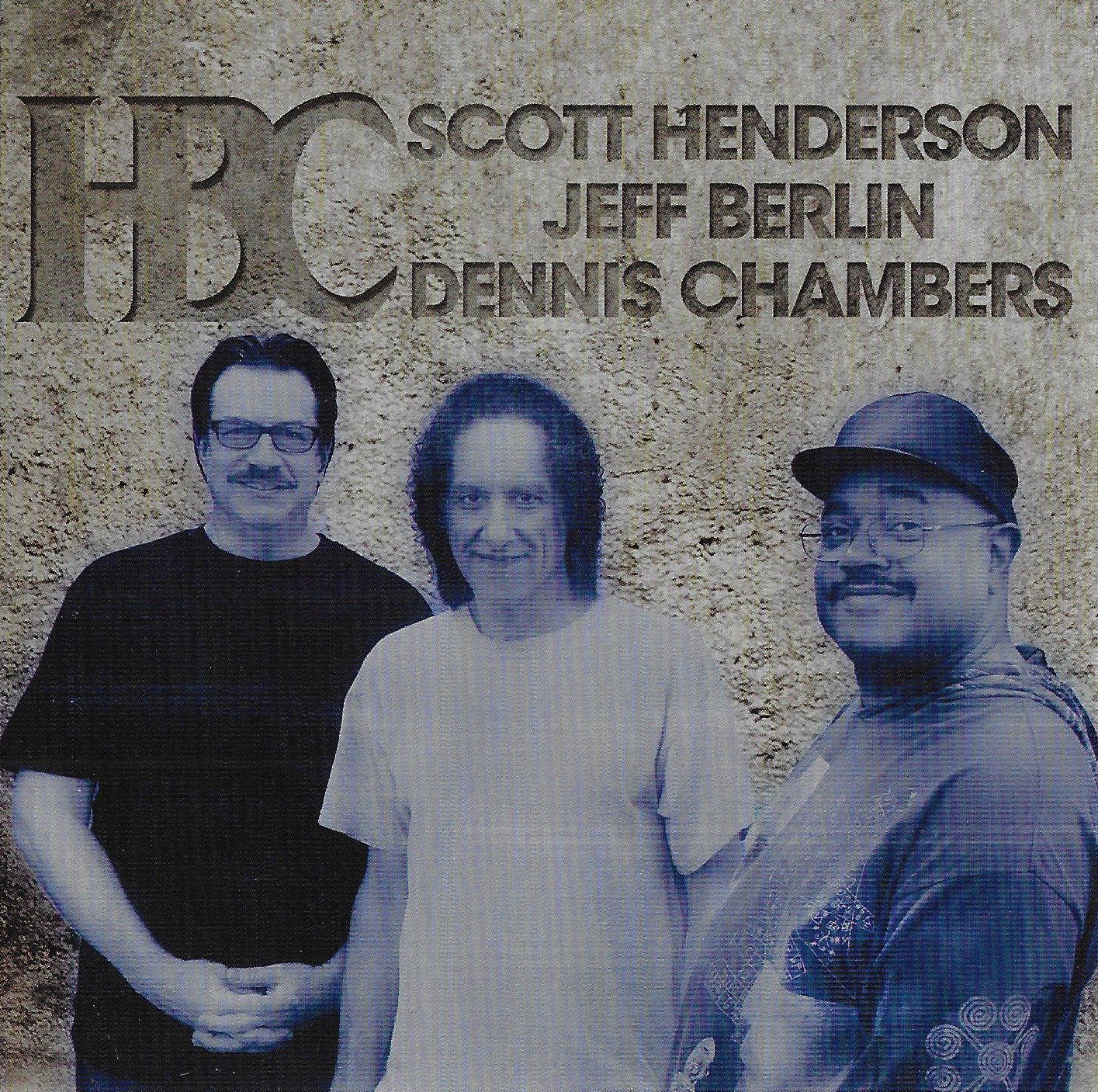
Scott Henderson, Jeff Berlin, Dennis Chambers - 2012 "HBC"

Not simply a super-group, but more like a jazz-fusion superpower as this formidable trio melds classic fusion works amid a few originals on its debut release, although the artists have crossed paths over the years. Bios and resumes would transcend the limitations of a review or analysis. So, it's the in-your-face attitude, creative impetus, and the respective musicians' gargantuan chops that account for a passionate exposition.

Guitarist Scott Henderson's enviable technique as a monumental blues-rock soloist shines on his "Wayward Son of Devil Boy," inflicting pain on his axe via some serious shedding and molding a blues-with-a-vengeance stance with blazing fills, detuned extended notes and wailing choruses. But the preponderance of the album offers an abundance of cunning insights and spins on pieces such as drummer Billy Cobham's jazz-fusion anthem "Stratus." Then again it would be a sacrilege to ignore this trend-setting classic. Here, all-universe session drummer Dennis Chambers slams the backbeat into overdrive in concert with bass great Jeff Berlin's sinuous fretless bass lines. Owing to the original recording, Henderson abides by late guitarist Tommy Bolin's tension and release buildup, and then goes off the radar with stratospheric licks, leading to the heavy metal-like finale.

Henderson morphs polytonal chord voicings to execute a translation of pianist Herbie Hancock's funkified "Actual Proof," where Berlin unleashes a mindboggling solo, awash with twirling notes and breakneck linear runs. Henderson injects some spacey electronic treatments and spatial attributes into saxophonist Wayne Shorter's title track from Weather Report's Mysterious Traveler (Columbia, 1974), raising the bar with edgy and distorted crunch chords while reshaping and reconfiguring the primary theme, tinted with a rather ominous rite of passage.

HBC also integrates a pure jazz element into Shorter's "Sightseeing," offset by the artists' expressive solo spots and streaming background effects, all the while prepping for the kill towards the coda as Berlin thumps and plucks his bass strings into submission. Sure, he's all over the place, but lessons learned will dictate that he makes every note count, marked by his lyrical thematic statements and a technique to die for.

Other than the instrumentalists' technical mastery, these works' construction lend to a refreshing glimpse of the proverbial roads previously traveled. From a holistic perspective of the jazz-fusion genre, it doesn't get a whole lot better.

As power trios go, it doesn’t get much more powerful than guitarist Scott Henderson, bassist Jeff Berlin and drummer Dennis Chambers. Like an update of the McLaughlin/Pastorius/Williams “Trio of Doom,” HBC succeeds by putting musicality above its overwhelming technical skills-only far better than that hit-and-miss collective did.

On HBC, this trio opts for mostly modern standards by the fusion era’s elite composers. Berlin’s serpentine bassline and Henderson’s keyboard mimicry highlight Herbie Hancock’s opening “Actual Proof.” Wayne Shorter gets his due as well: Henderson’s spacey intro and Chambers’ combustible drumming highlight “Mysterious Traveler,” and the guitarist’s underrated straightahead jazz chops shine through on “Footprints” and “Sightseeing.” Another Weather Report composition-the funky, stop-and-start “D Flat Waltz” by Henderson’s onetime employer Joe Zawinul-proves the 12-minute highlight among this honorary sequence.

Other highlights: Chambers blends funk and fury on Billy Cobham’s closing “Stratus,” a homecoming of sorts for Henderson, who wowed club crowds with it in his native Florida during the ’70s. And Berlin’s solo reading of his “Threedom” provides the disc’s best original moments.

HBC is the new fusion supergroup comprised of three virtuoso musicians: Scott Henderson Jeff Berlin and Dennis Chambers who join together to create one of the most phenomenal trios in the history of jazz fusion. Rather than jumping into the studio as virtual strangers and winging it like some superstar alliances HBC hit the road first and refined a repertoire of classic fusion covers in front of thousands of hungry fusion fans. After assembling an impressive collection of road-tested masterpieces, the group, composed of all leaders, decided that it was finally time to combine their talents to make this musical statement.

Henderson is one of the most well-known contemporary guitarists in the jazz fusion genre and he has mesmerized guitar fans around the globe with his masterful phrases and unique style. Guitar fans have enjoyed hearing Scott work with Jean-luc Ponty, Chick Corea, Joe Zawinul, and power fusion trio "Henderson, Smith, and Wooten" with Steve Smith and Victor Wooten. In addition Scott has churned out an incredible body of work stemming from his other career as founding member of Tribal Tech and also a solo artist, both of which he has toured extensively to support.

Bassist Jeff Berlin is a celebrated solo artist with numerous fusion recordings under his name and affiliations with artists such as Al Di Meola, Bill Bruford, Allan Holdsworth, John McLaughlin, and Billy Cobham. Berlin is widely regarded as one of the greatest bassists in the world and is equally adept at playing hard-core no holds-barred jazz-fusion and straight ahead traditional jazz. As a bassist Berlin's tone phrasing, and keen sense of melody are a winning combination that has helped him reach the top of magazine reader's polls for years.

A formidable, ferocious, and ultra-funky presence behind the kit in such celebrated ensembles as Parlament-Funkadelic, Steely Dan, Santana, and The Brecker Brothers as well as incendiary fusion outfits led by guitarist John Scofield, Steve Kahn, Mike Stern, and John McLaughlin, Dennis Chambers is a miracle in modern music. A remarkably versatile drummer who has shown limitless ability to swing on a small kit in traditional jazz settings or flaunt his stylistic chops in fusion supersessions, Dennis Chambers is one of the most recorded drummers in the world of jazz fusion.

Track listing:

01. Actual Proof
02. Mysterious Traveller
03. Footprints
05. D Flat Waltz
06. The Orphan
07. Sightseeing
08. Wayward Son Of Devil Boy
09. Threedom
10. Stratus

Personnel:

Scott Henderson: guitar;
Jeff Berlin: bass;
Dennis Chambers: drums.