Showing posts sorted by relevance for query joe henderson. Sort by date Show all posts

Thursday, August 1, 2019

Joe Henderson - 1981 [1993] "Relaxin' at Camarillo"

Relaxin' at Camarillo is an album by American jazz saxophonist Joe Henderson recorded in 1979 and released on the Contemporary label.

Henderson had been doing quality work for years on numerous independent and foreign labels, and 1979's Relaxin' at Camarillo, is just one among many examples of that. There are five selections, only one less than eight minutes long, with the usual Henderson attributes: full, deep tone, keen ideas, and an ability to sweep through registers and across octaves with ease. Chick Corea made an excellent partner, playing with none of the self-consciousness that crops up repeatedly in his fusion and electric fare. Bassists and drummers were interchangeable, although you can certainly tell Tony Williams from Peter Erskine (and that's no knock on Erskine).

Joe in his good mood is receiving a packet in velvet and lace, indigo-blue and tomato-red. Gets in the vanes and the bones, gets in, good for relaxing, working, cardriving and...saying it to someone.., it all is there, yeah. Muscular, straight ahead Joe like I've never heard him before. met him back in days of my military career in Norfolk, Virgia where he was playing. Like its title, this album is really the one to listen to if you want to relax. joe henderson's version of my one and only love is simply beautiful and the rest of the album are just equally great.

Joe Henderson's Relaxin' at Camarillo I recommend, not only for Joe Henderson's tenor saxophone playing, he is one of my favourites, but Chick Corea's piano playing, interpreting the lone Joe Henderson composition, first cut on the album, as if he wrote it himself and of course on the two Corea wrote for this album, his playing stands out. Charlie Parker and George Gershwin composed the other two tracks making five enjoyable compositions. Henderson and Corea are great musicians but Tony Williams on drums (on some tracks its Peter Erskine) is always welcome by me. Richard Davis and Tony Dumas take turns on bass.

FANTASTIC SAXOPHONE RECORD! On here Joe Henderson is every bit as good as Sonny Rollings, Dexter Gordon and other all time great saxophonists. He reminds me of John Coltrane before he went Free Jazz (ca. My Favorite Things Album). There is also an excellent backing band supporting him. (chick corea not only plays the piano but also wrote two of the songs here).

https://jazz-rock-fusion-guitar.blogspot.com/search?q=joe+henderson

Track listing:

    "Y Todavia la Quiero" (Joe Henderson) – 11:42
    "My One and Only Love" (Robert Mellin, Guy Wood) – 9:59
    "Crimson Lake" (Chick Corea) – 5:26
    "Yes, My Dear" (Corea) – 8:44
    "Relaxin' at Camarillo" (Charlie Parker) – 9:21

Personnel:

    Joe Henderson - tenor saxophone
    Chick Corea - piano
    Tony Dumas - Bass (tracks 1, 2, 5)
    Richard Davis - Bass (tracks 3, 4)
    Peter Erskine  - Drums (tracks 1, 2, 5)
    Tony Williams  - Drums (tracks 3, 4)

Thursday, June 18, 2020

Joe Henderson Quintet - 1970 [2006] "At the Lighthouse"

Joe Henderson Quintet at the Lighthouse is a live album recorded at the Lighthouse Café, Hermosa Beach, California, between September 24, 1970 and September 26, 1970. Personnel include Woody Shaw on trumpet and flugelhorn, George Cables on electric piano, Ron McClure on acoustic bass (electric bass on track 8 only), and Lenny White on drums. Tony Waters plays congas on tracks 1, 8 and 9 only.

This is a live album from the famous Lighthouse in Hermosa Beach CA. This venue has hosted many live albums over the years by Lee Morgan & Cannonball Adderley to name two of my favorite albums recorded there.
This recording is special in my opinion due to the presence of trumpeter Woody Shaw as Henderson's frontline partner and George Cables on Fender Rhodes EP and acoustic piano. Lenny White on drums is in inspired form.

This music is similar in style and content to the music Freddie Hubbard composed for his Cti album "Red Clay" that Henderson and White played on so its not a big surprise to me to hear him coping Red Clay's sound for his group. The sound if I had to label it would be hard bop with subtle traces of R&B and early fusion especially on the track "If you're not part of the problem you're part of the solution". The group performs several of Henderson's most well known tunes that have become jazz standards & jam session favorites in the many years after this was recorded such as "Blue Bossa", Recorda Me and "The Shade of Jade" If you're a fan of live albums and jazz in general then you should have this album in your collection.

I cut my musical teeth back in the 1960s and 1970s, soaking up the Rock, Pop, and Soul sound of that era, and I didn't hear a lot of jazz growing up. So, I've somewhat belatedly been discovering some of the great jazz artists of the past several decades, and Joe Henderson ranks as one of those that I enjoy very much. I can't really pinpoint what it is about his syle of playing that appeals to me, but it just does. The tone, the mood, the vibe, whatever you want to call, it works for me.

In addition to Henderson, I've also become a fan of Woody Shaw, and both of those great musicians feature prominently on this live recording. And a good, clean recording it is, not even sounding like a typical noisy club show. You can read the other rave reviews for a rundown of the songs and who does what. If you've heard any Joe Henderson albums from this period (this was recorded in 1970) I think you'll dig it.

The CD comes with a booklet that includes the original liner notes written by Orrin Keepnews. It also includes a newer essay about Henderson and this recording, written by Jeff Kaliss for the reissue of the CD in 2004. I love the description of the music in liner notes: "... the dominant mood is effervescent, with the soloists at the tops of their respective games." Indeed, these guys are all in top form. A jazz treat!

If you're new to Joe Henderson, you need to check him out and this is a fine place to start.

I hear his improv style as a blend of Parker (master of changes), Rollins (exploits the tenor range and grabs the unexpected, but right note) and Coltrane (great intensity and lots of notes when he cuts loose.) In other words, he plays lots of well chosen notes, plays very quickly and clearly, has great intensity and can make very musical noise. I think of him as an earthier (more authentic?) sounding Michael Brecker.

On this disk, he covers a lot of stylistic territory. There's a lot of hard bop, bossa nova, some free blowing, modern jazz standards interpretation, even one cut ("If You're Not Part of") that is fusion...this CD is like a jazz sampler playlist all in one.

Regarding the other players, Woody Shaw is fine in the style of Freddie Hubbard. He's a very good match for Joe, so you get a lot of great trumpet at no extra charge.

The rhythm section is very tight. For the most part, Lenny White plays straight ahead drums here (vs. his better known fusion style with Return to Forever.) Ron McClure mostly plays the string bass. He has a very clear and harmonically informed touch. So no worries on the bottom end of the band. (The exception, of course is the "If You're Not Part of" cut where Lenny and Ron funk and Fender out.)

For me the electric piano is a nice touch throughout the CD. It gives the tunes a little of the original Chick Corea/Return to Forever sound (i.e. back when Chick played with Joe Farrell; prior to adopting an electric guitar into the band.) So, if you're worried that this is a dreaded "jazz fusion" album, you can relax.

George Cables is the pianist and he does a fine job when given the opportunity. Unlike Chick on Return to Forever, he's much less intense, which fits his supporting player role.

To wrap up, I can only say that I wish I was in the audience when Joe and co. were blowing the roof off.

I took a few lessons from the late great Joe Henderson in the mid 70's when he resided up north in the San Francisco bay area near Colma. In my opinion, he was one of the best of the post-Coltrane saxophonists along with Wayne Shorter. This set culled from his performances at the Lighthouse in Hermosa Beach, 22 miles from L.A., represent one of his best live performances along with the "Live in Japan" date. The greatly under-rated trumpeter Woody Shaw, George Cables on Rhodes electric keyboard, Ron McClure on bass and Lenny White on drums composed a power house group with some Henderson originals (Isotope, Inner Urge, Recorda-Me) and some of the Blue Note tunes like "Blue Bossa", "Mode for Joe" and standards like "Round Midnight", "Invitation" ( a tune I've heard Joe play many times live and on record). If you're a fan of Joe Henderson or a hard bop buff, do get this one--it smokes!!

https://jazz-rock-fusion-guitar.blogspot.com/search?q=joe+henderson

 Track listing:

01     Caribbean Fire Dance     5:37
02     Recorda-Me     8:18
03     A Shade Of Jade     10:28
04     Isotope     4:28
05     'Round Midnight     9:02
06     Mode For Joe     8:34
07     Invitation     7:32
08     If You're Not Part Of The Solution, You're Part Of The Problem     11:29
09     Blue Bossa     9:43
10     Closing Theme     0:47

Personnel:

Saxophone – Joe Henderson
Trumpet, Flugelhorn – Woody Shaw
Bass – Ron McClure
Congas – Tony Waters (tracks: 1, 8, 9)
Drums – Lenny White
Electric Bass – Ron McClure (tracks: 8)
Electric Piano – George Cables

Sunday, November 4, 2018

Grant Green - 1964 [1995] "Solid"

Solid is an album by American jazz guitarist Grant Green featuring performances recorded in 1964 but not released on the Blue Note label until 1979.

Solid is a companion piece to the Grant Green classic Matador, recorded about a month later with the same rhythm section, and also not issued until 1979. Green is once again accompanied by the Coltrane supporting team of pianist McCoy Tyner and drummer Elvin Jones, plus bassist Bob Cranshaw; this time, however, Green is also joined on the front line by James Spaulding on alto sax and Joe Henderson on tenor. Both saxophonists really seem to light a fire under the proceedings, for in comparison with the relatively subdued Matador, Solid is a bright, hard-charging affair.

There's a little modal jazz, but Solid's repertoire is chiefly complex hard bop, full of challenging twists and turns that the players burn through with enthusiasm. Green didn't tackle this kind of material -- or play with this kind of group -- very often, and it's a treat to hear him do so on both counts. The compositions -- highlighted by Duke Pearson's "Minor League," Henderson's "The Kicker," and a storming, ten-minute exploration of George Russell's "Ezz-Thetic" -- provoke some intricate improvisations from Green, and his perfectly controlled soloing is an interesting contrast with the passionate Spaulding and Henderson. Tyner and Jones are once again telepathic in their support, elevating the whole package to one of Green's strongest jazz outings and a unique standout in his catalog. [Oddity: the CD bonus track "Wives and Lovers" seems to be the same one included on Matador, where it was a better fit.]

Grant Green's burning single-note lines out-swung most horn players. In the 1960s, Grant Green was the Blue Note guitarist. He could jam soulfully with organ combos, play bebop with the best, and dig into the most adventurous jazz on Blue Note while sounding perfectly at home. Solid, a memorable gem from 1964, remarkably went unreleased by Blue Note for 15 years because there were so many other Grant Green recordings at the time.

Green is part of a shockingly brilliant sextet (Joe Henderson, James Spaulding, McCoy Tyner, Bob Cranshaw and Elvin Jones) performing music worthy of their talents including George Russell's "Ezz-Thetic" and Henderson's "The Kicker." The playing is full of surprises, the rhythm section displays telepathic interplay, and Grant Green shows in every soulful note that he was a guitar giant.

The selection Minor League is a classic Blue Note composition, with instant recognition of the Blue Note sound. “The head gives off that really hip, quartal harmony that really rose to prominence in the 60’s. “The strong brass presence also eliminates any lingering concern it might be just a guitar album. Joe Henderson!

Green has a soul-jazz feeling on Solid, soft warm tone in unison with the brass, at times sounding more Hammond B3 than guitar, fluid  linear melodic exploration of the compositions. He has an unusual pairing of horns – Joe Henderson’s gruff tenor with James Spaulding’s bright alto. Henderson has a hard, fractious tone, his athletic figures covering the entire register of the tenor, while Spaulding does a credible job just holding his own.

Tyner contributes characteristically elegant sweeping forms, left hand chopping accents against the right hand’s fluid exploration of the upper keys.  Elvin Jones more than hints at the power below, punishing the ride cymbal to mark time. (Jones is a mixed blessing on Green albums. Here he is well controlled, but on Matador – Bedouin, he treats us to a long and out-of-place drum solo – the type which clears the auditorium and fills the bar). As always, the bass is the forgotten hero, Bob Cranshaw modestly holding everyone together.

https://jazz-rock-fusion-guitar.blogspot.com/search?q=Grant+Green

Track listing:

1. "Minor League" (Pearson) – 7:05
2. "Ezz-Thetic" (Russell) – 10:41
3. "Grant's Tune" (Grant Green) – 7:01
4. "Solid" (Rollins) – 7:23
5. "The Kicker" (Henderson) – 6:23
6. "Wives and Lovers" (Bacharach, David) – 9:00 Bonus track on CD reissue, from Matador

Personnel:

Grant Green - guitar
James Spaulding - alto saxophone (tracks 1-5)
Joe Henderson - tenor saxophone (tracks 1-5)
McCoy Tyner - piano
Bob Cranshaw - bass
Elvin Jones - drums

Saturday, May 7, 2016

Chick Corea, Stanley Clarke, Joe Henderson, Lenny White - 1982 "A Very Special Concert"

This concert features Chick Corea playing with members of the "Return to Forever" band, which includes the legendary players Stanley Clarke on bass, the much celebrated Lenny White on drums plus the multi-GRAMMY® winner Joe Henderson on tenor sax. Songs include "L#s Bop," "Why Wait," "500 Miles High," "Guernica." Chick Corea#s four-decade career is the stuff of jazz legend, a blend of influential, limit-breaking musical experiences which have filled pages of 20th century music history encyclopedias. Jazz has never been the same since the birth of the samba-flavored ensemble of Return to Forever.

Lenny White's introduction of his bandmates as 'The World's Greatest Musicians' is no exaggeration - this music performance is indeed special, and as the previous reviewer mentioned is a perfect place for newcomers to begin exploring modern acoustic jazz. [there is also another, separate DVD available - released four years ago - of Corea playing acoustic music: "Chick Corea & Friends: Remembering Bud Powell" (live 1996).]

This concert was video taped at Wolf & Rissmiller's Country Club in Reseda, California [not Tokyo, Japan as the previous review states] in 1982.

as mentioned in the other review, this DVD video focuses on Return To Forever music and musicians - but without electric instruments. The Chick Corea/Stanley Clarke/Lenny White section reunites from early-mid '70s album classics such as Stanley Clarke's "Children Of Forever" and RTF's "Hymn Of The Seventh Galaxy".

Tenor saxophonist Joe Henderson had worked with each of these musicians in various jazz contexts for many years before this 1982 reunion. Clarke and White had appeared on Henderson's own 1970-71 Milestone label albums "In Pursuit Of Blackness" and "If You're Not Part Of The Solution, You're Part Of The Problem" (memorably with Lenny White and trumpeter Woody Shaw on a smoking Sept. 1970 live at The Lighthouse session). White and Henderson also famously appeared together on Freddie Hubbard's "Red Clay" [CTI label, 1970] album. Corea and Henderson had worked together on recordings such as "Mirror, Mirror" [MPS label 1980, w/Ron Carter and Billy Higgins], "Relaxin' At Camarillo" [Contemporary label 1979, w/Peter Erskine and Tony Williams], and a great 1981 set "Live In Montreux" [Corea's own Stretch label, w/Gary Peacock and Roy Haynes].

Henderson is prominently featured on three of the tracks (he sits out for the trio to perform Corea's '500 Miles High'), giving a beautiful glimpse of his blues-inflected playing on Clarke's composition 'Why Wait', extended improvisation on 'Guernica' (Clarke - bowed bass), and his tour-de-force technique on the swift opener 'L's Bop' (which Lenny White - who co-produced the audio on this recording - closes with a bravura drum solo). Each musician is joyfully sensitive and alert to one another throughout the set; a display of jazz improvisational magic at its finest.

 The Corea/Clarke/Henderson/White lineup was being billed at the time as 'Echoes Of An Era', and the Musician label released a few LPs of this group featuring: Freddie Hubbard, trumpet, and Chaka Khan, vocal on one, Nancy Wilson, vocal [sans Hubbard and Khan] on another, and a third called "The Griffith Park Collection" [slyly announced by Chick in this video as their current release]. Three (or possibly four?) cameras were employed; audio was done as a digital, two-track live recording. Legon also explains those funky, casual threads worn by the musicians: an airport snow delay and their last-minute arrival to the gig.

Before the CHICK COREA AKOUSTIC BAND, Chick Corea was writing and performing acoustic music. To my knowledge this is the first concert of Chick Corea playing acoustic music on DVD. This quartet is particularly impressive seeing that it has 3/4 of the Corea led Return To Forever. RTF did perform acoustic music but this group is closer to jazz/bebop than RTF ever was. Chick Corea is joined by RTF veterans Lenny White on Drums and Stanley Clarke on bass as well as Joe Henderson on Tenor Saxophone. The result is a set of acoustic jazz that is, at times, amazing and always engaging.
The show is only about an hour long, but what an hour it is. Joe Henderson is a very good tenor sax player and is impressive at times on this disc. Lenny White shows that he can play drums in a non-electric setting. Lenny is solid throughout but doesn't do anything mind boggling like Dave Weckl does on the Akoustic Band CDs. Chick Corea shows why he is THE keyboard virtuoso/composer of the last 30 years. Stanley Clarke is Stanley Clarke. If you have never heard/seen Stanley play the acoustic bass then you are going to be blown away. The interplay between himself and Corea or White is amazing. Stanley Clarke knows how to link the melody and rhythm together and when he solos, look out. At long last, a chance to see Stanley on DVD.
The DVD is one set from the band, captured live in California in 1982. The music sounds as if the Akoustic band hired a Saxophone player to join them. The tunes are very similar to the Akoustic band in tonality/style although the saxophone adds a new dimension. The set includes only 4 songs so you know that it is heavy on improvisation. This is post-bop jazz. The band, as a whole, soars and Chick and Stanley are amazing. All of the songs are bop-influened. They also contain elements of othere jazz influences, most notably Chick Corea's '500 Miles High'. '500 Miles High' is the highlight for me. Henderson sits this song out and the trio performs another latin influeced Corea composition. The magic of RTF is revisited as all 3 are given space to do their thing. The interplay picks up from where Romantic Warrior left off. During this piece Stanley Clarke takes upright bass playing to unparalled heights. The Coltranesque technique that he plays on electric is unleashed on acoustic. Nobody plays upright like Stanley.
In conclusion, if you are familiar with Chick Corea's impressive acoustic catalog and you like what you've heard; then you'll also like this. IF you are a fusion fan and haven't yet begun to listen to bebop or straight jazz then this would be a good place to start. It has all of the elements that make acoustic jazz what it is.

Recorded live at Wolf & Rissmiller's Country Club, Reseda, California, 7 April 1982.
Playing time: 56.22 min.

Courtesy: Original uploader 

Tracklist

1. L's Bop – Lenny White
2. Why Wait – Stanley Clarke
3. 500 Miles High – Chick Corea
4. Guernica – Lenny White

Personnel:

Chick Corea - Keyboard
Stanley Clarke - Bass
Joe Henderson - Tenor Sax
Lenny White - Drums

Thursday, January 3, 2019

Rick Laird - 1977 [1989] "Soft Focus"

From ex-Mahavishnu bassist and featuring Joe Henderson (sax). Lively, creative, and intriguing mix of standards and originals.

This CD is a rare and amazing find. Laird (electric bass) has Tom Grant on piano, Ron Steen on drums, and Joe Henderson on tenor sax for several tunes. You'll find standards, funk, latin, done in most excellent arrangements, by these accomplished musicians. For Joe Henderson fans this is a must have.

Rick Laird stepped away from the bombast of the Mahavishnu Orchestra to wax Soft Focus (1979) - a swinging slab featuring Joe Henderson (who also served as producer), Ron Steen, and Tom Grant. Laird’s warm electric tone affords the resonance of an upright as he works the supportive and solo roles with his usual understated expertise.

Track list:

1 Outer Surge
2 Now You Know
3 Thorn In A White Robe
4 I Love You
5 Soft Focus
6 Tranquility
7 We'll Be Together Again
8 No Me Esqueca
9 Peddle Has A Point
10 Gazelle
11 Caribean Firedance
12 Mystified
13 Pannonica

Personnel:

Bass Guitar – Rick Laird
Drums – Ron Steen
Piano – Tom Grant (2)
Saxophone – Joe Henderson

Sunday, August 23, 2015

Chick Corea-Miroslav Vitous - 1968 1972 [1999] "Tones for Joan's Bones" - "Mountain in the Clouds"

This compilation hits a bull's-eye by pulling together two key sessions: Chick Corea's first as a leader, a blazing, advanced hard bop set from 1966, and Miroslav Vitous' Mountain in the Clouds, recorded in 1969 just prior to the bassist joining the original Weather Report. Corea's writing on Tones for Joan's Bones has an affinity with McCoy Tyner's seminal hard bop structures from this period. Tenor player Joe Farrell and trumpeter Woody Shaw are ideal for this music. They deliver virtuoso performances that are both visceral and cerebral. Steve Swallow, while later focusing exclusively on electric bass, often with a melodic, impressionistic approach, is pure thunder here. In a blindfold test his acoustic bass could be mistaken for Buster Williams'. Drummer Joe Chambers is all relentless, propulsive energy, but subtle too. Corea is a torrent of harmonic and melodic imagination, couched in unerring rhythm. On Vitous' fusion classic, Herbie Hancock's electric piano and John McLaughlin's electric guitar merge in a rich, dense, colorful foundation that affords Vitous and drummer Jack DeJohnette considerable freedom. McLaughlin combines the dreamy state he evokes on Miles Davis' In a Silent Way with the juddering rhythm attack heard on his own Extrapolation. Like Chambers, who actually takes the drum chair for two tracks, DeJohnette is powerful, creative, and passionate. The superbly recorded Vitous has a sound, technique, and concept that consistently sustain interest. Tenor giant Joe Henderson is on four tracks, including an intense, open-ended exploration of Eddie Harris' "Freedom Jazz Dance." Anybody with an interest in this vital and exciting period will find both of these sessions indispensable. 

Both albums are a pinnacle of achievement for Chick Corea and Miroslav Vitous. They foreshadow the direction of both artists and also reflect their influences. "Tones For Joan's Bones" is straight ahead Jazz combined with occasional Latin rhythms, outrageous melodies typical of the period and style, Chick Corea's "Tyneresque" piano voicings and fluid, crystal clear solos. This is all augmented by Joe Farrell on reeds and Woody Shaw on trumpet-two of the best. Check out Chick Corea's solo on "Tones For Joan's Bones". Other recordings from this period featuring these artists are available on Chick Corea's "Inner Space" album.
The compositions and musicians on Miroslav Vitous' "Mountain In The Clouds" are some of the most progressive and innovative ever recorded. The moods range from quiet, cerebral, and transcendental as in "Epilogue" and "Infinite Search", to unrelenting, up-tempo jams as in "Freedom Jazz Dance" and especially "I Will Tell Him On You". The latter featuring one of the best, most astonishing guitar solos by John McLaughlin, very much like his work on Tony Williams' "Emergency" cd. The rest of the musicians on the album are basically a "who's who" in the business: Joe Henderson on sax, Herbie Hancock on piano, Miroslav on bass and Jack DeJohnette on drums all add their unique personalities to a timeless classic.  


Track Listings
1. Litha - Chick Corea
2. This Is New - Chick Corea
3. Tones For Joan's Bones - Chick Corea
4. Straight Up And Down - Chick Corea
5. Freedom Jazz Dance - Miroslav Vitous
6. Mountain In The Clouds - Miroslav Vitous
7. Epilogue - Miroslav Vitous
8. Cerecka - Miroslav Vitous
9. Infinite Search - Miroslav Vitous
10. I Will Tell Him On You - Miroslav Vitous


Credits

Sunday, July 16, 2017

Grant Green - 1963 [2001] "Am I Blue"

Am I Blue is an album by American jazz guitarist Grant Green featuring performances recorded in 1963 and released on the Blue Note label.

This great guitarist recorded in a variety of settings and concepts during his years at Blue Note. Am I Blue featured the perennial trio of Green, organist John Patton and drummer Ben Dixon with the trumpet of Johnny Coles and the tenor saxophone of newcomer Joe Henderson.

What makes this album so unusual in Green's canon is that the entire album is in a soulful, atmospheric ballad groove. The material ranges from the blues ballad "Sweet Slumber" to the country song "Take These Chains From My Heart", but the after hours mood that these men create is never broken. This is the first appearance of this album on CD.

AM I BLUE features the classic Green/Patton/Dixon ensemble plus Johnny Cole and Joe Henderson on horns in a delightful yet unusually laid back vain. The gospel influence in John's playing is particularly evident on this recording, as is his minimalist philosophy. (If you don't have to play it, don't) Ironically, in his latter years, due to a strange accident with a car jack which would injure a tendon in his hand he would not have use of his pinky and fourth finger, yet could still create some of the richest and most amazing connections on the organ as well as develop very rich and lucid solo ideas ! The showstopper on the CD is the light and bouncy FOR ALL WE KNOW... Of course, Johnny Coles and a then newcomer and relatively unknown Joe Henderson definitely get their word in, but it is amazing to hear John's passing chords behind them. Grant Green typically lays out, listening, listening, listening, listening (which is what a soloist needs to be doing when his other bandmates are playing... not playing over them, or holding coversations, but listening and taking in the dialogue). Finally, Grant comes in and is as crisp, melodious and swinging and used expect him to be... throwing in a few surprise left hooks as well! - - Last word goes to John... who in turn not only takes a well crafted single note solo, but digs down with a real nifty shout chorus as well (though admittedly I will ever have to admit that Johnny Hammond Smith and Wild Bill will ever have him beat on that.) With Ben Dixon in his corner, however, he does take it home quite masterfully ! of note: That's the one thing that distinguishes a Grant Green session from one of those sessions where people are trying to copy such a session - - you can really tell the players are listening to each other, providing a lot of space and responding to one another's ideas! True Jazz masters are at their best not when they're showing off what they know... but when they're really listening and responding to what's going on around them. Then magic occurs, as was the historical case of John Coltrane's layer of sound discovery.

If you like Grant Green, you know what to expect from this album: a GREAT recording. Sure, it's not THAT unique from others around the time but it is by no means a bad album. There aren't any bonus tracks or alternate takes (like many of the other RVG remasters) but the album is impossible to find on vinyl so that's forgiveable; practically the only complaint I have with it. Don't be fooled by snobbery.

Track listing:

"Am I Blue" (Harry Akst, Grant Clarke) - 6:56
"Take These Chains from My Heart" (Hy Heath, Fred Rose) - 6:12
"I Wanna Be Loved" (Johnny Green, Edward Heyman, Billy Rose) - 7:39
"Sweet Slumber" (Lucky Millinder, Al J. Neiburg, Henri Woode) - 7:17
"For All We Know" (J. Fred Coots, Sam M. Lewis) - 13:59

Personnel:

Grant Green - guitar
Johnny Coles - trumpet
Joe Henderson - tenor saxophone
"Big" John Patton - organ
Ben Dixon - drums

Thursday, March 10, 2016

Freddie Hubbard - 1970 [1987] "Red Clay"

Red Clay is a soul/funk-influenced hard bop album recorded in 1970 by jazz trumpeter Freddie Hubbard. It was his first album released on Creed Taylor's CTI label and marked a shift away from Hubbard's long time recording affair with Blue Note Records and another shift toward the soul-jazz fusion sounds that would dominate his recordings in the later part of the decade. It was the album that established Taylor's vision for the music that was to appear on his labels in the coming decade. This is also Freddie Hubbard's seventeenth overall album.

This may be Freddie Hubbard's finest moment as a leader, in that it embodies and utilizes all of his strengths as a composer, soloist, and frontman. On Red Clay, Hubbard combines hard bop's glorious blues-out past with the soulful innovations of mainstream jazz in the 1960s, and reads them through the chunky groove innovations of '70s jazz fusion. This session places the trumpeter in the company of giants such as tenor saxophonist Joe Henderson, pianist Herbie Hancock, bassist Ron Carter, and drummer Lenny White. Hubbard's five compositions all come from deep inside blues territory; these shaded notions are grafted onto funky hard bop melodies worthy of Horace Silver's finest tunes, and are layered inside the smoothed-over cadences of shimmering, steaming soul. The 12-minute-plus title track features a 4/4 modal opening and a spare electric piano solo woven through the twin horns of Hubbard and Henderson. It is a fine example of snaky groove music. Henderson even takes his solo outside a bit without ever moving out of the rhythmatist's pocket. "Delphia" begins as a ballad with slow, clipped trumpet lines against a major-key background, and opens onto a midtempo groover, then winds back into the dark, steamy heart of bluesy melodicism. The hands-down favorite here, though, is "The Intrepid Fox," with its Miles-like opening of knotty changes and shifting modes, that are all rooted in bop's muscular architecture. It's White and Hancock who shift the track from underneath with large sevenths and triple-timed drums that land deeply inside the clamoring, ever-present riff. Where Hubbard and Henderson are playing against, as well as with one another, the rhythm section, lifted buoyantly by Carter's bridge-building bassline, carries the melody over until Hancock plays an uncharacteristically angular solo before splitting the groove in two and doubling back with a series of striking arpeggios. This is a classic, hands down. 

On Jan. 27, 1970, trumpeter Freddie Hubbard, playing at the peak of his powers after a string of seven brilliant Blue Note albums and three for the Atlantic label, went into the studio to cut his first for Creed Taylor’s CTI label. With Taylor producing, a stellar cast was assembled at Rudy Van Gelder’s studio in Englewood Cliffs, N.J., for three consecutive days of recording. They emerged with Red Clay, an album that would not only define Hubbard’s direction over the next decade while setting the template for all future CTI recordings, but would also have a dramatic impact on a generation of trumpet players coming up in the ’70s.
It was a transitional period in the jazz; the tectonic shift beginning with Miles Davis’ In a Silent Way, recorded the previous year. Hubbard’s entry into this crossover territory on Red Clay was characterized by the slyly syncopated beats of drummer Lenny White on the funky 12-minute title track, an infectious groover that was soon covered by budding crossover groups all over America. Essentially an inventive line set to the chord changes of “Sunny,” Bobby Hebb’s hit song from 1966, “Red Clay” would become Hubbard’s signature tune throughout his career. As trumpeter, friend and benefactor David Weiss, who is credited with bringing Hubbard out of self-imposed retirement in the late ’90s, explains, “Later in life Freddie would always announce it as ‘the tune that’s been keeping me alive for the last 30 years.’ We played ‘Red Clay’ every night and he would quote ‘Sunny’ over it every night.”

Like Stanley Turrentine, Freddie Hubbard's best work was always in the service of others until he signed with Creed Taylor's CTI label. He then released a trio of albums that represents his crowning achievement as a leader. Red Clay finds him in the company of Herbie Hancock, who played a large part in defining jazz fusion, as well as heavyweights like Ron Carter, Joe Henderson, and Lenny White. The title track kicks off the record with a funky groove that is much more memorable than any such trick attempted on Blue Note releases from the previous decade; the remaining tracks are fairly adventurous explorations of a variety of interesting themes. Hancock, whose electric piano is one of the guilty pleasures of the area, carries the day with funky vamping and tasteful soloing. But Hubbard is no slouch either, contributing some of his most memorable solos over the jazzy grooves. Henderson has smoothed out his previous sound, eliminating the stuttering and wailing that defined his style in the sixties. Simply put, Red Clay is one of the relatively few jazz masterpieces from the seventies.

Track listing

01    "Red Clay" - 12:11
02    "Delphia" - 7:23
03    "Suite Sioux" - 8:38
04    "The Intrepid Fox" - 10:45
05    "Cold Turkey" (Lennon) - 10:27
06    "Red Clay" [live] - 18:44 Bonus track on the 2002 & 2010 CD release

    All compositions by Freddie Hubbard except as indicated

        Recorded at Van Gelder Studios, Englewood Cliffs, New Jersey, January 27, 28 & 29, 1970 except track 6 recorded live at the Southgate Palace on July 19, 1971

Personnel

    Freddie Hubbard - trumpet
    Joe Henderson - tenor saxophone, flute
    Herbie Hancock - electric piano, organ
    Ron Carter - bass, electric bass
    Lenny White - drums

Track 6 Personnel

    Freddie Hubbard - trumpet
    Stanley Turrentine - tenor saxophone
    Johnny "Hammond" Smith - organ/electric piano
    George Benson - guitar
    Ron Carter - bass
    Billy Cobham - drums
    Airto Moreira - percussion

Thursday, September 28, 2017

McCoy Tyner - 1967 [1999] "The Real McCoy"

The Real McCoy is the seventh album by jazz pianist McCoy Tyner and his first released on the Blue Note label. It was recorded on April 21, 1967 following Tyner's departure from the John Coltrane Quartet and features performances by Tyner with Joe Henderson, Ron Carter and Elvin Jones. Producer Alfred Lion recalls the recording session as a "pure jazz session. There is absolutely no concession to commercialism, and there's a deep, passionate love for the music embedded in each of the selections".

In the liner notes, Tyner talks about the pieces selected for this album. The titles for "Passion Dance" and "Contemplation" came to the pianist only after he'd written the pieces. Whilst the former sounds like "a kind of American Indian dance, evoking trance-like states", the latter has "the sound of a man alone. A man reflecting on what religion means to him, reflecting on the meaning of life." Tyner titled the fourth piece "Search for Peace" because of its tranquil feeling; it "has to do with a man's submission to God" and the "giving over of the self to the universe". The album closes with an upbeat, merry piece called "Blues on the Corner", a reminiscent musical portrait of Tyner's childhood: "When I was growing up in Philadelphia, some of the kids I knew liked to hang out on the corner [...] youngsters talking, kidding around, jiving.

Two and a half years after his last recording as a leader for Impulse, pianist McCoy Tyner emerged to start a period on Blue Note that would result in seven albums. Having left John Coltrane's Quartet in late 1965, Tyner was entering a period of struggle, although artistically his playing grew quite a bit in the late '60s. For this release, the pianist is teamed with tenor saxophonist Joe Henderson, bassist Ron Carter, and drummer Elvin Jones for five of his originals. Highlights of the easily recommended album include "Passion Dance," "Four by Five," and "Blues on the Corner."

When someone uses the word “idyllic” to describe a scene, we think of Monet’s Water Lillies or another classic of impressionism – a work in summery shades that pretty much demands a daydream. But there are different kinds of idylls – as “Search For Peace,” one of five McCoy Tyner originals here, suggests. The tempo is slow, stately, deliberate. The harmony, outlined first by piano trills and broken chords, has purpose behind it: The title implies an ongoing and perhaps unattainable quest, not some easily abandoned momentary pursuit. The theme, when it arrives, enhances this sense – it’s at once solemn like a hymn, and contemplative, and also floatingly free. It puts forth an idealistic vision of what “peace” might feel like, and in the same breath holds the full awareness of possible (likely) futility. Crucially, it’s not the jingoistic sloganeering of a peace rally; it’s a meditation on the potentiality of peace, and what it means to pursue it.

Of course “peace” as a concept meant something different on April 22, 1967 than it does today. When Tyner and his group gathered at Rudy Van Gelder’s place to record this landmark, war was raging in Vietnam and the social upheavals over civil rights, race and the fast-emerging hippie culture were simmering throughout America. The jazz community responded to this heady time in all kinds of ways – song titles became commentary, and inevitably the “heat” of the cultural moment informed recordings and performances. Tyner, who departed from the Coltrane group in 1965, evidently felt that there was a need for music that looked inward and invited reflection. In Nat Hentoff’s original liner notes, the pianist explains that when he wrote the piece, he perceived it as outlining a spiritual mission, “the giving over of the self to the universe.”

The Real McCoy is Tyner’s Blue Note debut, and though it starts in a frenzied mood with “Passion Dance,” much of it finds the pianist and composer creating zones of reflection, offering musical refuge from the tumult of the times. Tyner has said that he left the Coltrane group because of its increasingly chaotic dissonance; his compositions here utilize the open block-chord harmonies Coltrane loved, channeled into tightly focused rhapsodies. There is a vibe of serenity in the writing, not just in the ascending theme of “Search for Peace,” but also the gentle, affirmative modal journey entitled “Contemplation” – this album contains five tunes, and two of them are riveting downtempo ballads. The other three are equally poised and thoughtful, and each is defined by its own internal logic. “Passion Dance” is an essay in rhythmic upheaval: Tyner’s spikes and Elvin Jones’ jabs establish an obstacle course, and the challenge for tenor saxophonist Joe Henderson is to navigate the shifting patterns while creating a cogent ad-libbed testimony. (Of the many Blue Note sessions featuring strong work by Henderson, this might be his shining hour, in part because of his patient impossible-to-notate inventions on “Passion Dance” and “Contemplation.”) “Four By Five” offers polyrhythmic daring in a different hue, while the entrancingly settled “Blues on the Corner,” the session’s lone blues, suggests that even this formidable group understood the importance of kicking back once in a while.

The peak statement of Tyner’s solo career, The Real McCoy is also one of a handful of recordings that define hard bop. Lots of records from this genre have interesting tunes and blazing solo performances, but few attain such an interconnected synergy. Listening to these these rich, beautifully realized atmospheres, and how they inspire deep, passionate, strikingly collective improvisations, you realize we are far removed from the anxieties – and the idealistic quests for peace – that governed 1967. That’s a mixed blessing.

Tyner first appeared on the scene in 1960 with the Golson/ Farmer Jazztet, moving to the John Coltrane Quartet for most of the early sixties up to 1965, when Coltrane  was becoming more atonal and free. Tyner is said to have been unhappy about that change in direction: “I didn’t see myself making any contribution to that music… All I could hear was a lot of noise. I didn’t have any feeling for the music, and when I don’t have feelings, I don’t play.” (So, I guess that is him and me both)

Tyner released six of his own titles whilst under contract to Impulse up to 1964 , and after leaving Coltrane, recorded for Blue Note with many bop greats in their second wind, Hank Mobley, Lee Morgan, Donald Byrd, Stanley Turrentine, Lou Donaldson and Bobby Hutcherson. In 1967, he recorded this, his first title for Liberty/ Blue Note, The Real McCoy, followed by a string of albums: Tender Moments, Time for Tyner, Expansions, Extensions,  and Cosmos, you can tell by the meditative album titles where this was heading: Enlightenment.

Track listing:

"Passion Dance" – 8:47
"Contemplation" – 9:12
"Four by Five" – 6:37
"Search for Peace" – 6:32
"Blues on the Corner" – 5:58

Personnel:

McCoy Tyner - piano
Joe Henderson - tenor saxophone
Ron Carter - bass
Elvin Jones - drums

Monday, October 15, 2018

Steve Khan - 1992 "Headline"

Recorded in '92, "HEADLINE" brought the trio with Ron Carter & Al Foster back together, but, once again Polydor K.K.(Japan) had their own ideas about the direction I should pursue. Go Steve!This time, in addition to the trio tracks, they wanted me to record with the Eyewitness instrumentation. As Anthony Jackson, Dennis Chambers and I had been touring Europe as a trio, it was easy to add Manolo Badrena to the mix, and this VERY special chemistry came back to us without missing a beat. The CD, which was released in the USA on Bluemoon Records, presents the contrast of these two formats and, for some fans of Eyewitness, it turned to be a great thing that they could hear us playing 'odd-ball' standards as opposed to our own unique original compositions. Like "LET'S CALL THIS" the music is drawn from the great jazz of the mid-'60s. "Autumn in Rome" was only the 2nd tune by my late father which I recorded. It's a pretty obscure piece, but, that's why I chose it. Along with so much of the other material, I try to select tunes which most guitarists don't play as a rule. Though there are many special moments from both configurations of personnel on this recording, I am especially pleased with the performance of "All of Nothing at All," which demonstrates the scope and depth of Dennis Chambers' drumming, and Eyewitness-like interplay from everyone. Joe Henderson's "Caribbean Fire Dance" shows that Anthony and Dennis have developed their own very special way of making music together, and the 'free' Intro to Ornette Coleman's "Turnaround" gives them further room to explore this chemistry.

Guitarist Steve Khan is heard in two different settings on this CD: in an acoustic trio with bassist Ron Carter and drummer Al Foster on six songs, and jamming with electric bassist Anthony Jackson, drummer Dennis Chambers and percussionist Manolo Badrena on three tunes. Actually, there is a definite unity to the program, and Khan is featured on a variety of jazz tunes including numbers by Larry Young, Ornette Coleman ("The Blessing" and "Turnaround"), Clare Fischer, Wayne Shorter, Thelonious Monk and Joe Henderson. He even plays a song ("Autumn In Rome") by his father, Sammy Cahn. The guitarist consistently stretches himself during these performances (which include a 10½-minute version of "All or Nothing at All") and is heard throughout at his most creative.

Track listing:

 [1] Tyrone(Larry Young)(5:54)
 [2] The Blessing(Ornette Coleman)(4:45)
 [3] Autumn in Rome(Sammy Cahn-Paul Weston)(6:31)
 [4] Turnaround(Ornette Coleman)(6:42)
 [5] Ontem a Noite(Clare Fischer)(5:52)
 [6] Water Babies(Wayne Shorter)(5:00)
 [7] All or Nothing at All(Jack Lawrence-Arthur Altman)(10:41)
 [8] Hackensack(Thelonious Monk)(5:23)
 [9] Caribbean Fire Dance(Joe Henderson)(8:06)

Personnel:

Guitar – Steve Khan
Bass – Anthony Jackson (tracks: 4,7,9), Ron Carter (tracks: 1,2,3,5,6,8)
Drums – Al Foster (tracks: 1,2,3,5,6,8), Dennis Chambers (tracks: 4,7,9)
Percussion – Manolo Badrena (tracks: 4,7,9)

Monday, November 26, 2018

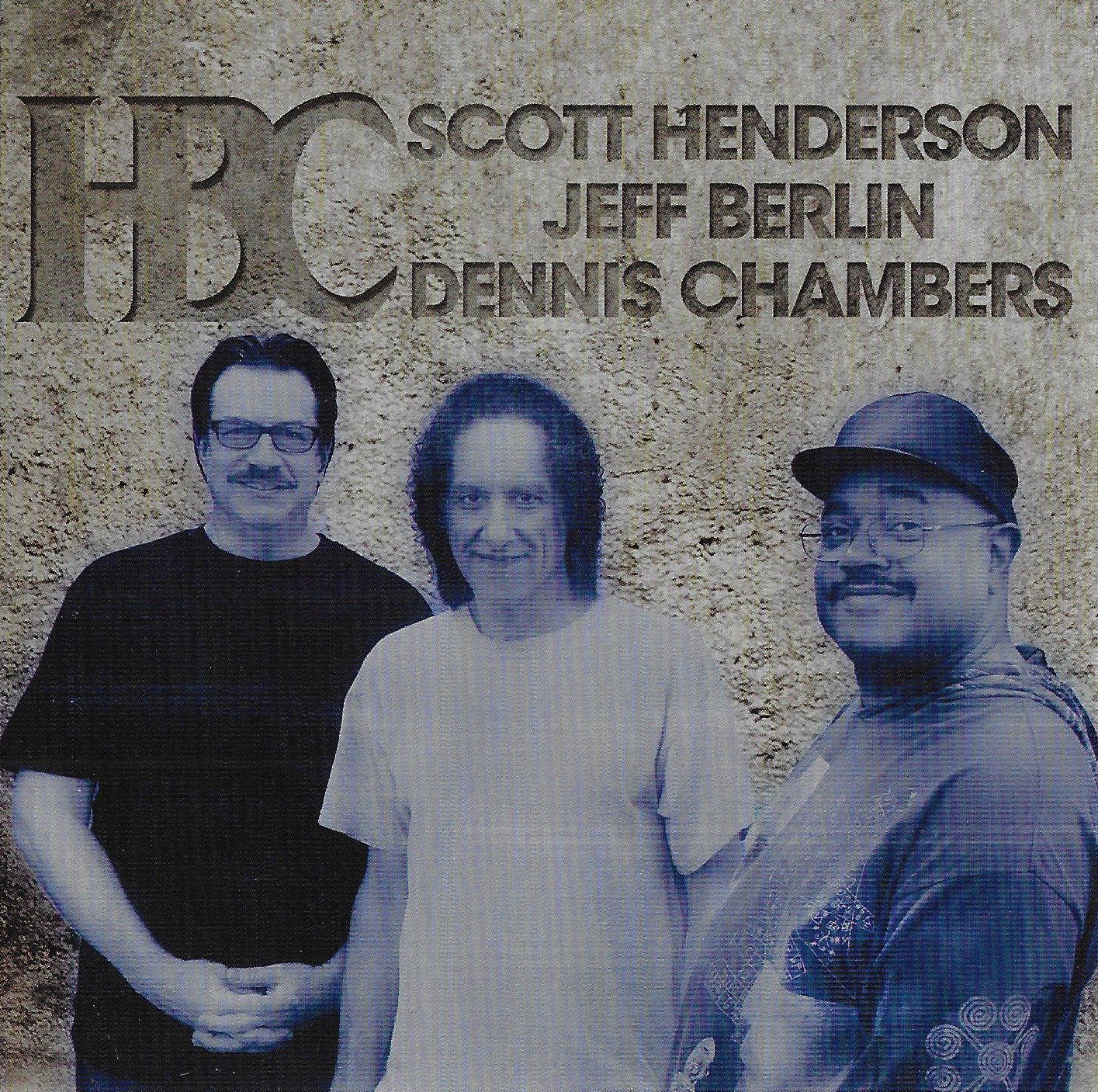
Scott Henderson, Jeff Berlin, Dennis Chambers - 2012 "HBC"

Not simply a super-group, but more like a jazz-fusion superpower as this formidable trio melds classic fusion works amid a few originals on its debut release, although the artists have crossed paths over the years. Bios and resumes would transcend the limitations of a review or analysis. So, it's the in-your-face attitude, creative impetus, and the respective musicians' gargantuan chops that account for a passionate exposition.

Guitarist Scott Henderson's enviable technique as a monumental blues-rock soloist shines on his "Wayward Son of Devil Boy," inflicting pain on his axe via some serious shedding and molding a blues-with-a-vengeance stance with blazing fills, detuned extended notes and wailing choruses. But the preponderance of the album offers an abundance of cunning insights and spins on pieces such as drummer Billy Cobham's jazz-fusion anthem "Stratus." Then again it would be a sacrilege to ignore this trend-setting classic. Here, all-universe session drummer Dennis Chambers slams the backbeat into overdrive in concert with bass great Jeff Berlin's sinuous fretless bass lines. Owing to the original recording, Henderson abides by late guitarist Tommy Bolin's tension and release buildup, and then goes off the radar with stratospheric licks, leading to the heavy metal-like finale.

Henderson morphs polytonal chord voicings to execute a translation of pianist Herbie Hancock's funkified "Actual Proof," where Berlin unleashes a mindboggling solo, awash with twirling notes and breakneck linear runs. Henderson injects some spacey electronic treatments and spatial attributes into saxophonist Wayne Shorter's title track from Weather Report's Mysterious Traveler (Columbia, 1974), raising the bar with edgy and distorted crunch chords while reshaping and reconfiguring the primary theme, tinted with a rather ominous rite of passage.

HBC also integrates a pure jazz element into Shorter's "Sightseeing," offset by the artists' expressive solo spots and streaming background effects, all the while prepping for the kill towards the coda as Berlin thumps and plucks his bass strings into submission. Sure, he's all over the place, but lessons learned will dictate that he makes every note count, marked by his lyrical thematic statements and a technique to die for.

Other than the instrumentalists' technical mastery, these works' construction lend to a refreshing glimpse of the proverbial roads previously traveled. From a holistic perspective of the jazz-fusion genre, it doesn't get a whole lot better.

As power trios go, it doesn’t get much more powerful than guitarist Scott Henderson, bassist Jeff Berlin and drummer Dennis Chambers. Like an update of the McLaughlin/Pastorius/Williams “Trio of Doom,” HBC succeeds by putting musicality above its overwhelming technical skills-only far better than that hit-and-miss collective did.

On HBC, this trio opts for mostly modern standards by the fusion era’s elite composers. Berlin’s serpentine bassline and Henderson’s keyboard mimicry highlight Herbie Hancock’s opening “Actual Proof.” Wayne Shorter gets his due as well: Henderson’s spacey intro and Chambers’ combustible drumming highlight “Mysterious Traveler,” and the guitarist’s underrated straightahead jazz chops shine through on “Footprints” and “Sightseeing.” Another Weather Report composition-the funky, stop-and-start “D Flat Waltz” by Henderson’s onetime employer Joe Zawinul-proves the 12-minute highlight among this honorary sequence.

Other highlights: Chambers blends funk and fury on Billy Cobham’s closing “Stratus,” a homecoming of sorts for Henderson, who wowed club crowds with it in his native Florida during the ’70s. And Berlin’s solo reading of his “Threedom” provides the disc’s best original moments.

HBC is the new fusion supergroup comprised of three virtuoso musicians: Scott Henderson Jeff Berlin and Dennis Chambers who join together to create one of the most phenomenal trios in the history of jazz fusion. Rather than jumping into the studio as virtual strangers and winging it like some superstar alliances HBC hit the road first and refined a repertoire of classic fusion covers in front of thousands of hungry fusion fans. After assembling an impressive collection of road-tested masterpieces, the group, composed of all leaders, decided that it was finally time to combine their talents to make this musical statement.

Henderson is one of the most well-known contemporary guitarists in the jazz fusion genre and he has mesmerized guitar fans around the globe with his masterful phrases and unique style. Guitar fans have enjoyed hearing Scott work with Jean-luc Ponty, Chick Corea, Joe Zawinul, and power fusion trio "Henderson, Smith, and Wooten" with Steve Smith and Victor Wooten. In addition Scott has churned out an incredible body of work stemming from his other career as founding member of Tribal Tech and also a solo artist, both of which he has toured extensively to support.

Bassist Jeff Berlin is a celebrated solo artist with numerous fusion recordings under his name and affiliations with artists such as Al Di Meola, Bill Bruford, Allan Holdsworth, John McLaughlin, and Billy Cobham. Berlin is widely regarded as one of the greatest bassists in the world and is equally adept at playing hard-core no holds-barred jazz-fusion and straight ahead traditional jazz. As a bassist Berlin's tone phrasing, and keen sense of melody are a winning combination that has helped him reach the top of magazine reader's polls for years.

A formidable, ferocious, and ultra-funky presence behind the kit in such celebrated ensembles as Parlament-Funkadelic, Steely Dan, Santana, and The Brecker Brothers as well as incendiary fusion outfits led by guitarist John Scofield, Steve Kahn, Mike Stern, and John McLaughlin, Dennis Chambers is a miracle in modern music. A remarkably versatile drummer who has shown limitless ability to swing on a small kit in traditional jazz settings or flaunt his stylistic chops in fusion supersessions, Dennis Chambers is one of the most recorded drummers in the world of jazz fusion.

Track listing:

01. Actual Proof
02. Mysterious Traveller
03. Footprints
05. D Flat Waltz
06. The Orphan
07. Sightseeing
08. Wayward Son Of Devil Boy
09. Threedom
10. Stratus

Personnel:

Scott Henderson: guitar;
Jeff Berlin: bass;
Dennis Chambers: drums.

Thursday, July 28, 2022

Scott Henderson - 2015 "Vibe Station"


Guitarist Scott Henderson is one of a select few artists who raised jazz fusion from the embers in the 80s, namely with the band, Tribal Tech. Indeed, this unit proffered a much needed uplift via a far-reaching perspective and armed with a torrential improvisational credo on numerous fronts. Since then, the guitarist has performed with other high-flying units but as a solo artist, he often kicks out the jazz rock, fusion and blues rock jams within the power trio format. Henderson's searing wizardry is vividly perceptible on Vibe Station, as he often converses with himself by modulating distortion-based tones on his electric guitar and by creating a polychromatic aural feast with variable currents and intensity levels.

Henderson wreaks havoc on his guitar amid howling bottleneck notes, multihued chord voicings and ungodly hype-mode licks atop the rhythm section's slamming grooves and agile progressions. He often harmonizes with bassist Travis Carlton and during a variety of movements the trio summons an Armageddon with supple and heightening choruses within the prog-metal domain.

The title track "Vibe Station," is centered on jazz and funk motifs, countered by the leader's gravelly phrasings, blazing runs and shock-therapy type cadenzas. Henderson uses an electric sitar or perhaps some electronics-based sampling process on the humming and buzzing jazz fusion fest "Manic Carpet," abetted by his fervent call and response dialogue with drummer Alan Hertz during the bridge. And the jazz influences resurface with a Thelonious Monk-like primary theme and prickly bop lines on "The Covered Head," as the band surges into a lofty and tempestuous improv segment, revved up by Henderson's caustic shadings, weeping breakouts and supersonic single note riffs.

"Dew Wot?" is another piece where the tide shifts and momentum builds upon a twirling and shuffling cadence, seguing into a hot n' nasty blues rock foray, contrasted with knotty time signatures, used as a passageway into an interminable abyss. Ultimately, Vibe Station should be deemed essential listening for Henderson's legion of admirers, along with curious students and others not thoroughly acquainted with his formidable legacy.

Following on the heels of his amazing “HBC” trio with bassist Jeff Berlin and drummer Dennis Chambers, guitarist Scott Henderson returns with his 5th solo project, “Vibe Station”, exhibiting “elements of jazz, rock & blues, but has a bigger variety of textures and tones. The new all instrumental CD features bassist Travis Carlton (son of Larry) & drummer extraordinaire Alan Hertz. Henderson speaks of the new work as the most challenging project of his career.

Says Henderson, “I’m really excited about this record because our trio has been touring a lot and that energy came through on all the performances. The music is still blues-based, but also has a lot of harmonic content. The big change is no vocals, which challenged me as a guitarist to write material which can be played in a vocal way on the guitar, while incorporating my own chord-melody style. I think fans will enjoy the scope of this record because it has elements of blues, rock, jazz and funk. There’s something for everyone here.”

Henderson also said that the majority of the songs are layered with multi guitar tracks, utilizing many different guitars, pedals, amps and speaker combinations, making it the most textural and versatile sounding album he’s ever done. Travis Carlton on bass and Alan Hertz on drums make this project and live show very much groove-based.

Says Henderson, “I need to see people moving in their seats. I’m not interested on putting on an intellectual show for musicians only. I don’t believe I need to dumb down the music to appeal to people who aren’t musicians, because when Travis and Alan play together, the groove is going to attack you whether you’re a musician or not”.

Henderson’s impressive work over the years as co-leader of the group TRIBAL TECH, leader of his own ground breaking trio, and sideman to some of the best jazz artists of their generation, including the great Joe Zawinul, has elevated him to the front ranks of both Jazz and Blues. Besides being a world class player and premier composer, Henderson’s trademark is his beautiful tone and striking ability to blend Blues, Rock, Funk, and Jazz, creating a soulful and unique voice on the guitar.”

Track listing:

 01 Church of Xotic Dance - 7:20
 02 Sphinx - 8:59  
 03 Vibe Station - 7:10
 04 Manic Carpet - 7:25
 05 Calhoun - 8:42
 06 The Covered Head - 6:56
 07 Festival of Ghosts - 8:40
 08 Dew Wut? - 6:59
 09 Chelsea Bridge - 5:41

Personnel:

Scott Henderson: Guitar
Travis Carlton: Bass
Alan Hertz: Drums

Friday, December 21, 2018

Grant Green - 2018 "5 Original Albums"

Grant Green, who died at the age of 43 in 1979 placed himself alongside Wes Montgomery as a paragon of guitar technique in the twentieth century. These five original albums appear to have the best of his extensive back catalogue.

By the early sixties, Green was a force to be reckoned with for the visionary application of such technical knowledge of which he was deservedly proud.

Green rarely played chords, the organ or piano did all that background and of course, much more too, in the ensemble. He learned his distinctive style by studying horn players, rather than tracking the hand movements of other guitarists. Serious heroin addiction stultified the gift and the musician, who was born in St Louis, moved to Detroit after 1969 to rehabilitate himself. Further music followed in the seventies.

The five albums assembled here are a comprehensive anthology, and the slipcase includes Street of Dreams, which might just end up your favourite late-night, feet-up loungy choice. The album has four, lengthy tracks, opening with I Wish You Love, the Charles Trenet classic which you may know better by its original title in French, Que reste-t-il de nos amours.

Lazy Afternoon, credited to J Latouche and J Moross (search me) follows, one of the best-known Green pieces, wistful, moodily elusive and permanent in its subtle glow. The guitarist’s reading of Antonio Carlos Jobim’s Corcovado features on the album I Want To Hold Your Hand, whose title track is, yes, you’ve guessed right, the Lennon/McCartney hit.  There is uptempo, swing-oriented material on Grant’s First Stand and gospel, bluesy approaches are essayed elsewhere. Alluring stuff, featuring an array of legends, aiding and abetting, including Bobby Hutcherson, Elvin Jones, Larry Young, Joe Henderson, Bob Cranshaw and others.

1961 Grant's First Stand:

Grant Green's debut album, Grant's First Stand, still ranks as one of his greatest pure soul-jazz outings, a set of killer grooves laid down by a hard-swinging organ trio. For having such a small lineup -- just organist Baby Face Willette and drummer Ben Dixon -- the group cooks up quite a bit of power, really sinking its teeth into the storming up-tempo numbers, and swinging loose and easy on the ballads. The influence of the blues on both Green and Willette is strong and, while that's far and away the dominant flavor of the session, Green also displays his unique bop phrasing (learned by studying horn players' lines, rather than other guitarists) to fine effect on his high-octane opener, "Miss Ann's Tempo," and Willette's "Baby's Minor Lope." Green's original blues "A Wee Bit O'Green" and "Blues for Willarene" are both memorable, particularly the former, and the two standards -- "Lullaby of the Leaves" and "'Tain't Nobody's Bizness If I Do" -- are given smoky treatments soaked in bluesy, late-night atmosphere. Willette and Dixon both supply a tremendous rhythmic drive, and Willette's solos burn with gospel fervor. This same trio performed together on Willette's Stop and Listen album, with equally heated results. None of Green's contemporaries used the single-note style (Green rarely played chords, leaving that to the organ or piano) to quite the same degree, making him a unique voice on his instrument. And his terrific debut pegged him as an up-and-comer to watch closely.

Track listing:

All compositions by Grant Green except as indicated
"Miss Ann's Tempo" – 5:38
"Lullaby of the Leaves" (Bernice Petkere, Joe Young) – 7:41
"Blues for Willareen" – 7:08
"Baby's Minor Lope" (Baby Face Willette) – 7:19
"'Tain't Nobody's Bizness If I Do" (Porter Grainger) – 4:26
"A Wee Bit O'Green" – 7:49

Personnel:

Grant Green – guitar
Baby Face Willette – organ
Ben Dixon – drums


1963 Idle Moments:

This languid, seductive gem may well be Grant Green's greatest moment on record. Right from the opening bars of the classic title cut, Idle Moments is immediately ingratiating and accessible, featuring some of Green's most stylish straight jazz playing. Whether he's running warm (pianist Duke Pearson's "Idle Moments"), cool (the Modern Jazz Quartet's "Django"), or a bit more up-tempo (Pearson's "Nomad," his own "Jean de Fleur"), Green treats the material with the graceful elegance that was the hallmark of his best hard bop sessions, and that quality achieves its fullest expression here. He's helped by an ensemble that, as a sextet, is slightly larger and fuller-sounding than usual, and there's plenty of room for solo explorations on the four extended pieces. Pearson's touch on the piano is typically warm, while two players best known on Blue Note for their modernist dates mellow out a bit -- the cool shimmer of Bobby Hutcherson's vibes is a marvelously effective addition to the atmosphere, while Joe Henderson plays with a husky, almost Ike Quebec-like breathiness. That cushion of support helps spur Green to some of the loveliest, most intimate performances of his career -- no matter what the tempo, it's as if his guitar is whispering secrets in your ear. It's especially true on the dreamy title track, though: a gorgeous, caressing, near-15-minute excursion that drifts softly along like a warm, starry summer night. Even more than the two-disc set The Complete Quartets With Sonny Clark, Idle Moments is the essential first Green purchase, and some of the finest guitar jazz of the hard bop era.

Track listing:

"Idle Moments" (Pearson) – 14:56
"Jean De Fleur" (Green) – 6:49
"Django" (John Lewis) – 8:44
"Nomad" (Pearson) – 12:16
Bonus tracks on CD reissue:

"Jean De Fleur" [Alternate Take] - 8:09
"Django" [Alternate Take] - 13:12
Recorded on November 4 (#1, 4-6)and November 15 (#2-3), 1963.

Personnel:

Grant Green - guitar
Joe Henderson - tenor saxophone
Duke Pearson - piano
Bobby Hutcherson - vibraphone
Bob Cranshaw - double bass
Al Harewood - drums


1963 The Latin Bit:

Grant Green, being known mainly as a soul jazz guitarist, eventually gravitated into the popular boogaloo sound. The Latin Bit is the natural bridge to that next phase, though a bit premature for most in 1961-1963, even relative to the subsequent bossa nova craze. Pianist Johnny Acea, long an underrated jazzman, is the nucleus of this session, grounding it with witty chops, chordal comping, and rhythmic meat. The Latino rhythm section of drummer Willie Bobo and conga player Carlos "Patato" Valdes personify authentic, seasoned spice, while at times the chekere sound of Garvin Masseaux makes the soup too thick. At its collective best, the group presents a steady, serene, and steamy "Besame Mucho" and the patient, slow, slinky, sultry "Tico Tico." Just a small step below is a classy take on Charlie Parker's "My Little Suede Shoes," a premier jazz bebop (emphasis) tune with a Latin undertow and Green's tiniest staccato phrases, slightly marred by the overbearing constant chekere, but still classic. "Mama Inez" ranks high for its calypso-infused happy feeling and wry stop-start lines. The straight-ahead hard bopper "Brazil" and lone soul-jazz tune, "Blues for Juanita," display the single-note acumen that made Green's style instantly recognizable. This date always yielded mixed results for staunch fans of Green, but it remains a credible effort, even if slightly flawed in part. [Some reissues add two selections with pianist Sonny Clark and tenor saxophonist Ike Quebec, the latter of whom plays hip secondary harmonies on the bossa nova-flavored "Granada," but is in the complete background and a non-factor on the pop tune "Hey There."]

Track listing:

All compositions by Grant Green except where noted

"Mambo Inn" (Bauzá, Sampson, Bobby Woodlen) – 5:52
"Bésame Mucho" (Consuelo Velázquez) – 7:12
"Mama Inez" (L. Wolfe Gilbert, Eliseo Grenet) – 6:42
"Brazil" (Barroso) – 5:01
"Tico Tico" (Zequinha de Abreu) – 7:46
"My Little Suede Shoes" (Parker) – 6:23
Bonus track on CD reissue:

"Blues for Juanita" – 7:06
"Granada" (Agustín Lara) – 6:27
"Hey There" (Adler, Ross) – 7:24
Recorded on April 26 (tracks 1-7) and September 7 (tracks 8-9), 1962.

Personnel:

Grant Green - guitar
Ike Quebec - tenor saxophone (tracks 8-9)
John Acea (tracks 1-7), Sonny Clark (tracks 8-9) - piano
Wendell Marshall - bass
Willie Bobo - drums
Carlos "Patato" Valdes - conga (tracks 1-6, 8-9)
Garvin Masseaux - chekere (tracks 1-6)


1964 Street Of Dreams:

Grant Green's second session with organist Larry Young, Street of Dreams brings back drummer Elvin Jones and adds Bobby Hutcherson on vibes for a mellow, dreamy album that lives up to its title. There are only four selections, all standards and all around eight to ten minutes long, and the musicians approach them as extended mood pieces, creating a marvelously light, cool atmosphere that's maintained throughout the record. Hutcherson is the perfect addition for this project, able to blend in with the modal advancement of the rest of the ensemble while adding his clear, shimmering tone to the overall texture of the album. All the musicians play with a delicate touch that's quite distinct from the modal soul-jazz on Talkin' About; it's not so much romantic as thoughtful and introspective, floating along as if buoyed by clouds. There aren't really any fireworks or funky grooves, as the music is all of a piece, which makes it difficult to choose the highlights from French songwriter Charles Trenet's "I Wish You Love," "Lazy Afternoon," the title track, or "Somewhere in the Night." It's another fine record in a discography filled with them, and yet another underrated Green session.

Track listing:

"I Wish You Love" (Chauliac, Trenet) – 8:46
"Lazy Afternoon" (Latouche, Moross) – 7:44
"Street of Dreams" (Young, Lewis) – 9:03
"Somewhere in the Night" (Billy May, Milt Raskin) – 8:01

Personnel:

Grant Green - guitar
Bobby Hutcherson - vibes
Larry Young - organ
Elvin Jones - drums


1966 I Want To Hold Your Hand:

The third of three sessions Grant Green co-led with modal organist Larry Young and Coltrane drummer Elvin Jones, I Want to Hold Your Hand continues in the soft, easy style of its predecessor, Street of Dreams. This time, however -- as one might guess from the title and cover photo -- the flavor is less reflective and more romantic and outwardly engaging. Part of the reason is tenor saxophonist Hank Mobley, who takes Bobby Hutcherson's place accompanying the core trio. His breathy, sensuous warmth keeps the album simmering at a low boil, and some of the repertoire helps as well, mixing romantic ballad standards (often associated with vocalists) and gently undulating bossa novas. The title track -- yes, the Beatles tune -- is one of the latter, cleverly adapted and arranged into perfectly viable jazz that suits Green's elegant touch with pop standards; the other bossa nova, Jobim's "Corcovado," is given a wonderfully caressing treatment. Even with all the straightforward pop overtones of much of the material, the quartet's playing is still very subtly advanced, both in its rhythmic interaction and the soloists' harmonic choices. Whether augmented by an extra voice or sticking to the basic trio format, the Green/Young/Jones team produced some of the most sophisticated organ/guitar combo music ever waxed, and I Want to Hold Your Hand is the loveliest of the bunch.

Track listing:

"I Want to Hold Your Hand" (John Lennon, Paul McCartney) – 7:23
"Speak Low" (Ogden Nash, Kurt Weill) – 7:14
"Stella by Starlight" (Ned Washington, Victor Young) – 6:29
"Corcovado (Quiet Nights)" (Antonio Carlos Jobim) – 5:59
"This Could Be the Start of Something" (Steve Allen) – 7:08
"At Long Last Love" (Cole Porter) – 7:17

Personnel:

Grant Green - guitar
Hank Mobley - tenor saxophone (tracks 1-4 & 6)
Larry Young - organ
Elvin Jones - drums

Sunday, August 23, 2015

Herbie Hancock - 1969 [2014] "Fat Albert Rotunda"

Disc: 1
1969 "Fat Albert Rotunda"


Fat Albert Rotunda is the eighth album by jazz keyboardist Herbie Hancock, released in 1969. It also was the first album that Hancock had on the Warner Bros. Records label, since leaving Blue Note Records. The music was originally done for the TV special Hey, Hey, Hey, It's Fat Albert, which later inspired Fat Albert and the Cosby Kids TV show. Fat Albert Rotunda, along with Mwandishi and Crossings was reissued in one set as Mwandishi: The Complete Warner Bros. Recordings in 1994.

On this album Hancock changes his style radically and takes instrumental soul music rather than jazz as the basis of his compositions. Many songs also hint at his forthcoming jazz-funk style that he fully approached a few years later. A perfect example of classic songs, such as "Tell Me a Bedtime Story" (which later turned up also on the 1978 Quincy Jones album, Sounds...and Stuff Like That!! in a more funk-esque type song) and "Jessica" (which later turned up on the 1977 Hancock album, VSOP: The Quintet.)

The jazz world generally looks at Herbie Hancock's 1973 jazz-funk opus Head Hunters as the keyboardist's first foray into combining the world of funk, soul and R&B rhythms with jazz improvisation, but in fact it was four years earlier with Fat Albert Rotunda that Herbie showed how funky jazz music could really be. Fat Albert Rotunda came about when Hancock was tapped to compose some soundtrack music for the "Fat Albert" television show, after which he ended up with a full album's worth of material. It would be his first of three albums released on Warner Brothers, marking a short stop between his tenure at Blue Note and his longtime home at Columbia Records. There are, of course, major differences between Head Hunters and Fat Albert Rotunda, the main ones being the heavy use of synthesizers and only a single horn player on the former, while Hancock employed the Fender Rhodes and a full horn section on the latter. This gives Fat Albert Rotunda a more Stax/Muscle Shoals feel to the funk than Head Hunters, but there are still the basic sensibilities at work: that jazz and funk could not only co-exist, but also thrive creatively.

And the album is not only a jazz-funk experiment, but also shows that Hancock was still at a creative high point, one he had been riding since his Blue Note debut Takin' Off in 1962. While there are funky tracks like "Fat Mama," which must have blown away a certain segment of the jazz community (critics and musicians alike) when it was released, there are also more modern jazz-oriented tunes like the phenomenal "Tell Me A Bedtime Story," which other then the funky drum line is more in line with much of the soul jazz happening at the time [listen to both tracks above].
herbie-hancock-fat-albert-rotunda-back-lp

The line-up for the session is a great one, for most of the record it is a powerhouse septet, with the likes of Johnny Coles, Joe Henderson and Albert "Tootie" Heath leading the way. For the first and last tracks, the group is expanded into a much larger one - one of the first "funky orchestras" maybe - with the addition of such soon-to-be '70s jazz funksters as Joe Farrell, Eric Gale and the legendary funky drummer Bernard Purdie. Everyone's playing is on-point, but more importantly it sounds like everyone is having a grand old time playing this music, which is the whole damn point in the end, is it not?

After Fat Albert Rotunda Hancock would form his "Mwandishi" band - which was first a sextet and then a septet - and would explore a very specific kind of electronic jazz for the first time. The group would appear on Mwandishi and Crossings (on Warner Brothers), as well as on Sextant (his first record for Columbia), and these three records really stand on their own in both Hancock's discography and the history of jazz. They are in a genre all their own. After Sextant, Hancock would enter into a whole new realm of popularity and critical acclaim with Head Hunters, but one listen to Fat Albert Rotunda and you can hear the roots of that music and glimpse the vision of the man who would open up a new realm for musicians to explore and jazz aficionados to enjoy.

Track Listings:


1. Wiggle Waggle
2. Fat Mama
3. Tell Me A Bedtime Story
4. Oh! Oh! Here He Comes
5. Jessica
6. Fat Albert Rotunda
7. Lil' Brother
8. Wiggle Waggle (Mono)
9. Fat Mama (Mono)

Personnel:

Herbie Hancock — piano, electric piano
Joe Henderson — tenor sax, alto flute
Joe Farrell — tenor sax (uncredited in original LP release)
Garnett Brown — trombone
Johnny Coles — trumpet, flugelhorn
Joe Newman — trumpet (uncredited in original LP release)
Buster Williams — electric & acoustic bass
Albert "Tootie" Heath, Bernard Purdie — drums (Purdie was uncredited in original LP release)
Eric Gale — guitar (uncredited in original LP release)

Monday, October 16, 2017

Players - 1987 "Players"

One of the greatest Jazz/fussion ever made, with Jeff Berlin, Scott Henderson, T.Lavitz and Steve Smith...amazing compositions and performance, 8 tracks of gold!! Totally recommended for good Jazz - fussion lovers.

Recorded live at Hop Sing's by the Record Plant, Los Angeles, mobile unit # 3 on Jan. 19, 1986.

Scott Henderson (born August 26, 1954) is an American jazz fusion and blues guitarist best known for his work with the band Tribal Tech.
Born in West Palm Beach, Florida, United States, Scott Henderson began playing guitar at an early age. His formative musical years were spent listening to rock, blues, funk, and soul, while his interest in jazz developed later on, thanks to the music of John Coltrane, Miles Davis, and others. He still professes to being a blues player at heart.

After graduating from Florida Atlantic University, Henderson moved to Los Angeles and began his career in earnest, playing rock with Twilight, a four-piece cover band that included Alice Long on bass and vocals. Soon, Henderson was recording with violinist Jean-Luc Ponty, bassist Jeff Berlin and "Players", and Weather Report's Joe Zawinul. Henderson first began receiving serious attention as the original guitarist for the Chick Corea Elektric Band together with Carlos Rios. But he stayed only six months with Corea and left after a disagreement.

http://jazz-rock-fusion-guitar.blogspot.com/search?q=scott+henderson

Terry "T" Lavitz (April 16, 1956 – October 7, 2010) was an American jazz-rock/fusion keyboardist, composer and producer. He is best known for his work with the Dixie Dregs and Jazz Is Dead.
Born on April 16, 1956, Lavitz grew up in New Jersey. He started taking piano lessons at the age of seven and was offered a scholarship at the Interlochen Arts Academy in Michigan where he studied keyboard and saxophone. After high school he attended University of Miami's School of Music. In his senior year at the UM he was asked to join the Dixie Dregs. He accepted the invitation and played his first show in January 1980. 'Dregs of the Earth', released in 1980, was the first Dregs album he could be heard on. In 1981 he won the 'Best New Talent' category of Keyboard Magazine's Annual Readers Poll.

The Dregs broke up in January 1983 and T Lavitz, Rod Morgenstein and Andy West went on tour with former Little Feat guitarist/singer Paul Barrere. 'Extended Play', a five song EP, was released in 1984. The album also featured future Dregs and Steve Morse Band bass player Dave LaRue. In 1985 Lavitz joined the Bluesbusters, a blues-rock quintet also featuring Paul Barrere, guitarist/singer Catfish Hodge, bass player Freebo (Bonnie Raitt) and drummer Larry Zack. They released two albums and toured extensively. His first solo album 'Storytime' was released in 1986. The critically acclaimed 'Players' album with Jeff Berlin, Steve Smith and Scott Henderson was released in 1987.

Jeffrey Arthur Berlin (born January 17, 1953) is an American jazz fusion bassist.
Berlin was born in Queens, New York, on January 17, 1953. He studied violin for ten years until he was 14, when he was inspired to play bass after seeing the Beatles. He then attended Berklee College of Music to study bass. Berlin's playing style has been compared to that of Jaco Pastorius; however, Berlin has repeatedly stated his distaste for Jaco-imitators.
On August 30 2013, he married Gabriela Sinagra, a jazz singer and vocal coach from Rosario, Argentina.

Steven Bruce "Steve" Smith (born August 21, 1954) is an American drummer best known as a member of the rock band Journey, rejoining the group for the third time in 2015.[1] Modern Drummer magazine readers have voted him the #1 All-Around Drummer five years in a row. In 2001, the publication named Smith one of the Top 25 Drummers of All Time, and in 2002 he was voted into the Modern Drummer Hall of Fame. He was inducted into the Rock and Roll Hall of Fame as a member of Journey on April 7, 2017.

Smith received his first drum kit at age two and in 1963 he began taking formal lessons with local Boston area drum teacher Bill Flanagan, who played in big bands in the swing era. Smith got his first “real” drum set when he was 12 years old. On many nights, Steve could be heard practicing in a small shed in the backyard of his Harvard Street home. Smith performed in the usual school band program and garage bands while in his teens, including Clyde, a South Shore sensation, but also began to broaden his performing experience by playing in a professional concert band and the big band at local Bridgewater State College.

Smith's first “paid gig” was with a garage band. He graduated from high school in 1972, and at 19 joined the 'Lin Biviano Big Band' playing with them for two years. After high school, Smith attended the Berklee College of Music in Boston, Massachusetts studying with Alan Dawson.

He has worked as a session musician for pop artists including Mariah Carey, Andrea Bocelli, Elisa, Vasco Rossi, Zucchero, Savage Garden, Bryan Adams, as well as world musicians Zakir Hussain and Sandip Burman. Additionally, he has played with well-known jazz artists including Mike Mainieri's Steps Ahead, Wadada Leo Smith, Tom Coster, Ahmad Jamal, Dave Liebman, Larry Coryell, Victor Wooten, Mike Stern, Randy Brecker, Scott Henderson, Frank Gambale, Stuart Hamm, Dweezil Zappa, Anthony Jackson, Aydın Esen, Torsten de Winkel, George Brooks, Michael Zilber, Steve Marcus, Andy Fusco, Kai Eckhardt, Lee Musiker, Howard Levy, Oteil Burbridge, Jerry Goodman, Tony MacAlpine and Bill Evans. Smith has led his own jazz group, Vital Information since 1977.
In the early 1990s, Smith studied with Freddie Gruber and as a result, his playing style completely changed.

http://jazz-rock-fusion-guitar.blogspot.com/search?q=steve+smith

I know this cd is out of print long time ago, but if you are lucky to have this cd, you know what i`m talking about. This is the super cd by super fusion group led by Scott Henderson, Steve Smith, Jeff Berlin and T. Lavitz. One of the best fusion albums from 80`s!

Track listing:

1. Crystal (T Lavitz) - 4:23
2. Valentine (Scott Henderson) - 5:28
3. 50/50 (Dave Wilczewski, Steve Smith) - 4:36
4. Vehicle (T Lavitz) - 4:18
5. Freight Train Shuffle (Jeff Berlin) - 5:26
6. Between Coming And Going (T Lavitz) - 5:25
7. The Creeping Terror (Scott Henderson) - 5:44
8. 20,000 Players (Jeff Berlin) - 6:39

Total Time: 41:56

Personnel:

T Lavitz - keyboards
Jeff Berlin - bass
Steve Smith - drums
Scott Henderson - guitar