Showing posts sorted by relevance for query Steve Khan. Sort by date Show all posts

Sunday, October 11, 2015

Steve Khan - 1990 "Public Access"

Steve Khan is a bit of an enigma in jazz guitar circles, as he neither clearly succeeds nor fails in any of his efforts. This is an exception, however, as the presence of Dave Weckl makes for one of the best GRP releases of the '90s. Khan's sound is still a bit weak, but his compositions are strong, as is the amazing percussion of Manolo Badrena. A longtime collaborator with Khan, Badrena seems to have every type of percussion ever made and uses them all effectively. Weckl thrives on the Latin rhythms and both players are complementary to each other. As with his other recordings, Khan's solos are not very interesting, and like Larry Coryell, he tries to play too fast. Despite this, they all seem to be having a great time. "Kamarica" is one of the happiest tunes here and contains some phenomenal soloing by Weckl. "Botero People" has a nice relaxed feel and a great bassline, proving that the tunes here are well written with a focus on rhythm rather than just improvisation. Although Badrena's singing is in Spanish, it is pleasant and an integral part of the music even if you don't know what he's saying. "Mama Chola" is the most intense piece here and features more great soloing by Weckl, who not only helps hold the band together, but actually manages to carry it for the majority of the session.

 Some 5 years after "CASA LOCO" had finally been released, Steve, Anthony, and Manolo made the commitment to record together again, this time, Eyewitness was joined by Dave Weckl on drums. The new compositions took the work the band had done with the extended song form to new heights. Because of the promotional power of GRP Records, this album reached the most people worldwide during the CD Age.

 Steve Khan is a bit of an enigma in jazz guitar circles, as he neither clearly succeeds nor fails in any of his efforts. This is an exception, however, as the presence of Dave Weckl makes for one of the best GRP releases of the '90s. Khan's sound is still a bit weak, but his compositions are strong, as is the amazing percussion of Manolo Badrena. A longtime collaborator with Khan, Badrena seems to have every type of percussion ever made and uses them all effectively. Weckl thrives on the Latin rhythms and both players are complementary to each other. As with his other recordings, Khan's solos are not very interesting, and like Larry Coryell, he tries to play too fast. Despite this, they all seem to be having a great time. "Kamarica" is one of the happiest tunes here and contains some phenomenal soloing by Weckl. "Botero People" has a nice relaxed feel and a great bassline, proving that the tunes here are well written with a focus on rhythm rather than just improvisation. Although Badrena's singing is in Spanish, it is pleasant and an integral part of the music even if you don't know what he's saying. "Mama Chola" is the most intense piece here and features more great soloing by Weckl, who not only helps hold the band together, but actually manages to carry it for the majority of the session.

 I read the review from Bass Player magazine and bought the CD because it sounded interesting; all I knew about Steve Khan was his great guitar fills on Steely Dan's Gaucho album.  As soon as you start the CD you know you are in for a ride. I can only describe it as the feeling you would get walking through a dense rain forest - an undercurrent of beauty but you have no idea what to expect.  It's a *very* contemporary jazz album - high end musicians doing their stuff.  Throughout the whole CD there's a fantastic sense of interaction between the players, which is something I really liked.  The bass (Anthony Jackson) and drums (Dave Weckl) (and percussion) are exceptional, very solid playing which also provide a lot of the fluid motion and feel of the tracks - you won't get bored listening to these guys.  Steve Khan's guitar creates a floating spacious wall of sound (a great clean tone!).  It's great combination - the sound is both rhythmic and spacious.  The recording quality is absolutely faultless.  I can see that some people might not like it because the sound is very unique - for this reason it may take a couple of listens to get on the same wavelength.  All I can say is I listen to this CD an *LOT* - I'm actually surprised how much.  My favourites are: "Botero People", "Mama Chola", "Sise", "Silent Screen".

If I had to relinquish my entire music collection with the exception of one cd, Public Access would be the record that I keep! What Steve, Dave, Anthony and Manolo put down during this session is the epitome of what a recording should be. This cd has all the ingredients... clarity! The tuning of the instruments and the mix is flawless! I bought this initially because of Dave Weckl. In my opinion, his best recording ever is here! His precise, surgeon like prowess on drums has to be heard to be comprehended. Yet, his loose phrasing on Blue Zone 41 is perfect for that tune. Nobody but nobody could have put what need to be played down like Dave did here!
Anthony Jackson was the only logical choice here! His phrasing and command of his contrabass shows why he was and is the man for the low end!
I'm usually not one for vocalizing/percussion on a jazz record when you already have a drummer. But, what Manolo Badrena played was very hip and again, perfect for this session. I knew of him by way of Weather Report, but his vocals and his percussion added just the perfect blend of helping make this cd a must own!
Steve's sound and his playing open up a plethora of new things everytime I listen to this record. I wish I could have been in on the recording as it went down. With all due respect to any musician that Steve Khan has ever hired to do a recording... only these 4 gentleman on this cd could have played what the listener has pleasure of hearing here! A COMPLETE RECORDING!!

 According to Steve's web site this is his biggest selling CD.

Track listing:

1 Sisé(Khan, Jackson, Badrena, Weckl, Jordan)(9:06)
2 Blue Zone 41(Steve Khan)(4:45)
3 Kamarica(Khan, Jackson, Badrena, Weckl, Jordan)(8:50)
4 Silent Screen(Steve Khan)(7:06)
5 Mambosa(Steve Khan)(8:20)
6 Butane Elvin(Steve Khan(5:13)
7 Botero People(Khan, Jackson, Badrena, Weckl, Jordan)(7:06)
8 Dedicated to You(Sammy Cahn-Saul Chaplin)(6:22)
9 Mama Chóla(Khan, Jackson, Badrena, Weckl, Jordan)(10:07)

Personnel:

Steve Khan - Guitar
Anthony Jackson - Bass
Dave Weckl - Drums
Maholo Badrena - Percussion

Friday, January 1, 2016

Steve Khan - 1977 "Tightrope"

Steve Khan and the Brecker Brothers coming together. With folks like this, and Steve Gadd and Bob James too, you have a formula for success. What do you get when you have a superb rhythm section, saucy keyboards, a hot and brassy mini-horn section, and one very tasteful jazz- and chops-laden guitarist all come together with some jazz and some fusion in mind? You have the magic of Khan's compositions are smooth yet lively enough not to bore. His unique drive, and pristine flourish and tone on his modded Fender Telecaster, and even his deft acoustic work, all come together to make a very satisfying blend of sexy jazz and funked-up, be bop fusion.

Yet there is that special touch that only Steve Khan can add that makes his releases a signature sound on each outing. If you listen closely, you will hear Larry Coryell-ian riffs and stylings (as Khan and Coryell used to jam together, and did record together).
Much ado is made about Mike Stern's guitar work in the '80s and '90s, but one listen to Khan and you will immediately hear who his big inspiration was. Next time you pick up an old Stern release you stand a good chance of seeing the words "produced by Steve Khan."

You can totally tell that this is a Bob James production. It's not bad at all, and don't get me wrong, James has done some great stuff. But you can also see why Steve Khan made no more Tappan Zee records, even though staying there probably would have guaranteed him more commercial success.

Being a Bob James production, it's far more dated than any other Khan record. It's also got a tighter, more pop-oriented sound, complete with goofy melodies and disco beats. Khan's signature guitar sound is there, but it seems to be less center-stage than his other recordings.

With the support of Bobby Colomby, I was signed by Bob James to Columbia Records in 1977. It was a tremendous thrill to be on the same label with some of the greatest jazz and jazz-fusion artists, one only has to begin with the name, Miles Davis.

At the time, I suppose I felt it was my 'mission' to somehow maintain the original sound and line-up of the Brecker Bros. Band, only featuring my guitar a little more. Of the great jazz-fusion groups from the early '70s (Weather Report, Mahavishnu Orchestra, and Return to Forever), the Brecker Bros. Band was the only group to feature a 'mini' horn section, and what a horn section it was: Randy Brecker(Trumpet); Michael Brecker(Tenor Sax); and David Sanborn(Alto Sax). Along with Randy's brilliant, unique and underappreciated compositions, this horn trio created a style, sound, and approach to phrasing which has influenced all genres of music and players and arrangers from all over the world.

When Dave left the band to pursue his solo career, Michael and Randy decided to continue without a third horn. On "TIGHTROPE," the horn section is featured on the title track as well as the Randy Brecker original, "The Big Ones," and their playing together remains a highlight for me. During these years(through '79), I was still playing my beefed-up, customized Fender Telecaster and probably only using a Fender Super Reverb.

Other highlights for me include: the drumming of Steve Gadd(especially on "Tightrope"); Michael Brecker's harmonizer-colored solo(his idea and his setting) on "Some Punk Funk"; Dave Sanborn's solos on "The Big Ones" & "Darlin' Darlin' Baby"; and the support of Don Grolnick, Bob James, and Will Lee throughout. On each of the three Columbia recordings, I featured one acoustic steel-string solo amidst an electric texture, the first of these features was on the tune, "Star Chamber."

"TIGHTROPE" is the best selling recording I've ever made, and is probably directly attributable to the inclusion of the Gamble & Huff aforementioned tune, "Darlin' Darlin' Baby," originally recorded by the O'Jays. Bob James wrote the gorgeous arrangement the morning of the session. This recording also marked the beginning of my friendship and link via album cover artwork to Jean-Michel Folon, all thanks to Paula Scher.

[1] Some Punk Funk(Steve Khan)(5:20)
[2] Darlin' Darlin' Baby(Sweet Tender Love)(Gamble-Huff)(6:29)
[3] Tightrope(Steve Khan)(5:44)
[4] The Big Ones(Randy Brecker)(6:02)
[5] Star Chamber(Steve Khan)(5:19)
[6] Soft Summer Breeze(Spencer-Heywood)(5:00)
[7] Where Shadows Meet(Steve Khan)(3:40)

Personnel:

Steve Khan - guitar & twelve-string electric guitar
Michael Brecker - tenor saxophone
Dave Sanborn - alto saxophone
Randy Brecker - trumpet
Bob James - Fender Rhodes & synthesizer
Don Grolnick - Fender Rhodes & acoustic piano (1), clavinet
David Spinozza, Jeff Mironov - guitar
Will Lee - bass
Steve Gadd - drums
Ralph MacDonald - percussion

Saturday, November 9, 2019

Steve Khan - 1991 "Let's Call This"

After the release in '90 of "PUBLIC ACCESS"(GRP), it seemed like there just wasn't enough live work for the quartet, Eyewitness. So, I decided to try working in a trio format with acoustic bass and drums. After some months of work, I went in one afternoon and recorded a quick 8-10 tune 'demo' in about three hours with bassist Jay Anderson and drummer Joel Rosenblatt, probably my favorite rhythm section.

Steve Khan, Al Foster, Ron CarterWhen Polydor K.K.(Japan) heard tapes of the trio, they wanted to record the music, but, they insisted that I use more well-known players. These are often times things one cannot argue about! So, I decided to call upon two old and dear friends, Ron Carter & Al Foster. "LET'S CALL THIS" was recorded in '91, and the tunes are essentially all drawn from music I used to listen to and study while attending U.C.L.A. during the mid-'60s.

If you were to go back and investigate the original versions of these tunes by Monk, Wayne Shorter, Lee Morgan, Larry Young, and Freddie Hubbard, you'd quickly hear just what I was into then. This CD begins a period of paying tribute to those years, those recordings, and those composers. "LET'S CALL THIS" was released in the USA on Bluemoon Records, and it is an especially beautiful recording by engineer Malcolm Pollack.

It features the incredible sound of Al Foster's Paiste sizzle flat-ride cymbal. Truly a key element for me, as it makes the music float and creates a sonic environment that is wonderful for a guitar trio. Believe it or not, THAT cymbal gives the music an orchestral feeling, and it's one of my favorite things about working with Al.

The CD was recorded as the Gulf War with Iraq commenced, and it was a pretty solemn time. When such things happen, they are impossible to ignore and, as global citizens, it's hard not to envision that such a chain of events could actually lead to World War III. Looking back, I sometimes feel that the grave nature of those days led to tempos which were considerably slower than where we had rehearsed the tunes, or where they had been when performed live. It only shows that, at times, it's impossible to block-out what's going on around you.
 
Best-known for his fusion recordings, Steve Khan (ten years after recording the purely acoustic solo date Evidence) stretches out on this pure jazz date. Accompanied by bassist Ron Carter and drummer Al Foster, Khan explores a variety of superior jazz standards (including songs by Thelonious Monk, Wayne Shorter, Larry Young, Freddie Hubbard and Lee Morgan) along with his own "Buddy System." This is one of Steve Khan's finest recordings to date and is highly recommended to those listeners not familiar with this side of his musical personality.

Fresh off his monumental work on Steely Dan's Gaucho, Steve went into the studio and cut these fabulous tracks. The three-piece really works, and Ron Carter on bass is exceptional. But it's Khan that really shines -- his creative guitar interpretation of Monk's original angular piano sound makes for heavenly listening, awash with texture, color, and personality. Highly recommended.

Off on a trip to L.A. to spend a week in a hotel, I grabbed this CD and a few others to pass some time. We listened to this one most of the way from San Francisco to L.A. I meant to put something else on, but just couldn't bring myself to take this out of the player. The tune selection is great, the players are all playing their butts off, and that's saying a lot. These guys can really play. Khan is one of my favorite guitarists. He sounds to me what Metheny might be like if he played strictly straight ahead jazz. That's a foolish thing to say, Metheny being my guitar idol and all, but I don't know how else to describe it. This CD is a revelation. The band's sense of rhythm is dead on. You might want to pick this one up.

This in my opinion Steve's Khan best release along with Ron Carter's Bass playing makes me listen to this CD from begining to end.

https://jazz-rock-fusion-guitar.blogspot.com/search?q=Steve+Khan

 Track Listing:

  1. Let's Call This (Thelonious Monk)(7:01)
  2. Masqualero (Wayne Shorter)(6:03)
  3. Backup (Larry Young)(6:27)
  4. Out Of This World (Harold Arlen-Johnny Mercer)(7:04)
  5. Played Twice (Thelonious Monk)(6:05)
  6. Little Sunflower (Freddie Hubbard)(8:11)
  7. Buddy System (Steve Khan)(5:05)
  8. Street Of Dreams (Victor Young)(7:47)
  9. Mr. Kenyatta (Lee Morgan)(7:50)

Personnel:

 Guitar, Producer – Steve Khan
 Double Bass [Acoustic Bass] – Ron Carter
 Drums – Al Foster

Friday, July 15, 2016

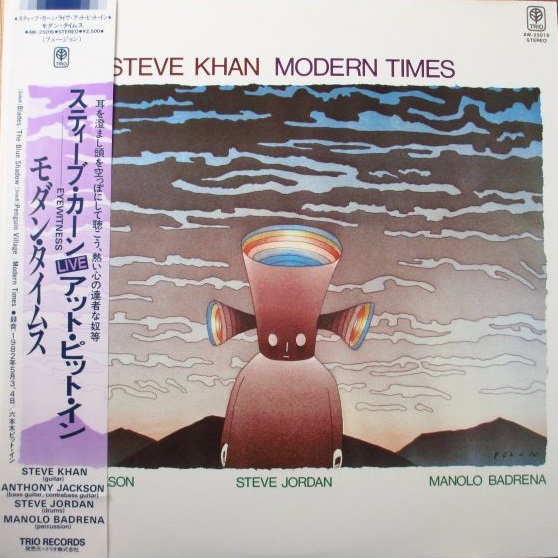
Steve Khan - 2016 (1981) "Eyewitness" - (1982) "Modern Times" - (1984) "Casa Loco"

Emerging on the New York scene in the mid-1970s, guitarist Steve Khan didn't long at all to develop a strong reputation as both chameleon-like session guitarist—comfortably crossing over from the jazz world into pop and rock and gracing albums by artists ranging from Esther Phillips, Freddie Hubbard and David Sanborn to Phoebe Snow, Billy Joel and Steely Dan—and valued member of the Brecker Brothers Band, playing on the seminal uptown group's sophomore effort, 1976's Back to Back, as well as 1977's Don't Stop the Music, both on Arista Records. Before long he was signed as a solo artist by Columbia Records, releasing three albums that, while intersecting stylistically with the Breckers' more funkified music, placed his sharp-toned Fender Telecaster—blues-inflected but with a more sophisticated harmonic bent that made him instantly recognizable—front and center.

Still, while the three albums Khan made for Columbia—1977's Tightrope, 1978's The Blue Man and 1979's Arrows—remain compelling on the two-disc 2015 BGO complication that brought these three albums back into print internationally for the first time in many years, by 1980, with the release of Khan's groundbreaking Arista debut, Evidence, it was clear that change was in the air. Khan's Columbia recordings were all exceptional recordings, but they were also, to some extent, obvious albums, where Khan's attention-grabbing writing laid the foundation for some aggressive, fusion-centric soloing that, clearly for the guitarist, had a limited shelf-life.

Evidence, on the other hand, was a true solo album, where Khan layered guitar upon guitar (upon guitar) in a setlist consisting completely of other peoples' writing. The first side of the original vinyl release collected compositions—some well-known, others more obscure—by jazz luminaries including Wayne Shorter, Joe Zawinul, Lee Morgan, Horace Silver and his previous employer, Randy Brecker. But it was the second side, an 18-minute medley of music by renegade composer/pianist Thelonious Monk, that was the knockout punch on a record that, from start to finish, demonstrated greater breadth—texturally, harmonically and conceptually—than any of Khan's previous recordings...and despite his more reductionist approach. More in service of the song than ever before, Khan also demonstrated greater attention to space and the idea that less can, indeed, oftentimes be more.

These changes were all the beginning of a paradigm shift for Khan, but it was with his next three albums, all featuring the same lineup, that the guitarist truly honed these changes as a guitarist and composer with the precision of a fine sculptor, but this time in the context of an empathic quartet featuring bassist Anthony Jackson, drummer Steve Jordan and ex-Weather Report percussionist Manolo Badrena.

The group's first album, Eyewitness (Antilles, 1981), was the subject of an extensive Rediscovery column at All About Jazz in early 2015, and it's flattering to learn that the column was one of a number of factors that led Khan to approach BGO Records with the idea of doing the same thing they'd done with his three Columbia recordings the previous year, but this time with the three albums released by the quartet that gained its name from that 1981 debut.

And so, BGO's reissue also includes the live Modern Times (Trio Records, 1982)—released in the USA as Blades (Passport Jazz)—and studio follow-up Casa Loco (Antilles, 1984) alongside Eyewitness: newly remastered (and approved by Khan) and spread across two CDs, with extensive liner notes by Matt Phillips. Eyewitness/Modern Times/Casa Loco rights a wrong by putting these albums back in print: three important records that truly redefined Khan as a guitarist, composer, interpreter and bandleader. They also set the stage for everything that was to follow, even if future albums ranged from the freely interpretive trio of The Green Field (Tone Center, 2006) to the guitarist's most recent Tone Centre releases—2007's Borrowed Time; 2011's Parting Shot; and 2014's Subtext—which more decidedly explored the guitarist's career-long interest in all things Latin and Afro-Cuban.

But in a career that's positioned Khan as a guitarist's guitarist, it's with these three Eyewitness albums that everything changed—and began again—for Khan. The Rediscovery column may, indeed, be amongst the final words on Eyewitness, describing the genesis of the group and how Khan applied a sparer, largely gentler approach that eschewed overt pyrotechnics and, instead, made deep grooves, group interplay and, most important, collective listening Eyewitness' significant modus operandi.

No group is worth its salt, however, if it doesn't continue to evolve, and this two-disc set demonstrates just how Eyewitness grew over the course of an eighteen-month timespan, from the November, 1981 recording of Eyewitness through the May, 1983 sessions that yielded the more provocative Casa Loco.

It also demonstrates how Khan had grown into an artist who felt ready to take real chances; Modern Times may possess the feel of a group that's spent some significant road time together, but this May, 1982 live date from Tokyo's The Pit Inn was, in fact, Eyewitness' first ever live date. Given the tenor of the times, with the emergence of the young lions and neoconservative jazz movement in full, well, swing, Modern Times represented a significant risk on many fronts, beyond being the group's first live performance. First, this was all-original music: three compositions by Khan and the closing title track—a collectively composed piece that moves from brooding, ethereal opening to four-on-the-floor theme, driven by Khan's whammy bar-driven chords, ultimately opening up to a solo section for Khan that's propelled by the reggae-inflected Jordan, Badrena's empathic punctuations, and Jackson's remarkable ability to completely anchor the group while, at the same time, altering the harmonic centre of the piece and acting as an near-telepathic melodic foil for the guitarist.

Second, this was a live album (then an LP) with four tracks all hovering near the 11-minute mark: a bold move (and, truthfully, a hard sell for Khan) made all the bolder still when taking into account that some significant editing had to be done in order to get the tunes down to that length. More than anything else, this was a playing band that also applied judicious editing in the studio (considering the number of fade-outs on Eyewitness and Casa Loco), but which applied absolutely no restrictions on how and where the music took it in either context.

Third, while these aren't what could be called "fusion" records in any way or at any time—though they're certainly both electric and electrifying—there's little to place Eyewitness in the context of the backwards-looking neocon movement of its time. While every piece on Modern Times swings in its own way, for the most part they don't swing the way the Marsalises of the world were asserting as the only way at the time. That said, while "The Blue Shadow" opens up with a bass/drums duet that, more backbeat-driven, clearly demonstrates the mitochondrial connection shared by Jackson and Jordan, it ultimately unfolds into a solo middle section that swings in a more decidedly jazz-like fashion. Jordan makes clear that, as much as his future would be more focused on other arenas—recording with artists ranging from The Rolling Stones' Keith Richards and soulful blues guitarist Robert Cray to country crooner/guitar wizard Vince Gill—at least some of his roots were unmistakably in the jazz sphere, as both he and Badrena bolster Jackson's walking bass lines and Khan's lean phrasing and sophisticated voicings.

It's unlikely that Khan ever crossed paths with Allan Holdsworth, but there's something indescribably Holdsworthian about the construction of "Penguin Village," though once Khan winds his way through the composition's primary theme, it becomes all Eyewitness—the guitarist's sinewy melody driven relentlessly by Jordan's rimshot snare, Jackson's staggered bass lines and Badrena's pulsating congas.

But more than any individual component, that Modern Times was taken from Eyewitness' first live performance only serves to show how astute Khan was in putting this particular group of players together in the first place. The entire album bristles with excitement, even when the mood is more subdued, and there's an overriding sense, throughout its entire 46-minute duration, of a group hanging on for dear life. Still, despite every nanosecond feeling imbued with risk there is, nevertheless, a feeling of confidence amongst Khan and his bandmates; no matter where anyone chooses to go, there's a feeling of certainty that the others will always manage to be there—either to follow the lead...or to grab the reins and drive the music in even more unexpected directions.

Following a paradigm shifter like Eyewitness and a live album like Modern Times may have represented a challenge for some but, if anything, Casa Loco represents a group continuing to evolve...and may well be the best amongst a group of albums where every single one offers something unique and appealing.

Some of Casa Loco's six compositions are more concise. The opening, Simmons drum-driven "The Breakaway"—also featuring Badrena's idiosyncratic vocal utterings—barely cracks the three-minute mark. But if "The Breakaway" and closing "The Suitcase"—also the title of a subsequent live album that, culled from a 1994 German show with Jackson and drummer Dennis Chambers and released by Tone Centre in 2008—are relatively brief, the twelve-minute title track and nine-minute "Uncle Roy" provide plenty of stretching space.

Somewhere in-between, there's the metrically challenging "Some Sharks," and a completely unexpected look at Steve Leonard's 1964 surf hit with The Pyramids, "Penetration," that manages to be both reverent and thoroughly modern. Both tracks flesh out a record that differs significantly from what came before in many ways, if for no other reason than only one of its six songs being written by Khan.

Beyond the guitarist's "Uncle Roy" and "Penetration," Casa Loco's four other tracks are all co-credited to the entire group, making this an even more collaborative effort than what came before. The more pervasive inclusion of Badrena's vocals is another significant differentiator, as is Jordan's fairly liberal use of the then-relatively new Simmons electronic drums, which allowed him to inject a variety of electronic colors throughout the record---surprisingly, thirty years later, weathering time far better than many of those early electronic drum experiments. And though Khan's tone is largely clean, warm and occasionally chorused, he also injects some unexpectedly jagged overdrive on "The Suitcase" and "Penetration," and leans a little more heavily towards the overtly virtuosic...delivering rapid-fire lines that, nevertheless, never come at the expense of either the collective group sound or the heart of the music.

But while all the definers of previous Eyewitness records remain, Casa Loco is overall a more hard-driving record, with a more aggressive stance. Despite Khan's ongoing commitment to creating distinctive chord voicings and a general eschewal of "look at me" pyrotechnics, Casa Loco lights a fire that even the undeniably incendiary Modern Times failed to light...or, more fairly, lit in an entirely different way. Casa Loco is also an edgier record, with Jackson and Jordan creating a more unsettling foundation, and Badrena's improvised vocals, at times, quirkily idiosyncratic.

Taken together, Eyewitness, Modern Times and Casa Loco represent something all too rare in most musicians' discographies, defining, as they do, a very specific point in time where everything changed. Providing the opportunity to hear and feel Khan redefine both himself and his bandmates to freer possibilities—and with all three albums largely out of print for many years—credit must also go to Britain's BGO Records for being amenable to the reissue of these three important titles. As Khan prepares for a Subtext followup, Eyewitness/Modern Times/Casa Loco not only fills the gap nicely, it should act as a major eye-and ear-opener to Khan fans who've never had the opportunity—and the pleasure—to hear these three absolutely seminal and groundbreaking recordings.

Track Listing:

 CD1:
Eyewitness: 1. Where's Mumphrey? 2. Dr. Slump 3. Auxiliary Police 4. Guy Lafleur 5. Eyewitness.
Modern Times: 6. Blades 7. The Blue Shadow.

 CD2:  
Modern Times (con't): 1. Penguin Village 2. Modern Times.
Casa Loco: 3. The Breakaway 4. Casa Loco 5. Penetration 6. Some Sharks 7. Uncle Roy 8. The Suitcase.

Personnel:

Steve Khan: guitar; Anthony Jackson: bass guitar, contrabass guitar (CD1#6-7, CD2); Steve Jordan: drums, Simmons drums (CD2#3-8) ; Manolo Badrena: percussion, vocals (CD2#3-8).

Saturday, January 30, 2016

Larry Coryell & Steve Khan - 1977 [1990] "Two For The Road"

Two for the Road is a live album by the American guitarists Larry Coryell and Steve Khan, which was released by Arista Records in 1977.

Intermittently on the road as an acoustic duo between gaps in the schedules of their respective ultra-hip fusion bands, Larry Coryell and Steve Khan managed to record several shows and then panned the tape stream to find the nuggets for posterity. There are choices that might have been made out of the fashions of the day, such as the version of Chick Corea's "Spain" that opens the album's first side. Thankfully there are also selections that are here because both guitarists must have realized they were playing magnificently.
Coryell's flair for Wayne Shorter extends beyond simply mastering the tunes to conceptualizing unique guitar settings. Parts of "Juju"'s head are pronounced in simple, chiming harmonics, a delightful way of pointing out that these players understand the guitar in its totality, not just the parts of it that can be used to impress speedfreaks. The hot version of "Footprints" doesn't really express the mystery of Shorter's original mood, yet is terrifically in line with the Django Reinhardt approach to playing a tune, once again full of the kinds of activities fans of acoustic guitar music will find pleasurable.
"St. Gallen" is, in some ways, a remarkable performance. The long introduction sounds like a solo from Coryell, parts of which might be the missing link between him and Derek Bailey. An episode thick with minor seconds and low, throbbing dissonance is only one of many stops on a route that in some ways is as breathtaking as the "milk run" that leaves the St. Gallen station and heads into the Swiss Alps, stopping at farmhouses along the way to pick up fresh dairy shipments. Prior to evoking this image, the piece in its initial moments includes passages of purely show-off rapidity culminating in a lethal swipe at the bridge, the equivalent of a mad critic throwing a knife at a fusion guitarist mid-solo stream.
Khan's admiration for his partner is evident from the liner notes alone. His own style is edgy and observant, and while he doesn't sound simply like someone trying to keep up, he too easily agrees to participate in moments of pieces that come off as more or less typical jamming, such as "Son of Stiff Neck." As for the previously mentioned "Spain," it's too bad they went there -- although anybody performing on this scene during this era was expected to play this "In the Midnight Hour" of jazz standards. A chord emphasized much beyond its importance immediately sets the stage for a flat performance in which the main question listeners might ask themselves is why are there so many notes in the theme -- not the desired reaction when performing a head. The live recording quality is excellent, the tracks fading quickly when the applause begins.

Why this recording is not on CD is a mystery to me. I bought the original LP when it first came out and was astounded by the level of playing. Thankfully, I have some of the tracks from this record on tape, but will order the vinyl again at some point.

No offense to fans of Ovation guitars, but I love the fact that the instruments on this live recording are ASW (all solid wood, with the attendant sound). The recording quality is good, and though the playing is of a highly virtuosic level it does not suffer from technical sterility. "Footprints" is my favorite of the tracks. I remember when this album came out many electric players were floored to hear jazz played like this on acoustic guitars.

As the previous reviewer has noted, this was a remarkable album when released in the late 1970s. To this day, I am amazed at the technical AND musical accomplishments of Larry Coryell. A very rare individual indeed. Here he is astounding along with fine support from fellow fusion player Steve Khan. Guitar enthusiasts take note, if you can find a copy of this recording, by all means grab it. It holds up extremely well. By the way, I would like to know why the Arista records portion of Larry's catalogue is still in some kind of musical limbo. The artist and music fans alike deserve better. P.S. Nice cover artwork. 

Track listing

    "Spain" (Chick Corea, Joaquín Rodrigo) – 5:20
    "Bouquet" (Bobby Hutcherson) – 5:30
    "Son of Stiff Neck" (Larry Coryell, Steve Khan) – 5:35
    "JuJu" (Wayne Shorter) – 3:08
    "St Gallen" (Larry Coryell) – 7:10
    "Footprints" (Wayne Shorter) – 5:30
    "General Moto’s Well Laid Plan" (Steve Swallow) – 5:07
    "Toronto under the Sign of Capricorn" (Larry Coryell) – [Bonus Track] 8:38
    "For Philip and Django" (Larry Coryell) – [Bonus Track] 4:32
    "Rodrigo Reflections" (Larry Coryell) – [Bonus Track] 7:22

Personnel

    Larry Coryell – guitar
    Steve Khan – guitar

Saturday, January 19, 2019

Arista All Stars - 1978 [2014] "Blue Montreux"

A sweet session of 70s electric jazz – recorded as a unique live all-star outing by a group of Arista's best jazz players at the time! The group's an octet, but plays together in differing formations throughout the record – with Warren Bernhardt on keyboards, Michael Brecker on saxes, Randy Brecker on trumpet, Steve Jordan on drums, Steve Khan and Larry Coryell on guitars, Tony Levin on bass, and Mike Maineri on vibes – the last of which really make for some of the best numbers on the album! Bernhardt's keyboards are pretty good too – stepping out with a spacious, fluid feel that's never jamming – and more in the open-ended Bob James side of the spectrum, although his overall sound is a lot different than Bob's!

At the 1978 Montreux Jazz Festival, a variety of artists (including keyboardist Warren Bernhardt, tenor-saxophonist Michael Brecker, guitarists Steve Khan and Larry Coryell, trumpeter Randy Brecker and vibraphonist Mike Mainieri) recorded a dozen funky selections which were originally released on two Arista LPs. This single CD has the eight top performances from these important fusion stylists; Michael Brecker in particular is in good form. The results are not essential but offer listeners a time capsule of where R&B-oriented fusion was in 1978.

Both CDs are absolute fantastic recordings. Mike Mainierie and especially Mike Brecker are at their best. For me the highlight came one year later in the recording of Jun Fukamachi & New York All SAtars. Joined by David Sanborn, Steve Jordan replaced by Steve Gadd and Steve Khan on guitar. Tuines are mainly identical but I think they have more drive than the Montreux ones.

Personally, Larry Coryell IS one of my favorite guitarists, and since he covered Rocks on his Planet End album it's fitting he guests here. The other stellar guitar moment is Steve Khan's awesome solo on Magic Carpet. Other than that it's about the horns and what horns!!. While this is not straight ahead jazz, it's not fusion like either. Electric instruments mixed into an acoustic setting with taste. If you like the Breckers, buy this if you can find it. It's a gem.

What a line-up! An incredible performance by legends in their own time. I was particularly surprised to find Tony Levin here. His playing on "Rocks" is unbelievable. This is an album to be reckoned with. Sometimes fast and aggresive, lots of feeling when called for. The Breckers tear the CD player apart! They pull out all the stops on "Rocks". Michael's opening line in "I'm Sorry" shows the sensibilities he's capable of rendering. Just an amazing album by an amazing bunch!

This recording is the beginnings of what was to become Steps. Michael Brecker, God rest his soul never made a bad recording and this is worth buying for the tune, "I'm Sorry" alone. The intro still brings tears to me eyes. There's a little bit everyone's compositions including Randy Brecker's eccentric funk, and Manieri's lyricism. I believe that drummer, Steve Jordan was around 19 or 20 at the time of this concert and still a phenom in the world of jazz-fusion. Tony Levin holds down the bottom and Warren Bernhardt contributes nicely on keyboards.

Track listing:

Blue Montreux (8:47)
Rocks (7:54)
I'm Sorry (8:38)
Magic Carpet (5:34)
Buds (4:58)
Floating (7:54)
The Virgin And The Gypsy (8:24)

Personnel:

Guitar – Steve Khan (tracks: 1-6), larry Coryell (tracks: 2)
Tenor Saxophone – Michael Brecker (tracks: 1-3, 5-6)
Trumpet – Randy Brecker (tracks: 1,2,5-7)
Vibraphone, Synthesizer [Oberheim] – Mike Mainieri
Bass – Eddie Gomez (tracks: 1-6)
Bass, Chapman Stick – Tony Levin (tracks: 1-6)
Drums – Steve Jordan (tracks: 1-6)
Piano, Electric Piano [Fender Rhodes], Keyboards – Warren Bernhardt

Monday, November 20, 2017

Various Artists - 1997 "Jazz Fusion Volume 2"

The second of two Rhino CDs mostly covers the 1975-1984 period (with Miles Davis' "Mr. Pastorius" dating from 1989). One of the most interesting aspects to this reissue is that it not only has examples of jazz musicians playing rock, but rock musicians coming closer to performing jazz. The second volume has one selection apiece from the Brecker Brothers ("Some Skunk Funk"), Brand X, Jean-Luc Ponty, Bruford, Ronnie Montrose, Dixie Dregs, Larry Carlton, John McLaughlin ("Belo Horizonte"), Steve Khan, Miles Davis, Allan Holdsworth, and Steve Morse. Most of the performances are quite fiery and the instrumental music is consistently exciting. Although the two Rhino volumes are not quite definitive (some groups are missing and the selections are not strictly in chronological order), they do offer listeners an excellent overview of the much-maligned music.

Here's a refreshingly varied collection of some of the best jazz-rock fusion music from Rhino, who are really masters at digging up little-known gems to put beside the more famous ones in their compilations. This collection is much better than Jazz Fusion Volume 1 at displaying the true hormonal magic and utterly unique musical plane that can result when, rare enough though it is, all the elements come together in a virtuoso jazz-fusion group. Where else can you find hard-to-find stuff like Steve Khan's Casa Loco, to go along with Miles Davis's brilliant late-period "Mr. Pastorious," Jean-Luc Ponty's classic Enigmatic Ocean, parts I to IV, Bill Bruford's Hell's Bells, Ronnie Montrose, The Brecker Bros. and the Dixie Dregs' "Take it Off the Top" on the same CD? And if all that still doesn't kick your mule sore, turbo-charge you hormones and make you macho, here's something even more gaucho: just play "Nuclear Burn" by Phil Collins' monster '70s fusion group Brand X with the volume knob at 11, and call me if your brain isn't an omelette after you're done. Rounding out the diverse appearnces are the legendary "Point It Up" guitar solo from Larry Carlton, and, as a sort of breather from all the fire-breathing, John Mclaughlin's gorgeous and ultra-sophisticated flamenco-jazz-Brazilian-fusion acoustic piece "Belo Horizonte." So, if you can put your envy aside and just accept the fact that you'll probably never be able to play your instrument half as good as any of these guys (the skin-flute excluded), there is some extremely good music to be discovered in the much despised and ignored "Jazz Fusion" genre. This disc is a great place to start.

http://jazz-rock-fusion-guitar.blogspot.com/2015/09/various-artists-1997-jazz-fusion-volume.html

Track Listing:

  01. Some Skunk Funk - The Brecker Bros.
  02. Nuclear Burn - Brand X
  03. Enigmatic Ocean, Parts I-IV - Jean-Luc Ponty
  04. Hell's Bells - Bruford
  05. Town Without Pity - Ronnie Montrose
  06. Take It Off The Top - Dixie Dregs
  07. Point It Up - Larry Carlton
  08. Belo Horizonte - John Mc Laughlin
  09. Casa Loco - Steve Khan
  10. Mr. Pastorius - Miles Davis
  11. Three Sheets To The Wind - Allan Holdsworth
  12. The Introduction - Steve Morse Band

Personnel:

Guitar - Bob Mann, John Goodsall, Ronnie Montrose, Steve Morse, Larry Carlton, Allan Holdsworth, Steve Khan, John McLaughlin, Daryl Stuermer
Drums - Harvey Mason, Sr., Jeff Porcaro, Rick Shlosser, Steve Jordan, Chad Wackerman, Tommy Campbell, Al Foster, Bill Bruford, Phil Collins, Steve Smith
Bass - Marcus Miller, Jerry Peek, Andy West, Jeff Berlin, Ralphe Armstrong, Jean Paul Celea, Alan Fitzgerald, Anthony Jackson, Percy Jones, Abraham Laboriel, Will Lee
Keyboards - Mark Parrish, Allan Zavod, Dave Stewart, Francois Couturier, Robin Lumley, Don Grolnick, Greg Mathieson
Percussion - Steve Sheman, Ralph MacDonald, Manolo Badrena, Jean-Pierre Drouet
Violin - Allen Sloan, Jean-Luc Ponty
Synthesizer - Katia Labeque
Flugelhorn, Trumpet - Randy Brecker
Piano - Edgar Winter
Sax (Tenor) - Michael Brecker
Trumpet - Miles Davis
Sax (Alto) - David Sanborn

Saturday, February 22, 2020

The Brecker Brothers - 2012 "The Complete Arista Albums Collection" [8 CD Box]

The Brecker Brothers -- Michael and Randy -- were one of the most successful of the jazz/fusion groups that arose in the 1970s, recording 6 best-selling albums for Arista between 1975 and 1981. Musicians on the records make a jazz/fusion hall of fame including David Sanborn, Steve Gadd, Will Lee, Harvey Mason, Marcus Miller, George Duke, and many more. In 1979 they also participated in all-star shows at the Montreux Jazz Festival. The band was Steve Khan, Tony Levin, Mike Mainieri and Steve Jordan. These two albums are included here as bonuses. None of these albums have ever been released on CD in the U.S.
Randy Brecker contributes liner notes to the set which also includes full discographical info. and rare photos.
The Brecker Bros. have reunited as The Brecker Brothers Reunion Band-- with excellent Italian saxophonist Ada Rovatti keeping it in the family (she is Randy s wife) and ably filling the late Michael's role -- for an all-new studio recording of new material, featuring David Sanborn, Mike Stern, Dave Weckl, and Will Lee (to be released in September).
A new Brecker Bros. Reunion live DVD from the Blue Note jazz club will also be released. Both new releases are on Half Note Records, the label of The Blue Note Jazz club in New York, which will sponsor a record release show the week of Sept. 11-18 in New York. The band will be playing major jazz festivals in the U.S., Europe, and Japan. Randy s own profile at the moment is very high. He received 3 Grammy nominations this year.

Trumpeter Randy Brecker and saxophonist Michael Brecker had already shared the bandstand and logged plenty of studio time together before they formed The Brecker Brothers. The siblings stood as a team with Horace Silver s hard bop ensemble, the proto-fusion unit Dreams, and Billy Cobham's early Crosswinds band, as well as on myriad studio dates for a panoply of artists from James Taylor to Parliament.

By 1975 it was time for them to make their own mark. Gathering together some of the cream of the studio players that they were spending considerable time with, including saxophonist David Sanborn and bassist Will Lee, the brothers formed a tight combo that would integrate their taste for jazz, fusion, R&B, funk and pop. Right out of the box, they garnered a hit single, "Sneakin' Up Behind You," from their debut recording, Brecker Brothers, which also included the emblematic "Some Skunk Funk."

Subsequent albums saw name players like guitarists Steve Khan and Hiram Bullock, keyboardist George Duke, bassist Marcus Miller and vocalist Luther Vandross making vital contributions. No matter how commercially oriented the music might veer, the solid playing of both Randy and Michael could be heard. On such albums as the live recordings, Heavy Metal Bebop and the special project Blue Montreux, the brothers fully displayed their extraordinary technical skills and gutsy phrasing. Combining jazz chops and R&B seasoning, both of the Breckers became important stylistic influences on their respective horns.

In retrospect, the Brecker Brothers can be seen as dashing heroes, unafraid to follow wherever their muse lead them no matter what straight-laced critics objected to. From today's eclectic viewpoint, their up front blend of jazz and outright pop sounds was not only ahead of the curve, it was right up to the minute.

This 8 cd box set was a collection I have always hoped would be released.The Brecker Brothers have always been favorites of mine and this set captures the history of the brothers musically. It was during this period that Michael Brecker really grew and developed his style. Any fan of funky jazz and rock influenced jazz will love this release. The last 2 discs of the collection are of live recordings at Montreux Jazz festival in 1978 and I love the collaboration of the Breckers with Mike Maineri, Eddie Gomez and Larry Coryell. The Collection features so many great players in modern jazz from an early standpoint, Will Lee and David Sanborn and many others. This collection is truly a piece of modern jazz history. So thankful that Randy Brecker put this collection together. I love listening to these albums. It brings back so many memories and musically much of the tracks are still fresh today (especially on the album "Detente"). The loss of Michael Brecker a few years ago, definitely left a huge hole in the jazz world. This collection definitely helps to to remember one of the greatest tenor players ever.

In 2001, the Brecker Brothers' Arista releases were reissued on CD by the One Way label, but the discs quickly went out of print. French and Japanese reissues surfaced toward the end of the decade, but this box set from Sony's Legacy division makes them easy to obtain in the U.S. -- that is, if you're willing to shell out for an eight-disc box, priced around $60 at the time of its September 2012 release. The discs are in durable LP replica sleeves, though they are not as high quality as a standard Japanese reissue. All-original artwork, front sleeve and back sleeve, is reproduced, and there's a booklet as well. The set contains not only each one of the Breckers' 1975-1980 Arista releases (The Brecker Bros., Back to Back, Don't Stop the Music, Heavy Metal Be-Bop, Détente, and Straphangin') but the two Blue Montreux releases from 1979 as well. At the time of release, each one of the Brecker titles here (neither Blue Montreux nor Blue Montreux II) was available separately as a digital download.

CD's Included in Box Set:
1) The Brecker Brothers (Arista 1975)
2) Back To Back (Arista 1976)
3) Don't Stop The Music (Arista 1977)
4) Heavy Metal Be-Bop (Arista 1978)
5) Detente (Arista 1980)
6) Straphangin' (Arista 1981)
7) Blue Montreux (Arista 1979)
8) Blue Montreux II (Arista 1979)

Track Listings:

Disc: 1

The Brecker Brothers

  1. Some Skunk Funk
  2. Sponge
  3. A Creature of Many Faces
  4. Twilight
  5. Sneakin' Up Behind You
  6. Rocks
  7. Levitate
  8. Oh My Stars
  9. D.B.B.

Personnel:

    Randy Brecker – trumpet, flugelhorn, vocals on "Oh My Stars"
    Michael Brecker – tenor saxophone
    David Sanborn – alto saxophone
    Don Grolnick – keyboards
    Bob Mann – guitar
    Will Lee – bass, vocals on "Sneakin’ up Behind You"
    Harvey Mason – drums
    Chris Parker – drums on "Sneakin’ up Behind You"
    Ralph MacDonald – percussion

Disc: 2

Back To Back

  1. Keep It Steady (Brecker Bump)
  2. If You Wanna Boogie...Forget It
  3. Lovely Lady
  4. Night Flight
  5. Slick Stuff
  6. Dig a Little Deeper
  7. Grease Piece
  8. What Can a Miracle Do
  9. I Love Wastin' Time with You

Personnel:

    Randy Brecker – trumpet, electric trumpet, flugelhorn
    Michael Brecker – tenor saxophone, flute
    David Sanborn – alto saxophone
    Don Grolnick – keyboards
    Steve Khan – guitar
    Will Lee – bass, lead vocals
    Chris Parker – drums
    Steve Gadd – drums (4, 9)
    Ralph MacDonald – percussion
    Sammy Figueroa – percussion (4)
    Rafael Cruz – percussion (4)
    Lew Del Gatto – baritone saxophone (2)
    David Friedman – marimba (6)
    Dave Whitman – synthesizer programmer
    Patti Austin – background vocals (9)
    Allee Willis – background vocals (9)
    Luther Vandross – vocals, vocals arrangement
    Robin Clark – vocals
    Diane Sumler – vocals

Disc: 3

Don't Stop The Music

  1. Finger Lickin' Good
  2. Funky Sea, Funky Dew
  3. As Long As I've Got Your Love
  4. Squids
  5. Don't Stop The Music
  6. Petals
  7. Tabula Rasa

Personnel:

    Randy Brecker – trumpet, flugelhorn, electric trumpet
    Michael Brecker – tenor saxophone, flute
    Will Lee – bass
    Don Grolnick – keyboards
    Doug Riley – keyboards
    Steve Khan – guitar, 12-string guitar
    Jerry Friedman – guitar (1, 5)
    Sandy Torano – guitar (1, 3)
    Hiram Bullock – guitar (2, 3, 4, 6)
    Chris Parker – drums
    Steve Gadd – drums (4, 6)
    Lenny White – drums (7)
    Ralph MacDonald – percussion
    Sammy Figueroa – congas (7)
    Doug and Beverly Billard – background vocals (3)
    Will Lee, Christine Faith, Robin Clark, Josh Brown – background vocals
    Horn Section
        Lou Marini – alto sax
        Alan Rubin – trumpet
        Randy Brecker – trumpet
        David Taylor – bass trombone
        Barry Rogers – trombone
        Michael Brecker – tenor sax
        Lew Del Gatto – baritone sax
    String Section
        Aaron Rosand, Guy Lumia, Paul Gershman, Harry Lookofsky, Sanford Allen, Ariana Bronne, Harold Kohon, Matthew Raimondi, Peter Dimitriades – violins
        Lamar Alsop, Richard Maximoff, Alfred Brown – violas
        Jesse Levy, Richard Locker – cellos

Disc: 4

Heavy Metal Be-Bop

  1. East River
  2. Inside Out
  3. Some Skunk Funk
  4. Sponge (Live Version)
  5. Funky Sea, Funky Dew (Live Version)
  6. Squids (Live Version)

Personnel:

    Randy Brecker – Trumpet and Keyboards
    Michael Brecker – Tenor Saxophone
    Barry Finnerty – guitars, guitorganiser, background vocals
    Terry Bozzio – drums, background vocals
    Neil Jason – bass, lead vocals
    Sammy Figueroa – percussion
    Rafael Cruz – percussion
    Additional musicians on "East River"
        Kash Monet – handclaps, percussion, backing vocals
        Paul Shaffer – Fender Rhodes
        Victoria – tambourine
        Jeff Schoen – backing vocals
        Roy Herring – backing vocals
        Allan Schwartzberg – drums
        Bob Clearmountain – handclaps

Disc: 5

Detente

  1. You Ga (Ta Give It) - The Brecker Brothers feat. D.J. Rogers & Carl Carlwell
  2. Not Tonight - The Brecker Brothers feat. Carl Carlwell
  3. Don't Get Funny With My Money
  4. Tee'd Off
  5. You Left Something Behind
  6. Squish
  7. Dream Theme
  8. Baffled
  9. I Don't Know Either

Personnel:

    Michael Brecker – tenor saxophone, flute
    Randy Brecker – trumpet, flugelhorn
    Airto Moreira – percussion
    Hiram Bullock – guitar
    Paulinho Da Costa – percussion
    Steve Gadd – drums
    Mark Gray – keyboards
    Don Grolnick – keyboards
    Neil Jason – bass
    Steve Jordan – drums
    Ralph MacDonald – percussion
    Marcus Miller – bass
    Jeff Mironov – guitar
    D.J. Rogers – vocals
    David Spinozza – guitar
    Carl Carlwell – vocals

Disc: 6

Straphangin'

  1. Straphangin'
  2. Threesome
  3. Bathsheba
  4. Jacknife
  5. Why Can't I Be There
  6. Not Ethiopia
  7. Spreadeagle

Personnel:

    Randy Brecker – trumpet, flugelhorn
    Michael Brecker – tenor saxophone
    Barry Finnerty – guitar
    Mark Gray – keyboards
    Marcus Miller – bass
    Richie Morales – drums
    Don Alias – percussion
    Manolo Badrena – percussion

Disc: 7

Blue Montreux

  1. Blue Montreux - Arista All Stars
  2. Rocks - Arista All Stars
  3. I'm Sorry - Arista All Stars
  4. Magic Carpet - Arista All Stars
  5. Buds - Arista All Stars
  6. Floating - Arista All Stars
  7. The Virgin And The Gypsy - Arista All Stars

Personnel:

Guitar – Steve Khan (tracks: 1-6), larry Coryell (tracks: 2)
Tenor Saxophone – Michael Brecker (tracks: 1-3, 5-6)
Trumpet – Randy Brecker (tracks: 1,2,5-7)
Vibraphone, Synthesizer [Oberheim] – Mike Mainieri
Bass – Eddie Gomez (tracks: 1-6)
Bass, Chapman Stick – Tony Levin (tracks: 1-6)
Drums – Steve Jordan (tracks: 1-6)
Piano, Electric Piano [Fender Rhodes], Keyboards – Warren Bernhardt

Disc: 8

Blue Montreux II

  1. Funky Waltz - Arista All Stars
  2. Candles - Arista All Stars
  3. Uptown Ed - Arista All Stars
  4. Love Play - Arista All Stars
  5. Cloud Motion - Arista All Stars

Personnel:

    Acoustic Bass – Eddie Gomez (tracks: A3)
    Drums – Steve Jordan
    Electric Bass – Tony Levin (tracks: A2, B1, B2)
    Electric Bass [Electric Stick] – Tony Levin (tracks: A1)
    Electric Guitar – Steve Khan (tracks: A1, A2, B1, B2)
    Electric Guitar, Soloist – Larry Coryell (tracks: A1)
    Keyboards – Warren Bernhardt (tracks: A2, B1, B2)
    Percussion – Mike Mainieri (tracks: A2)
    Piano – Warren Bernhardt (tracks: A1, A3)
    Saxophone – Michael Brecker (tracks: B2)
    Soprano Saxophone – Michael Brecker (tracks: A2)
    Synthesizer [Mini-moog] – Mike Mainieri (tracks: B1)
    Synthesizer [Synthe-vibe] – Mike Mainieri (tracks: B1)
    Tenor Saxophone – Michael Brecker (tracks: A1, A3)
    Trumpet – Randy Brecker (tracks: A1, B2)
    Vibraphone [Electric] – Mike Mainieri (tracks: A2, A3, B1, B2)

Saturday, April 22, 2017

Larry Coryell - 1975 "Difference"

Larry Coryell is joined on this ‘78 French release by other pickers, Steve Kahn, Arthur Rhames and Glen Moore; along with Michael Brecker, Dave Sanborn Don Grolnick, Will Lee, Steve Gadd and Tony Williams.

An obscure recording that finds Coryell in solo, duo and group settings. The group performances range from free ("Octaves") to funk ("Memphis Underground"). Of the two solo guitar performances, "Improvisation," is the more cohesive as "Acoustic Solo" finds Coryell laboring for speed, a fault that has often hindered his playing. "Picean Moon" is a moody piece similar to the "ECM sound," with Michael Brecker sounding like a dead ringer for Jan Garbarek. "Serabond" is a fine acoustic duet with Steve Khan and even includes a quote from "Theme from Love Story."

Yet another outstanding Coryell album, and one of the most unashamed jazz-rock guitar albums, yet all to short IMHO in its duration. The usual guests are around, Tony Williams, Steve Khan, the Brecker brothers, etc. Although the album was recorded in 75, it didn't see the light of day until 78; indeed it is an assemblage of Electric Lady studio (the Hendrix facilities) recordings and the Montreux festival of the same year. The only things that would make this album a bit different is the label that issued it (Egg) and the unrelated sea photo artwork, as the rest makes it a typical Coryell album.
The opening Octaves is an excellent instrumental (the whole album is) where Brecker and Sanborn make remarkable sax interventions. Memphis Underground could easily sound as if it escaped an Eleventh House album, but the line-up is nowhere near the group's. Picean Moon is a rather chilling piece of jazz, sometimes nearing the dissonant.
As usual, there are acoustic guitar tracks, with the aptly titled Acoustic Solo (maybe a little lengthy, but we won't complain given the overall album duration), the short but nervous Improvisation (that's its name) and the duo flamenco-influenced Serabound, where Khan gets in act.

This album made me flying in the sky. Not kidding. Tony Williams is so great on Picean Moon and on Octaves ; his hi-hat on picean is like a shadow moving around the basic pulsation, the snare's shots aren't on the expected times, Michael Brecker is...divine. Octaves desserved more than this; it's like the Montagnes russes. 

Tracks Listing

1. Octaves (3:49)
2. Acoustic Solo (5:35)
3. Memphis Underground (3:38)
4. Improv (2:32)
5. Picean Moon (5:58)
6. Serabond (4:45)
7. Aquarian Mode (5:07)

Total time 31:24

Line-up / Musicians

- Larry Coryell / acoustic & electric guitars

With:
- Steve Khan / guitar (3)
- Arthur Rhames / guitar (1,5,7)
- Glen Moore / acoustic guitar (1,5,7)
- Michael Brecker / saxophone (1,3,5,7)
- David Sanborn / alto saxophone (3)
- Don Grolnick / keyboards (3)
- Will Lee / bass
- Tony Williams / drums
- Steve Gadd / drums (3)

Monday, October 15, 2018

Steve Khan - 1992 "Headline"

Recorded in '92, "HEADLINE" brought the trio with Ron Carter & Al Foster back together, but, once again Polydor K.K.(Japan) had their own ideas about the direction I should pursue. Go Steve!This time, in addition to the trio tracks, they wanted me to record with the Eyewitness instrumentation. As Anthony Jackson, Dennis Chambers and I had been touring Europe as a trio, it was easy to add Manolo Badrena to the mix, and this VERY special chemistry came back to us without missing a beat. The CD, which was released in the USA on Bluemoon Records, presents the contrast of these two formats and, for some fans of Eyewitness, it turned to be a great thing that they could hear us playing 'odd-ball' standards as opposed to our own unique original compositions. Like "LET'S CALL THIS" the music is drawn from the great jazz of the mid-'60s. "Autumn in Rome" was only the 2nd tune by my late father which I recorded. It's a pretty obscure piece, but, that's why I chose it. Along with so much of the other material, I try to select tunes which most guitarists don't play as a rule. Though there are many special moments from both configurations of personnel on this recording, I am especially pleased with the performance of "All of Nothing at All," which demonstrates the scope and depth of Dennis Chambers' drumming, and Eyewitness-like interplay from everyone. Joe Henderson's "Caribbean Fire Dance" shows that Anthony and Dennis have developed their own very special way of making music together, and the 'free' Intro to Ornette Coleman's "Turnaround" gives them further room to explore this chemistry.

Guitarist Steve Khan is heard in two different settings on this CD: in an acoustic trio with bassist Ron Carter and drummer Al Foster on six songs, and jamming with electric bassist Anthony Jackson, drummer Dennis Chambers and percussionist Manolo Badrena on three tunes. Actually, there is a definite unity to the program, and Khan is featured on a variety of jazz tunes including numbers by Larry Young, Ornette Coleman ("The Blessing" and "Turnaround"), Clare Fischer, Wayne Shorter, Thelonious Monk and Joe Henderson. He even plays a song ("Autumn In Rome") by his father, Sammy Cahn. The guitarist consistently stretches himself during these performances (which include a 10½-minute version of "All or Nothing at All") and is heard throughout at his most creative.

Track listing:

 [1] Tyrone(Larry Young)(5:54)
 [2] The Blessing(Ornette Coleman)(4:45)
 [3] Autumn in Rome(Sammy Cahn-Paul Weston)(6:31)
 [4] Turnaround(Ornette Coleman)(6:42)
 [5] Ontem a Noite(Clare Fischer)(5:52)
 [6] Water Babies(Wayne Shorter)(5:00)
 [7] All or Nothing at All(Jack Lawrence-Arthur Altman)(10:41)
 [8] Hackensack(Thelonious Monk)(5:23)
 [9] Caribbean Fire Dance(Joe Henderson)(8:06)

Personnel:

Guitar – Steve Khan
Bass – Anthony Jackson (tracks: 4,7,9), Ron Carter (tracks: 1,2,3,5,6,8)
Drums – Al Foster (tracks: 1,2,3,5,6,8), Dennis Chambers (tracks: 4,7,9)
Percussion – Manolo Badrena (tracks: 4,7,9)

Thursday, November 19, 2015

Elements - 1988 "Illumination"

Elements was an American jazz fusion ensemble founded by bass guitarist Mark Egan and drummer Danny Gottlieb in 1982. Both Egan and Gottlieb were former members of the Pat Metheny Group, and Elements' sound draws deeply from their experience as Metheny's former rhythm section. Band members included Bill Evans, Gil Goldstein, Steve Khan and Clifford Carter.
They released albums from 1982 to 1996 on labels including Novus and Antilles.

Bassist Mark Egan and drummer Danny Gottlieb have been longtime friends, starting with their days at the University of Miami in the early '70s and continuing during their period with Pat Metheny (Egan was in the guitarist's group from 1978-1980, while Gottlieb stayed until 1983). They formed Elements in 1982, which, from its start, also included Bill Evans on soprano and tenor and keyboardist Clifford Carter; guitarist Steve Khan, keyboardist Gil Goldstein, several percussionists, saxophonist David Mann, and other players have been guests.

By request :-)

Tracklist

01. Hymnalayas
02. Walk In
03. Mandala
04. Illumination
05. The Seeker
06. 1000 Words
07. Go Ahead Stan
08. Sunken Cathedral

Personnel :

Mark Egan - bass
Danny Gottlieb - drums
Bill Evans - saxophone
Clifford Carter - keyboards
Stan Samole - Guitar
Steve Khan - Guitar

Saturday, January 2, 2016

Steps Ahead - 1992 "Yin-Yang"

Steps Ahead (originally known as Steps) is a jazz fusion group and the brainchild of vibraphonist Mike Mainieri. According to the liner notes of the group's 1983 debut album (for worldwide release), entitled Steps Ahead, "Steps began as a part-time venture in 1979 at Seventh Avenue South, a New York City nightclub." The group began releasing recordings in Japan as far back as 1980.
The first line-up of Steps in the period 1979-1981, as can be read on the live album Smokin' in the Pit, consisted of Michael Brecker (tenor sax), Steve Gadd (drums), Eddie Gómez (bass), Don Grolnick (piano), Mike Mainieri (vibraphone), and special guest Kazumi Watanabe (guitar). This double live album was recorded on 15 and 16 December 1979 at The Pit Inn Tokyo. A second studio recording was made on 17 December 1979, called Step by Step. Smokin' in the Pit was released in 1980 and awarded a gold record. The studio album Step by Step was released shortly after, followed in the summer of 1980 by another live recording called Paradox. These three albums (see Mike Mainieri's notes in the booklet of the 1999 cd release of Smokin' in the Pit) were the only albums released by the group under the name of Steps. In 1982 they learned that the name Steps had been trademarked by a band in North Carolina, and therefore changed their name to Steps Ahead.
The line-up for the Steps Ahead album consisted of Mainieri, Michael Brecker (tenor sax), Eliane Elias (piano), Peter Erskine (drums), and Eddie Gómez (bass).
The group's members has also included Dennis Chambers, Warren Bernhardt, Rachel Z, Donny McCaslin, Chuck Loeb, Victor Bailey, Tony Levin, Bob Berg, Darryl Jones, Mike Stern, Richard Bona, and many others.
Brecker and Mainieri are featured on the Dire Straits album Brothers in Arms. For rock listeners, the albums Steps Ahead and Modern Times (1984, with Bernhardt replacing Elias in the main line-up, and other guest musicians appearing in limited roles) are a great bridge into a kind of jazz that is energetic and powerful. Reflecting the cooperative, ensemble nature of the band, the Modern Times album included compositions by Mainieri, Brecker, Erskine, and Bernhardt.
According to the website NYC Records, which include's Mainieri's biographical sketch and touring schedule with Steps Ahead, the 2007 instantiation of Steps Ahead includes: Mainieri (vibes), Bill Evans (sax; not to be confused with the jazz pianist also named Bill Evans), Bryan Baker (guitar), Anthony Jackson (bass), and Steve Smith (drums), a former member of the rock group Journey. On some stops of the tour, Etienne Mbappe is listed as filling in for Jackson.
 
This CD from the part-time fusion band Steps Ahead is probably most notable for introducing the fine keyboardist Rachel Z. Also in the group at the time were leader Mike Mainieri on MIDI vibraharp and synclavier, saxophonist Bendik, bassist Jeff Andrews and drummer Steve Smith. Put out by Mainieri's NYC label, this mostly high-powered performance consists of group originals, generally by Mainieri and Bendik. Unlike other Steps Ahead records, there are quite a few guests on various tracks including guitarists Steve Khan, Wayne Krantz, Jimi Tunnell and Chuck Loeb, electric bassist Victor Bailey and tenorman Rick Margitza. The music has spirit and drive.

Different forms of style here: ballads, rock based backbeats, straight ahead jazz...Mike's vibraphone tells a story and the rhythm section play with great precision and feel. Awesome Steve Smith and Jeff! Racheal Z. and a host of guest artist put the finishing touch on a sexy, sophisticated, beautiful experience. buy it! 

Purchasing this particular album was a bit of a gamble for me since Michael Brecker's Sax is not there, as on previous Steps Ahead albums. Surprisingly, Brecker's absence allows more of a statement from Mike Mainieri's Vibraharp, Synclavier, etc. The result is very cool and rhythmic with more of a melodic presence. Enjoy.

Track listing:

01. Sidewalk Maneuvers(4:49) [Mike Mainieri]
02. Praise (4:47) [Mike Mainieri]
03. Nite Owl (5:32) [Mike Mainieri]
04. Taxi (3:28) [Bendik]
05. Tamarin Lion (5:44) [R.Skår, Bendik]
06. Gory Details (4:55) [R.Nicolazzo, Mike Mainieri]
07. Agitate The Gravel (5:56) [Spencer Cozens, Miles Bould, Mike Mainieri]
08. Okapi (6:20) [Bendik]
09. Orion (4:38) [R.Nicolazzo, Mike Mainieri]
10. Steppish (7:57) [Mike Mainieri]
11. Saras Toush (6:33) [Mike Mainieri]

Personnel:

Mike Manieri (vibraphone, synthesizer, percussion);
Bendik (saxophone);
Rachel Z. (piano, synthesizer);
Jeff Andrews (acoustic & electric basses);
Steve Smith (drums).

Additional personnel:

Wayne Krantz (acoustic guitar, electric guitar);
Dean Brown , Steve Khan, Jimi Tunnell, Chuck Loeb (electric guitar);
Rick Margitza (tenor saxophone);
Spencer Cozens (keyboards, bass synthesizer);
Bruce Martin (synthesizer, percussion);
George Whitty (synthesizer);
Victor Bailey (electric bass);
Miles Bould (percussion);
Victor Bailey (electric bass);
Alan Thompson (bass);
Miles Bould (percussion, programming).

Friday, August 14, 2015

Bill Connors - 1985 [1990] Step It

This session accented the funk/R&B and rock elements of Connors' arsenal; the eight selections were dominated both by drummer Dave Weckl's prominent backbeats and Connors' riffs and dashing licks, as well as catchy hooks, progressions, and patterns from bassist Tom Kennedy. Such songs as "A Pedal," "Brody," and the title cut weren't melodically sophisticated, but had a bass-heavy structure and quick, animated solos. Although the date is a bit old, its qualities prove a perfect fit on several new adult contemporary and lite-jazz outlets.

Another essential CD for Bill Connors (ex-Return To Forever) fans is "Step It!", which offers prime examples of fluid, legato guitar in a Coltrane-meets-Hendrix, fusion context. Not only is Connors a silky smooth lead player, but his rhythm work is particularly intricate and inspiring. Bassist Tom Kennedy and drummer Dave Weckl also stand out - Kennedy with his poly-rhythmic stylings and Weckl with his energy, feel and panache. Produced by guitarist Steve Khan (who guest solos on "Twinkle"), "Step It!" is a super companion disc to Double Up, and also a great introduction to the work of Connors for the uninitiated. Remarkable fusion from a pioneer who can still deliver excellence.

Tracks Listing

1. Lydia (3:35)
2. A Pedal (8:48)
3. Step It (4:33)
4. Cookies (4:46)
5. Brody (4:15)
6. Twinkle (5:58)
7. Titan (6:37)
8. Flickering Lights (5:07)

Total Time 78:12

Line-up / Musicians
 
- Bill Connors / guitar
- Dave Weckl / drums
- Tom Kennedy / bass
- Steve Khan / guitar (6)