Showing posts sorted by date for query Steve Khan. Sort by relevance Show all posts

Saturday, February 22, 2020

The Brecker Brothers - 2012 "The Complete Arista Albums Collection" [8 CD Box]

The Brecker Brothers -- Michael and Randy -- were one of the most successful of the jazz/fusion groups that arose in the 1970s, recording 6 best-selling albums for Arista between 1975 and 1981. Musicians on the records make a jazz/fusion hall of fame including David Sanborn, Steve Gadd, Will Lee, Harvey Mason, Marcus Miller, George Duke, and many more. In 1979 they also participated in all-star shows at the Montreux Jazz Festival. The band was Steve Khan, Tony Levin, Mike Mainieri and Steve Jordan. These two albums are included here as bonuses. None of these albums have ever been released on CD in the U.S.
Randy Brecker contributes liner notes to the set which also includes full discographical info. and rare photos.
The Brecker Bros. have reunited as The Brecker Brothers Reunion Band-- with excellent Italian saxophonist Ada Rovatti keeping it in the family (she is Randy s wife) and ably filling the late Michael's role -- for an all-new studio recording of new material, featuring David Sanborn, Mike Stern, Dave Weckl, and Will Lee (to be released in September).
A new Brecker Bros. Reunion live DVD from the Blue Note jazz club will also be released. Both new releases are on Half Note Records, the label of The Blue Note Jazz club in New York, which will sponsor a record release show the week of Sept. 11-18 in New York. The band will be playing major jazz festivals in the U.S., Europe, and Japan. Randy s own profile at the moment is very high. He received 3 Grammy nominations this year.

Trumpeter Randy Brecker and saxophonist Michael Brecker had already shared the bandstand and logged plenty of studio time together before they formed The Brecker Brothers. The siblings stood as a team with Horace Silver s hard bop ensemble, the proto-fusion unit Dreams, and Billy Cobham's early Crosswinds band, as well as on myriad studio dates for a panoply of artists from James Taylor to Parliament.

By 1975 it was time for them to make their own mark. Gathering together some of the cream of the studio players that they were spending considerable time with, including saxophonist David Sanborn and bassist Will Lee, the brothers formed a tight combo that would integrate their taste for jazz, fusion, R&B, funk and pop. Right out of the box, they garnered a hit single, "Sneakin' Up Behind You," from their debut recording, Brecker Brothers, which also included the emblematic "Some Skunk Funk."

Subsequent albums saw name players like guitarists Steve Khan and Hiram Bullock, keyboardist George Duke, bassist Marcus Miller and vocalist Luther Vandross making vital contributions. No matter how commercially oriented the music might veer, the solid playing of both Randy and Michael could be heard. On such albums as the live recordings, Heavy Metal Bebop and the special project Blue Montreux, the brothers fully displayed their extraordinary technical skills and gutsy phrasing. Combining jazz chops and R&B seasoning, both of the Breckers became important stylistic influences on their respective horns.

In retrospect, the Brecker Brothers can be seen as dashing heroes, unafraid to follow wherever their muse lead them no matter what straight-laced critics objected to. From today's eclectic viewpoint, their up front blend of jazz and outright pop sounds was not only ahead of the curve, it was right up to the minute.

This 8 cd box set was a collection I have always hoped would be released.The Brecker Brothers have always been favorites of mine and this set captures the history of the brothers musically. It was during this period that Michael Brecker really grew and developed his style. Any fan of funky jazz and rock influenced jazz will love this release. The last 2 discs of the collection are of live recordings at Montreux Jazz festival in 1978 and I love the collaboration of the Breckers with Mike Maineri, Eddie Gomez and Larry Coryell. The Collection features so many great players in modern jazz from an early standpoint, Will Lee and David Sanborn and many others. This collection is truly a piece of modern jazz history. So thankful that Randy Brecker put this collection together. I love listening to these albums. It brings back so many memories and musically much of the tracks are still fresh today (especially on the album "Detente"). The loss of Michael Brecker a few years ago, definitely left a huge hole in the jazz world. This collection definitely helps to to remember one of the greatest tenor players ever.

In 2001, the Brecker Brothers' Arista releases were reissued on CD by the One Way label, but the discs quickly went out of print. French and Japanese reissues surfaced toward the end of the decade, but this box set from Sony's Legacy division makes them easy to obtain in the U.S. -- that is, if you're willing to shell out for an eight-disc box, priced around $60 at the time of its September 2012 release. The discs are in durable LP replica sleeves, though they are not as high quality as a standard Japanese reissue. All-original artwork, front sleeve and back sleeve, is reproduced, and there's a booklet as well. The set contains not only each one of the Breckers' 1975-1980 Arista releases (The Brecker Bros., Back to Back, Don't Stop the Music, Heavy Metal Be-Bop, Détente, and Straphangin') but the two Blue Montreux releases from 1979 as well. At the time of release, each one of the Brecker titles here (neither Blue Montreux nor Blue Montreux II) was available separately as a digital download.

CD's Included in Box Set:
1) The Brecker Brothers (Arista 1975)
2) Back To Back (Arista 1976)
3) Don't Stop The Music (Arista 1977)
4) Heavy Metal Be-Bop (Arista 1978)
5) Detente (Arista 1980)
6) Straphangin' (Arista 1981)
7) Blue Montreux (Arista 1979)
8) Blue Montreux II (Arista 1979)

Track Listings:

Disc: 1

The Brecker Brothers

  1. Some Skunk Funk
  2. Sponge
  3. A Creature of Many Faces
  4. Twilight
  5. Sneakin' Up Behind You
  6. Rocks
  7. Levitate
  8. Oh My Stars
  9. D.B.B.

Personnel:

    Randy Brecker – trumpet, flugelhorn, vocals on "Oh My Stars"
    Michael Brecker – tenor saxophone
    David Sanborn – alto saxophone
    Don Grolnick – keyboards
    Bob Mann – guitar
    Will Lee – bass, vocals on "Sneakin’ up Behind You"
    Harvey Mason – drums
    Chris Parker – drums on "Sneakin’ up Behind You"
    Ralph MacDonald – percussion

Disc: 2

Back To Back

  1. Keep It Steady (Brecker Bump)
  2. If You Wanna Boogie...Forget It
  3. Lovely Lady
  4. Night Flight
  5. Slick Stuff
  6. Dig a Little Deeper
  7. Grease Piece
  8. What Can a Miracle Do
  9. I Love Wastin' Time with You

Personnel:

    Randy Brecker – trumpet, electric trumpet, flugelhorn
    Michael Brecker – tenor saxophone, flute
    David Sanborn – alto saxophone
    Don Grolnick – keyboards
    Steve Khan – guitar
    Will Lee – bass, lead vocals
    Chris Parker – drums
    Steve Gadd – drums (4, 9)
    Ralph MacDonald – percussion
    Sammy Figueroa – percussion (4)
    Rafael Cruz – percussion (4)
    Lew Del Gatto – baritone saxophone (2)
    David Friedman – marimba (6)
    Dave Whitman – synthesizer programmer
    Patti Austin – background vocals (9)
    Allee Willis – background vocals (9)
    Luther Vandross – vocals, vocals arrangement
    Robin Clark – vocals
    Diane Sumler – vocals

Disc: 3

Don't Stop The Music

  1. Finger Lickin' Good
  2. Funky Sea, Funky Dew
  3. As Long As I've Got Your Love
  4. Squids
  5. Don't Stop The Music
  6. Petals
  7. Tabula Rasa

Personnel:

    Randy Brecker – trumpet, flugelhorn, electric trumpet
    Michael Brecker – tenor saxophone, flute
    Will Lee – bass
    Don Grolnick – keyboards
    Doug Riley – keyboards
    Steve Khan – guitar, 12-string guitar
    Jerry Friedman – guitar (1, 5)
    Sandy Torano – guitar (1, 3)
    Hiram Bullock – guitar (2, 3, 4, 6)
    Chris Parker – drums
    Steve Gadd – drums (4, 6)
    Lenny White – drums (7)
    Ralph MacDonald – percussion
    Sammy Figueroa – congas (7)
    Doug and Beverly Billard – background vocals (3)
    Will Lee, Christine Faith, Robin Clark, Josh Brown – background vocals
    Horn Section
        Lou Marini – alto sax
        Alan Rubin – trumpet
        Randy Brecker – trumpet
        David Taylor – bass trombone
        Barry Rogers – trombone
        Michael Brecker – tenor sax
        Lew Del Gatto – baritone sax
    String Section
        Aaron Rosand, Guy Lumia, Paul Gershman, Harry Lookofsky, Sanford Allen, Ariana Bronne, Harold Kohon, Matthew Raimondi, Peter Dimitriades – violins
        Lamar Alsop, Richard Maximoff, Alfred Brown – violas
        Jesse Levy, Richard Locker – cellos

Disc: 4

Heavy Metal Be-Bop

  1. East River
  2. Inside Out
  3. Some Skunk Funk
  4. Sponge (Live Version)
  5. Funky Sea, Funky Dew (Live Version)
  6. Squids (Live Version)

Personnel:

    Randy Brecker – Trumpet and Keyboards
    Michael Brecker – Tenor Saxophone
    Barry Finnerty – guitars, guitorganiser, background vocals
    Terry Bozzio – drums, background vocals
    Neil Jason – bass, lead vocals
    Sammy Figueroa – percussion
    Rafael Cruz – percussion
    Additional musicians on "East River"
        Kash Monet – handclaps, percussion, backing vocals
        Paul Shaffer – Fender Rhodes
        Victoria – tambourine
        Jeff Schoen – backing vocals
        Roy Herring – backing vocals
        Allan Schwartzberg – drums
        Bob Clearmountain – handclaps

Disc: 5

Detente

  1. You Ga (Ta Give It) - The Brecker Brothers feat. D.J. Rogers & Carl Carlwell
  2. Not Tonight - The Brecker Brothers feat. Carl Carlwell
  3. Don't Get Funny With My Money
  4. Tee'd Off
  5. You Left Something Behind
  6. Squish
  7. Dream Theme
  8. Baffled
  9. I Don't Know Either

Personnel:

    Michael Brecker – tenor saxophone, flute
    Randy Brecker – trumpet, flugelhorn
    Airto Moreira – percussion
    Hiram Bullock – guitar
    Paulinho Da Costa – percussion
    Steve Gadd – drums
    Mark Gray – keyboards
    Don Grolnick – keyboards
    Neil Jason – bass
    Steve Jordan – drums
    Ralph MacDonald – percussion
    Marcus Miller – bass
    Jeff Mironov – guitar
    D.J. Rogers – vocals
    David Spinozza – guitar
    Carl Carlwell – vocals

Disc: 6

Straphangin'

  1. Straphangin'
  2. Threesome
  3. Bathsheba
  4. Jacknife
  5. Why Can't I Be There
  6. Not Ethiopia
  7. Spreadeagle

Personnel:

    Randy Brecker – trumpet, flugelhorn
    Michael Brecker – tenor saxophone
    Barry Finnerty – guitar
    Mark Gray – keyboards
    Marcus Miller – bass
    Richie Morales – drums
    Don Alias – percussion
    Manolo Badrena – percussion

Disc: 7

Blue Montreux

  1. Blue Montreux - Arista All Stars
  2. Rocks - Arista All Stars
  3. I'm Sorry - Arista All Stars
  4. Magic Carpet - Arista All Stars
  5. Buds - Arista All Stars
  6. Floating - Arista All Stars
  7. The Virgin And The Gypsy - Arista All Stars

Personnel:

Guitar – Steve Khan (tracks: 1-6), larry Coryell (tracks: 2)
Tenor Saxophone – Michael Brecker (tracks: 1-3, 5-6)
Trumpet – Randy Brecker (tracks: 1,2,5-7)
Vibraphone, Synthesizer [Oberheim] – Mike Mainieri
Bass – Eddie Gomez (tracks: 1-6)
Bass, Chapman Stick – Tony Levin (tracks: 1-6)
Drums – Steve Jordan (tracks: 1-6)
Piano, Electric Piano [Fender Rhodes], Keyboards – Warren Bernhardt

Disc: 8

Blue Montreux II

  1. Funky Waltz - Arista All Stars
  2. Candles - Arista All Stars
  3. Uptown Ed - Arista All Stars
  4. Love Play - Arista All Stars
  5. Cloud Motion - Arista All Stars

Personnel:

    Acoustic Bass – Eddie Gomez (tracks: A3)
    Drums – Steve Jordan
    Electric Bass – Tony Levin (tracks: A2, B1, B2)
    Electric Bass [Electric Stick] – Tony Levin (tracks: A1)
    Electric Guitar – Steve Khan (tracks: A1, A2, B1, B2)
    Electric Guitar, Soloist – Larry Coryell (tracks: A1)
    Keyboards – Warren Bernhardt (tracks: A2, B1, B2)
    Percussion – Mike Mainieri (tracks: A2)
    Piano – Warren Bernhardt (tracks: A1, A3)
    Saxophone – Michael Brecker (tracks: B2)
    Soprano Saxophone – Michael Brecker (tracks: A2)
    Synthesizer [Mini-moog] – Mike Mainieri (tracks: B1)
    Synthesizer [Synthe-vibe] – Mike Mainieri (tracks: B1)
    Tenor Saxophone – Michael Brecker (tracks: A1, A3)
    Trumpet – Randy Brecker (tracks: A1, B2)
    Vibraphone [Electric] – Mike Mainieri (tracks: A2, A3, B1, B2)

Saturday, November 9, 2019

Steve Khan - 1991 "Let's Call This"

After the release in '90 of "PUBLIC ACCESS"(GRP), it seemed like there just wasn't enough live work for the quartet, Eyewitness. So, I decided to try working in a trio format with acoustic bass and drums. After some months of work, I went in one afternoon and recorded a quick 8-10 tune 'demo' in about three hours with bassist Jay Anderson and drummer Joel Rosenblatt, probably my favorite rhythm section.

Steve Khan, Al Foster, Ron CarterWhen Polydor K.K.(Japan) heard tapes of the trio, they wanted to record the music, but, they insisted that I use more well-known players. These are often times things one cannot argue about! So, I decided to call upon two old and dear friends, Ron Carter & Al Foster. "LET'S CALL THIS" was recorded in '91, and the tunes are essentially all drawn from music I used to listen to and study while attending U.C.L.A. during the mid-'60s.

If you were to go back and investigate the original versions of these tunes by Monk, Wayne Shorter, Lee Morgan, Larry Young, and Freddie Hubbard, you'd quickly hear just what I was into then. This CD begins a period of paying tribute to those years, those recordings, and those composers. "LET'S CALL THIS" was released in the USA on Bluemoon Records, and it is an especially beautiful recording by engineer Malcolm Pollack.

It features the incredible sound of Al Foster's Paiste sizzle flat-ride cymbal. Truly a key element for me, as it makes the music float and creates a sonic environment that is wonderful for a guitar trio. Believe it or not, THAT cymbal gives the music an orchestral feeling, and it's one of my favorite things about working with Al.

The CD was recorded as the Gulf War with Iraq commenced, and it was a pretty solemn time. When such things happen, they are impossible to ignore and, as global citizens, it's hard not to envision that such a chain of events could actually lead to World War III. Looking back, I sometimes feel that the grave nature of those days led to tempos which were considerably slower than where we had rehearsed the tunes, or where they had been when performed live. It only shows that, at times, it's impossible to block-out what's going on around you.
 
Best-known for his fusion recordings, Steve Khan (ten years after recording the purely acoustic solo date Evidence) stretches out on this pure jazz date. Accompanied by bassist Ron Carter and drummer Al Foster, Khan explores a variety of superior jazz standards (including songs by Thelonious Monk, Wayne Shorter, Larry Young, Freddie Hubbard and Lee Morgan) along with his own "Buddy System." This is one of Steve Khan's finest recordings to date and is highly recommended to those listeners not familiar with this side of his musical personality.

Fresh off his monumental work on Steely Dan's Gaucho, Steve went into the studio and cut these fabulous tracks. The three-piece really works, and Ron Carter on bass is exceptional. But it's Khan that really shines -- his creative guitar interpretation of Monk's original angular piano sound makes for heavenly listening, awash with texture, color, and personality. Highly recommended.

Off on a trip to L.A. to spend a week in a hotel, I grabbed this CD and a few others to pass some time. We listened to this one most of the way from San Francisco to L.A. I meant to put something else on, but just couldn't bring myself to take this out of the player. The tune selection is great, the players are all playing their butts off, and that's saying a lot. These guys can really play. Khan is one of my favorite guitarists. He sounds to me what Metheny might be like if he played strictly straight ahead jazz. That's a foolish thing to say, Metheny being my guitar idol and all, but I don't know how else to describe it. This CD is a revelation. The band's sense of rhythm is dead on. You might want to pick this one up.

This in my opinion Steve's Khan best release along with Ron Carter's Bass playing makes me listen to this CD from begining to end.

https://jazz-rock-fusion-guitar.blogspot.com/search?q=Steve+Khan

 Track Listing:

  1. Let's Call This (Thelonious Monk)(7:01)
  2. Masqualero (Wayne Shorter)(6:03)
  3. Backup (Larry Young)(6:27)
  4. Out Of This World (Harold Arlen-Johnny Mercer)(7:04)
  5. Played Twice (Thelonious Monk)(6:05)
  6. Little Sunflower (Freddie Hubbard)(8:11)
  7. Buddy System (Steve Khan)(5:05)
  8. Street Of Dreams (Victor Young)(7:47)
  9. Mr. Kenyatta (Lee Morgan)(7:50)

Personnel:

 Guitar, Producer – Steve Khan
 Double Bass [Acoustic Bass] – Ron Carter
 Drums – Al Foster

Saturday, January 19, 2019

Arista All Stars - 1978 [2014] "Blue Montreux"

A sweet session of 70s electric jazz – recorded as a unique live all-star outing by a group of Arista's best jazz players at the time! The group's an octet, but plays together in differing formations throughout the record – with Warren Bernhardt on keyboards, Michael Brecker on saxes, Randy Brecker on trumpet, Steve Jordan on drums, Steve Khan and Larry Coryell on guitars, Tony Levin on bass, and Mike Maineri on vibes – the last of which really make for some of the best numbers on the album! Bernhardt's keyboards are pretty good too – stepping out with a spacious, fluid feel that's never jamming – and more in the open-ended Bob James side of the spectrum, although his overall sound is a lot different than Bob's!

At the 1978 Montreux Jazz Festival, a variety of artists (including keyboardist Warren Bernhardt, tenor-saxophonist Michael Brecker, guitarists Steve Khan and Larry Coryell, trumpeter Randy Brecker and vibraphonist Mike Mainieri) recorded a dozen funky selections which were originally released on two Arista LPs. This single CD has the eight top performances from these important fusion stylists; Michael Brecker in particular is in good form. The results are not essential but offer listeners a time capsule of where R&B-oriented fusion was in 1978.

Both CDs are absolute fantastic recordings. Mike Mainierie and especially Mike Brecker are at their best. For me the highlight came one year later in the recording of Jun Fukamachi & New York All SAtars. Joined by David Sanborn, Steve Jordan replaced by Steve Gadd and Steve Khan on guitar. Tuines are mainly identical but I think they have more drive than the Montreux ones.

Personally, Larry Coryell IS one of my favorite guitarists, and since he covered Rocks on his Planet End album it's fitting he guests here. The other stellar guitar moment is Steve Khan's awesome solo on Magic Carpet. Other than that it's about the horns and what horns!!. While this is not straight ahead jazz, it's not fusion like either. Electric instruments mixed into an acoustic setting with taste. If you like the Breckers, buy this if you can find it. It's a gem.

What a line-up! An incredible performance by legends in their own time. I was particularly surprised to find Tony Levin here. His playing on "Rocks" is unbelievable. This is an album to be reckoned with. Sometimes fast and aggresive, lots of feeling when called for. The Breckers tear the CD player apart! They pull out all the stops on "Rocks". Michael's opening line in "I'm Sorry" shows the sensibilities he's capable of rendering. Just an amazing album by an amazing bunch!

This recording is the beginnings of what was to become Steps. Michael Brecker, God rest his soul never made a bad recording and this is worth buying for the tune, "I'm Sorry" alone. The intro still brings tears to me eyes. There's a little bit everyone's compositions including Randy Brecker's eccentric funk, and Manieri's lyricism. I believe that drummer, Steve Jordan was around 19 or 20 at the time of this concert and still a phenom in the world of jazz-fusion. Tony Levin holds down the bottom and Warren Bernhardt contributes nicely on keyboards.

Track listing:

Blue Montreux (8:47)
Rocks (7:54)
I'm Sorry (8:38)
Magic Carpet (5:34)
Buds (4:58)
Floating (7:54)
The Virgin And The Gypsy (8:24)

Personnel:

Guitar – Steve Khan (tracks: 1-6), larry Coryell (tracks: 2)
Tenor Saxophone – Michael Brecker (tracks: 1-3, 5-6)
Trumpet – Randy Brecker (tracks: 1,2,5-7)
Vibraphone, Synthesizer [Oberheim] – Mike Mainieri
Bass – Eddie Gomez (tracks: 1-6)
Bass, Chapman Stick – Tony Levin (tracks: 1-6)
Drums – Steve Jordan (tracks: 1-6)
Piano, Electric Piano [Fender Rhodes], Keyboards – Warren Bernhardt

Monday, October 15, 2018

Steve Khan - 1992 "Headline"

Recorded in '92, "HEADLINE" brought the trio with Ron Carter & Al Foster back together, but, once again Polydor K.K.(Japan) had their own ideas about the direction I should pursue. Go Steve!This time, in addition to the trio tracks, they wanted me to record with the Eyewitness instrumentation. As Anthony Jackson, Dennis Chambers and I had been touring Europe as a trio, it was easy to add Manolo Badrena to the mix, and this VERY special chemistry came back to us without missing a beat. The CD, which was released in the USA on Bluemoon Records, presents the contrast of these two formats and, for some fans of Eyewitness, it turned to be a great thing that they could hear us playing 'odd-ball' standards as opposed to our own unique original compositions. Like "LET'S CALL THIS" the music is drawn from the great jazz of the mid-'60s. "Autumn in Rome" was only the 2nd tune by my late father which I recorded. It's a pretty obscure piece, but, that's why I chose it. Along with so much of the other material, I try to select tunes which most guitarists don't play as a rule. Though there are many special moments from both configurations of personnel on this recording, I am especially pleased with the performance of "All of Nothing at All," which demonstrates the scope and depth of Dennis Chambers' drumming, and Eyewitness-like interplay from everyone. Joe Henderson's "Caribbean Fire Dance" shows that Anthony and Dennis have developed their own very special way of making music together, and the 'free' Intro to Ornette Coleman's "Turnaround" gives them further room to explore this chemistry.

Guitarist Steve Khan is heard in two different settings on this CD: in an acoustic trio with bassist Ron Carter and drummer Al Foster on six songs, and jamming with electric bassist Anthony Jackson, drummer Dennis Chambers and percussionist Manolo Badrena on three tunes. Actually, there is a definite unity to the program, and Khan is featured on a variety of jazz tunes including numbers by Larry Young, Ornette Coleman ("The Blessing" and "Turnaround"), Clare Fischer, Wayne Shorter, Thelonious Monk and Joe Henderson. He even plays a song ("Autumn In Rome") by his father, Sammy Cahn. The guitarist consistently stretches himself during these performances (which include a 10½-minute version of "All or Nothing at All") and is heard throughout at his most creative.

Track listing:

 [1] Tyrone(Larry Young)(5:54)
 [2] The Blessing(Ornette Coleman)(4:45)
 [3] Autumn in Rome(Sammy Cahn-Paul Weston)(6:31)
 [4] Turnaround(Ornette Coleman)(6:42)
 [5] Ontem a Noite(Clare Fischer)(5:52)
 [6] Water Babies(Wayne Shorter)(5:00)
 [7] All or Nothing at All(Jack Lawrence-Arthur Altman)(10:41)
 [8] Hackensack(Thelonious Monk)(5:23)
 [9] Caribbean Fire Dance(Joe Henderson)(8:06)

Personnel:

Guitar – Steve Khan
Bass – Anthony Jackson (tracks: 4,7,9), Ron Carter (tracks: 1,2,3,5,6,8)
Drums – Al Foster (tracks: 1,2,3,5,6,8), Dennis Chambers (tracks: 4,7,9)
Percussion – Manolo Badrena (tracks: 4,7,9)

Saturday, September 22, 2018

Elements - 1990 "Spirit River"

Elements is an American jazz fusion ensemble founded by bass guitarist Mark Egan and drummer Danny Gottlieb in 1982. Both Egan and Gottlieb were members of the Pat Metheny Group, and Elements's sound draws from their experience. Band members include Bill Evans, Gil Goldstein, Steve Khan and Clifford Carter

Quiet clearly, Mark Egan's years with Pat Metheny had a lasting impact on his composing and playing. When Spirit River was recorded in 1990, a decade had passed since the electric bassist's departure from the Metheny Group; but Metheny's influence remained. Nonetheless, the album makes it clear that Egan and drummer Danny Gottlieb (Elements' other leader) have a collective vision of their own. This charming jazz/pop date isn't about intense or aggressive swinging, and tends to have an introspective, floating quality. Saxman Bill Evans (not to be confused with the late piano legend) is characteristically expressive and soulful on soprano, and Brazilian greats Flora Purim (vocals) and Airto Moreira (percussion) make some valuable, heartfelt contributions to the engaging CD.

https://jazz-rock-fusion-guitar.blogspot.com/2015/11/elements-1988-illumination.html

Track listing:

01. Spirit River 5:48
02. Streets Of Rio 4:54
03. Amazon Beauty 5:57
04. Braza 2:24
05. Puerto Sagua 5:49
06. True Confessions 5:53
07. Let's Pretend 6:37
08. Calunga 1:46
09. Carnivaloco 2:42
10. Emerald Beach 7:34

Personnel:

Bass, Bass [Fretless], Bass [Fretted], Producer – Mark Egan
Drums, Producer – Danny Gottlieb
Keyboards – Clifford Carter
Saxophone [Soprano] – Bill Evans
Guitar - Jeff Mironov
Manzer Harp Guitar - Stan Samole
Vocals - Flora Pluim
Percussion - Airto Moreira, Manolo Badrena, Cafe

Monday, May 7, 2018

Joe Beck - 1975 [1987] "Beck & Sanborn"

Popular crossover smash session linking two instrumental pop stars for a 1975 album. Beck played in a slick, light style, while Sanborn, although restrained, would occasionally slip in a hot blues lick or a fluid alto solo.

We are extremely fortunate that these two stellar players got together to make this album, as it is the definitive one of its kind. Sanborn has never sounded better, period, and Beck is incredible in his simplicity yet perfectly grooved playing. Beck's improvisational ideas, mostly low key, are the perfect contrast to Sanborn, who goes wild on this album as only he can. To measure Sanborn's impact on the generation of alto players that followed him, all one has to do is listen to this recording. He is simply outstanding and unique. The rhythm section is also utterly fantastic - they never get in the way and always create the hippest feel possible on every song. This is a must-purchase recording! It will blow you away!

This 1975 Kudu album by Joe Beck was never reissued on CD in the United States but available only as a Japanese import on the King label. Beck is a masterpiece of mid-'70s funky jazz and fusion. Beck retired in 1971 to be a dairy farmer. He returned to make this album his opus. Featuring David Sanborn, Don Grolnick, Will Lee, and Chris Parker, all of the album's six tracks were recorded in two days. Overdubs were done in another day and the minimal strings added by Don Sebesky were added on a third day. "Star Fire" opens the set and features the interplay of Beck's riffing and lead fills with Sanborn's timely, rhythmic legato phrasing, and the communication level is high and the groove level even higher. On "Texas Ann," another Beck original, Sanborn hits the blues stride from the jump, but Beck comes in adding the funk underneath Grolnick's keyboard while never losing his Albert Collins' feel. On "Red Eye," Beck's two- and three-chord funk vamps inform the verse while Sebesky's unobtrusive strings provide a gorgeous backdrop for Sanborn, who stays in the mellow pocket until the refrains, when he cuts loose in his best Maceo Parker. The deep funk of Jalaluddin Mansur Nuriddin's "Café Black Rose" showcases the band's commitment to groove jazz with a razor's edge. The composition is full of nooks and crannies and syncopated intervallic elements for the rhythm section. Steve Khan's slide guitar adds electric Delta feel to a Sly Stone funk groove along with a Jack McDuff riff makes the whole thing feel like a greasy good time. Beck is essential listening for anyone interested in mid-'70s commercial jazz. The chops are there, but far more than that, Beck leads a band into a soul-deep blowing session with killer charts, nasty tunes, and killer vibes.

This album was originally released as an LP in 1975. It had 6 tracks and was 36 minutes long. The CD release has two bonus tracks and the total time is now 50 minutes. The sound quality is very good. The US edition is out of print, but you can find an import version, that is more expensive.

The band is Joe Beck on guitar and David Sanborn on sax with many studio musicians backing them up. This very good jazz with twinges of fusion. It is very typical of the jazz styles of the mid seventies. It is much better than the Sunday Brunch style of music that would come in the late seventies and early eighties.

All of the compositions are very good and interesting. The music is very fluid. The first 6 tracks are more on the mellow side. The two bonus tracks are more lively and electric. If you are a fan of Spyro Gyra or other soft jazz bands, you might not like this. If you like intelligent music with good compositions, this is a good CD to get. It is not the best jazz ablum of the time, but it is certainly a good album.

http://jazz-rock-fusion-guitar.blogspot.com/search?q=Joe+Beck

http://jazz-rock-fusion-guitar.blogspot.com/search?q=David+Sanborn

Track listing:

1 Star Fire 4:31
2 Cactus 4:55
3 Texas Ann 7:53
4 Red Eye 7:10
5 Cafe Black Rose 4:23
6 Brothers And Others 6:23
7 Ain't It Good 7:29
8 Spoon's Theme 6:57

Personnel:

Guitar – Joe Beck, Steve Khan
Alto Saxophone – David Sanborn
Bass – Will Lee
Cello – Charles McCracken, George Ricci, Jesse Levy
Drums – Chris Parker (2)
Keyboards – Don Grolnick
Percussion – Ray Mantilla
Violin – Charles Libove, David Nadien, Frederick Buldrini, Harold Kohon, Harry Cykman, Harry Lookofsky, Joe Malin, Max Ellen, Peter Dimitriades

Saturday, January 20, 2018

Steps Ahead - 1989 "N.Y.C."

Steps Ahead is a jazz fusion group formed by vibraphonist Mike Mainieri in the 1970s. The lineup consisted of Mainieri, Michael Brecker, Don Grolnick, Eddie Gómez, and Steve Gadd and would change often over the years. Steps Ahead fused elements of rock, funk, jazz, and rhythm and blues.

The group arose out of spontaneous sessions at Seventh Avenue South, a jazz club in New York City owned by saxophonist Michael Brecker and trumpeter brother Randy Brecker. The first three albums were released under the name Steps, later changed to Steps Ahead, on Nippon Columbia in Japan, starting with the debut live album Smokin' in the Pit (1979), followed by Step By Step (1979) and Paradox (1981).

The shifting roster has included saxophonists Bob Berg, Bendik Hofseth, Bill Evans, Ernie Watts, and Donny McCaslin; pianists Eliane Elias and Rachel Z; guitarists Mike Stern, Chuck Loeb, and Steve Khan; bassists Darryl Jones, Tony Levin, Victor Bailey, and Marc Johnson; and drummers Peter Erskine, Steve Smith, and Dennis Chambers.

Steps Ahead was active during the 1970s and '80s, intermittently during the 1990s, reunited for concerts in the mid-2000s, and released a new album in 2016.

In 1989, Steps Ahead consisted of Mike Mainieri on MIDI vibraharp, synclavier and acoustic piano, the young saxophonist Bendik doubling on keyboards, guitarist Steve Kahn, Tony Levin on electric bass and Chapman stick, and drummer Steve Smith. The powerful band did not have a great deal of subtlety by this era, but it helped to keep the much-maligned genre of fusion alive, mixing the sound of rock with jazz improvising. The 11 selections on this obscure effort were all written or co-composed by Mainieri and Bendik and make up in intensity for their lack of dynamics. Rock listeners will most enjoy this decent, if not too substantial release.

I have just about all the albums by steps/ahead and I think I would probably give them all five stars although some I haven't listened to a great deal yet. One song I particularly liked was lust for life. If you check the NYC web site you find a review of this album that indicates that the saxophonist composed four songs on this album including that one I particularly liked. Besides that, I like his playing. The guy has earned my respect. That review I mentioned indicated that mainieri felt the compositions were an even greater virtue than the instrumental prowess of the steps/ahead group. I would say at the very least, listeners should give due credit for composing excellence. I consider mainieri a first tier jazz composer, and bendik has shown he can compose at that level as well.

There appears to be an overwhelming "old camp" fan base of Steps, regarding other reviewer's opinions. While having enjoyed several of the older recordings and different lineups of players, this recording (NYC)was my first introduction to the group, and understandably my favorite. I cannot understate the deep, soulful emotion being poured out on several of these tracks. I must address the reference to Michael Brecker's absense as noted by another reviewer. Yes, he is to be revered, and I respect him. However, In spirit of a true step forward, this album's sax player, Bendik, is unbelievable. I cannot sit back and watch him be discredited for not being the previous player. Get real! I cannot recall a player who can conjure such emotion while coaxing the strange, twisted sounds he produces. Some of you may understand that a piece of music can touch you so deeply as to bring tears to your eyes. This album truely touches my soul. Not to mention, I am a bassist / Chapman Stick player, inspired by the legendary Tony Levin, who is not normally seen in this genre. His playing naturally is a departure from the standard/bop sound in some ways, but he also does perform some selections on upright, and does them a great justice. If you appreciate not just what was done on previous recordings, but welcome an embracing of new techniques / technology, this album is a perfect, natural transition to the future. Mike Manieri did a fine job of tipping his hat to his original sound and fan base, while enthusiastically embracing new directions. In the true spirit of Steps Ahead, you must open your mind and give this a try. If you simply enjoy the fulfilment of honest, inventive, fresh, inspired music, you need this recording.

World class musicians playing great music!

http://jazz-rock-fusion-guitar.blogspot.com/2015/07/steps-1979-1999-smokin-in-pit-nyc.html

http://jazz-rock-fusion-guitar.blogspot.com/2016/01/steps-ahead-1992-yin-yang.html

Track listing:

01 Well, In That Case 5:08
02 Lust For Life 4:16
03 Senegal Calling 4:58
04 Red Neon, Go Or Give 2:48
05 Charanga 5:02
06 Get It 3:15
07 N.Y.C. 5:08
08 Stick Jam 4:54
09 Absolutely Maybe 3:51
10 Festival 5:08
11 Paradiso 3:01

Personnel:

Mike Mainieri - Synthesizer [Midi Vibraharp, Synclavier], Piano [Acoustic], Percussion
Steve Kahn* - Electric Guitar, Acoustic Guitar (tracks: 2 to 9, 11)
Tony Levin - Electric Bass, Chapman Stick
Steve Smith  - Drums (5)
Bendik* - Saxophone, Keyboards
Bruce Martin - Keyboards [Additional], Programmed By [Synclavier], Percussion
Magatte Fall - Percussion [M'beung-m'beung - Rythmic Drum], Talking Drum [Tama]
Abdoulaye Diop - Percussion [Lamb - Bass Drum]

Monday, November 20, 2017

Various Artists - 1997 "Jazz Fusion Volume 2"

The second of two Rhino CDs mostly covers the 1975-1984 period (with Miles Davis' "Mr. Pastorius" dating from 1989). One of the most interesting aspects to this reissue is that it not only has examples of jazz musicians playing rock, but rock musicians coming closer to performing jazz. The second volume has one selection apiece from the Brecker Brothers ("Some Skunk Funk"), Brand X, Jean-Luc Ponty, Bruford, Ronnie Montrose, Dixie Dregs, Larry Carlton, John McLaughlin ("Belo Horizonte"), Steve Khan, Miles Davis, Allan Holdsworth, and Steve Morse. Most of the performances are quite fiery and the instrumental music is consistently exciting. Although the two Rhino volumes are not quite definitive (some groups are missing and the selections are not strictly in chronological order), they do offer listeners an excellent overview of the much-maligned music.

Here's a refreshingly varied collection of some of the best jazz-rock fusion music from Rhino, who are really masters at digging up little-known gems to put beside the more famous ones in their compilations. This collection is much better than Jazz Fusion Volume 1 at displaying the true hormonal magic and utterly unique musical plane that can result when, rare enough though it is, all the elements come together in a virtuoso jazz-fusion group. Where else can you find hard-to-find stuff like Steve Khan's Casa Loco, to go along with Miles Davis's brilliant late-period "Mr. Pastorious," Jean-Luc Ponty's classic Enigmatic Ocean, parts I to IV, Bill Bruford's Hell's Bells, Ronnie Montrose, The Brecker Bros. and the Dixie Dregs' "Take it Off the Top" on the same CD? And if all that still doesn't kick your mule sore, turbo-charge you hormones and make you macho, here's something even more gaucho: just play "Nuclear Burn" by Phil Collins' monster '70s fusion group Brand X with the volume knob at 11, and call me if your brain isn't an omelette after you're done. Rounding out the diverse appearnces are the legendary "Point It Up" guitar solo from Larry Carlton, and, as a sort of breather from all the fire-breathing, John Mclaughlin's gorgeous and ultra-sophisticated flamenco-jazz-Brazilian-fusion acoustic piece "Belo Horizonte." So, if you can put your envy aside and just accept the fact that you'll probably never be able to play your instrument half as good as any of these guys (the skin-flute excluded), there is some extremely good music to be discovered in the much despised and ignored "Jazz Fusion" genre. This disc is a great place to start.

http://jazz-rock-fusion-guitar.blogspot.com/2015/09/various-artists-1997-jazz-fusion-volume.html

Track Listing:

  01. Some Skunk Funk - The Brecker Bros.
  02. Nuclear Burn - Brand X
  03. Enigmatic Ocean, Parts I-IV - Jean-Luc Ponty
  04. Hell's Bells - Bruford
  05. Town Without Pity - Ronnie Montrose
  06. Take It Off The Top - Dixie Dregs
  07. Point It Up - Larry Carlton
  08. Belo Horizonte - John Mc Laughlin
  09. Casa Loco - Steve Khan
  10. Mr. Pastorius - Miles Davis
  11. Three Sheets To The Wind - Allan Holdsworth
  12. The Introduction - Steve Morse Band

Personnel:

Guitar - Bob Mann, John Goodsall, Ronnie Montrose, Steve Morse, Larry Carlton, Allan Holdsworth, Steve Khan, John McLaughlin, Daryl Stuermer
Drums - Harvey Mason, Sr., Jeff Porcaro, Rick Shlosser, Steve Jordan, Chad Wackerman, Tommy Campbell, Al Foster, Bill Bruford, Phil Collins, Steve Smith
Bass - Marcus Miller, Jerry Peek, Andy West, Jeff Berlin, Ralphe Armstrong, Jean Paul Celea, Alan Fitzgerald, Anthony Jackson, Percy Jones, Abraham Laboriel, Will Lee
Keyboards - Mark Parrish, Allan Zavod, Dave Stewart, Francois Couturier, Robin Lumley, Don Grolnick, Greg Mathieson
Percussion - Steve Sheman, Ralph MacDonald, Manolo Badrena, Jean-Pierre Drouet
Violin - Allen Sloan, Jean-Luc Ponty
Synthesizer - Katia Labeque
Flugelhorn, Trumpet - Randy Brecker
Piano - Edgar Winter
Sax (Tenor) - Michael Brecker
Trumpet - Miles Davis
Sax (Alto) - David Sanborn

Saturday, April 22, 2017

Larry Coryell - 1975 "Difference"

Larry Coryell is joined on this ‘78 French release by other pickers, Steve Kahn, Arthur Rhames and Glen Moore; along with Michael Brecker, Dave Sanborn Don Grolnick, Will Lee, Steve Gadd and Tony Williams.

An obscure recording that finds Coryell in solo, duo and group settings. The group performances range from free ("Octaves") to funk ("Memphis Underground"). Of the two solo guitar performances, "Improvisation," is the more cohesive as "Acoustic Solo" finds Coryell laboring for speed, a fault that has often hindered his playing. "Picean Moon" is a moody piece similar to the "ECM sound," with Michael Brecker sounding like a dead ringer for Jan Garbarek. "Serabond" is a fine acoustic duet with Steve Khan and even includes a quote from "Theme from Love Story."

Yet another outstanding Coryell album, and one of the most unashamed jazz-rock guitar albums, yet all to short IMHO in its duration. The usual guests are around, Tony Williams, Steve Khan, the Brecker brothers, etc. Although the album was recorded in 75, it didn't see the light of day until 78; indeed it is an assemblage of Electric Lady studio (the Hendrix facilities) recordings and the Montreux festival of the same year. The only things that would make this album a bit different is the label that issued it (Egg) and the unrelated sea photo artwork, as the rest makes it a typical Coryell album.
The opening Octaves is an excellent instrumental (the whole album is) where Brecker and Sanborn make remarkable sax interventions. Memphis Underground could easily sound as if it escaped an Eleventh House album, but the line-up is nowhere near the group's. Picean Moon is a rather chilling piece of jazz, sometimes nearing the dissonant.
As usual, there are acoustic guitar tracks, with the aptly titled Acoustic Solo (maybe a little lengthy, but we won't complain given the overall album duration), the short but nervous Improvisation (that's its name) and the duo flamenco-influenced Serabound, where Khan gets in act.

This album made me flying in the sky. Not kidding. Tony Williams is so great on Picean Moon and on Octaves ; his hi-hat on picean is like a shadow moving around the basic pulsation, the snare's shots aren't on the expected times, Michael Brecker is...divine. Octaves desserved more than this; it's like the Montagnes russes. 

Tracks Listing

1. Octaves (3:49)
2. Acoustic Solo (5:35)
3. Memphis Underground (3:38)
4. Improv (2:32)
5. Picean Moon (5:58)
6. Serabond (4:45)
7. Aquarian Mode (5:07)

Total time 31:24

Line-up / Musicians

- Larry Coryell / acoustic & electric guitars

With:
- Steve Khan / guitar (3)
- Arthur Rhames / guitar (1,5,7)
- Glen Moore / acoustic guitar (1,5,7)
- Michael Brecker / saxophone (1,3,5,7)
- David Sanborn / alto saxophone (3)
- Don Grolnick / keyboards (3)
- Will Lee / bass
- Tony Williams / drums
- Steve Gadd / drums (3)

Wednesday, April 5, 2017

The Eleventh House Feat. Larry Coryell - 1975 [2012] "Level One"

Level One is The Eleventh House's second album released 1975 for the Arista label. The album reached 1975 number 23 on Billboard magazine's Jazz album chart and number 163 on the Billboard 200 chart.

This was the follow-up to the legendary Introducing the Eleventh House recording. While it never achieved the classic status of its predecessor, it is an excellent follow-up that captures the band at their creative and technical peak. From the whimsical "Diedra" to the intense "Nyctophobia," Coryell leads his group with an understated refrain. He has always been at his best when acting as an equal within a group's space rather than as the centerpiece. His one indulgence here is the pretty, acoustic guitar solo "Eyes of Love." Of particular interest on this recording is the ferocious drumming of Alponse Mouzon, who displays a style of speed and power that rivals that of Billy Cobham. This is a forgotten gem from the fusion era.

You really have to hand it to reissue labels like Wounded Bird, who do a fantastic job of unearthing gems from the vaults as well as getting vintage in-demand, previously out of print releases by popular artists back in circulation. Jazz-fusion fanatics have long been clamoring for Level One from The Eleventh House to be reissued on CD, and now here it is. For anyone who is unfamiliar with this band, it featured guitarist Larry Coryell, drummer Alphonse Mouzon, Mike Mandel on keyboards, bassist John Lee, and horn player Michael Lawrence (Randy Brecker and Danny Trifan were in an earlier incarnation of the band). Level One was originally released in 1975, and is a seminal recording from the fusion era that also spawned such acts as Return to Forever, The Mahavishnu Orchestra, Weather Report, The Brecker Brothers, The Tony Williams Lifetime, Brand X, and so many other groundbreaking bands.
Level One was the bands third release, and last before they disbanded for the first time (The Eleventh House would reunite several times with various line-up over the next few decades), but it is an extremely solid effort that rivals their debut Introducing the Eleventh House from 1973. Led by the sizzling guitar of Coryell and Mouzon's dynamic drum work, Level One contains many standout tracks of scorching fusion, like the killer opening title cut and "Some Greasy Stuff". Coryell's licks and solos have a certain John McLaughlin feel to them, as he also favored distorted, rapid fire passages that mixed rock and funk styles, zig-zagging through arrangements also colored with trumpet, flugelhorn, and keyboards. "Nyclaphobia" is an aggressive fusion monster, with Mouzon's acrobatic drum fills blazing underneath furious riffs from Mandel & Coryell, easily a song that will appeal to fans of Return to Forever and The Mahavishnu Orchestra. If you love the sound of the Fender Rhodes, Mandel puts on a show here. The majestic 3-part "Suite" is simply lovely, as the band combines jazz and progressive rock, while "Eyes of Love" shows Coryell's deft touch on the acoustic guitar. Another highlight on Level One is the surging funk rocker "Struttin' With Sunshine", a real barnburner with fat bass riffs from Lee and a wealth of horns, ethereal keyboards, and Coryell's nasty licks. Closer "That the Joint" is a bombastic, rockin' slice of fusion, with all the players delivering scorching passages within the catchy, can't miss melody.
Top to bottom, Level One is scorching, mandatory listening for any fan of '70s jazz-fusion. It's a shame this band basically burned out so quickly,as they had just as much to offer the scene back in the day as any of the groups mentioned above. Kudos once again to Wounded Bird for unleashing this beast on CD.

Someone finally had the decency to release this music on CD. Larry Coryell and company were at the top of their game when they put this title out. As several reviewers have already said; this ranks right up there at the top of so-called classic fusion recordings. I'm talking about being in the same league as Billy Cobham's Spectrum, any one of Return To Forever's recordings, Tony Williams Lifetime and other such dearly beloved fusion classics. I was fortunate enough to see Larry Coryell and the Eleventh House when they played at the University of Florida not long after this recording was made. Let me tell you, at the time, Larry was considered the shredmeister of the day. He was so revered (not just because of his technical ability and pure speed but also his musicality) that he was given a regular column in Guitar Player magazine. Do yourself a great favor; purchase this CD now while it's available. Everyone (and I do mean everyone) who currently cherishes their copy of this title in it's original vinyl form will be purchasing this CD! Buy this CD and while you are at it, buy his book "Improvising". Listen to this recording while reading his book. Then do a Google search on his name and read every article you can find. Believe me, there are plenty of stories and information not included in his book because there was not enough room, he forgot or he was trying to be modest and not come off as a braggart.

I was glad to see this fusion classic finally released on cd. this really is one of the fusion classics from the '70s and has always been a favorite eleventh house album for me. without a doubt, it is coryell's best album for hot, rocking electric guitar. coryell, who has always been a jazz guitar god, is one of the pioneers in fusion, with the first eleventh house album making its debut in '68, when fusion was still practically unheard of. as you can tell by the geeky cover photos (not the brightest move), level one was released in '75 during the funk-jazz era just before the dawn of disco popularity. and some of the music reflects the updated funk-jazz-pre-disco trends of the time, although this music is so much more palatable than disco for a number of reasons: it's very powerful instrumental fusion driven by coryell's hot and very rocking electric guitar work. although some tunes aim their powerful melodies in a funk-jazz-pre-disco era direction, they are well-delivered and memorable songs (even for people like me who never liked disco). and there are a good number of tunes with a stronger sense of jazz fusion composition that are quite impressive for people who want to see inventive jazz/rock fusion composition on an album like this. the mix of tunes with haunting melodies and tunes with intricate compositions was well chosen and executed. although EH's original trumpet man (randy brecker) had been replaced by michael lawrence by the time they did this album, music quality did not suffer.  lawrence did a wonderful job belting out his trumpet parts.....whether in hard-driving melodies or smoking jams, lawrence delivers on the horn! and EH standard personnel alphonse mouzon (drums) and mike mandel (keyboards) deliver in fine style, as expected. the other newcomer on this album, john lee is also a very worthy and respectable man on bass. the main reason i'm only giving this album 4 stars is because the album and all the songs in it are a little shorter than they should be (with the exception of coryell's acoustic solo piece, which is perfectly fine even in its brevity). if the jams were all longer on all tunes, the songs and the overall album would have been a more respectable length. still, despite being shorter than it should have been, this is a very pleasing album for fans of jazz fusion, and i'm glad i finally get to have it on cd! it's about time! 

 I had this album in vinyl when it first came out...This is my favorite fusion album from the jazz side...HANDS DOWN! This
album rocks! This goes very well with Jeff Beck's Wired album that is fusion from the rock side. The sum of the two are
synergistic in nature, and will fuse your mind with an energy field that does not wear off when the last track is played!
Level One is one of my greatest albums I've ever owned. Kudos to the bright individual who brought this great work back
to life without changing the mix! Just like the vinyl........................IT'S ALIVE!!!


Tracks Listing

1. Level One (3:21)
2. The Other Side (4:35)
3. Diedra (3:56)
4. Some Greasy Stuff (3:30)
5. Nyctaphobia (4:03)
6. Suite (5:32) :
- a) Entrance
- b) Repose
- c) Exit
7. Eyes Of Love (2:35)
8. Struttin' With Sunshine (3:20)
9. That's The Joint (4:03)

Total Time: 34:40

Line-up / Musicians

- Larry Coryell / guitar
- Mike Lawrence / trumpet, flugelhorn
- Mike Mandel / keyboards
- John Lee / bass
- Alphonse Mouzon / percussion

With:
- Steve Khan / 12-string guitar (1)

Tuesday, February 28, 2017

The Eleventh House Feat. Larry Coryell - 1976 [2014] "Aspects"

Never fit to be tied, Coryell decided to leave behind his jazz-rock fusion in pursuit of disco-funk. There is some good playing here (Coryell lays out on "Kowloon Jag"), but this is not a complimentary setting for him. John Lee and Gerry Brown were the correct sidemen for the job, as was the inclusion of David Sanborn, but Coryell sounds uncomfortable and continuously reverts back to his trademark licks when he runs out of ideas. Even the guitar solo, "Rodrigo Reflections," turns out to be a disappointment due to some very annoying and poorly recorded percussion accompaniment. A less than memorable session that probably seemed like a good idea at the time. All Music.

Reissue of this 1976 album from this band formed by Jazz great Larry Coryell. Larry is best known as one of the original Jazz-Fusion guitarists of the 1970s. He has issued solo albums, along with collaborations with John McLaughlin and other Fusion-Jazz luminaries. He also headed up the highly praised Fusion group the Eleventh House. This group featured keyboardist Mike Mandel. 

This is one of my all time favourite Coryell albums. I have Been waiting for a long time for this to come out on cd, I own the record! I discovered Coryell back when the fusion stuff was taking off, early - mid 70's. I got to see Larry open for John Mclaughlin with his "One Truth Band" at the Columbus Ohio Agora Larry and John even did an impromptu` just trading licks onstage. Kowloon Jag, Titus, and Aspects, are probably my fav's. One thing I always liked about Larry, he's famous for doing a song in one take, even if it meant leaving a 'pucker' (mistake) on the recording to keep it fresh. Watch out folks, don't be alarmed, this album comes from and era when every song on an album was good. Get This One! 


Saturday, August 20, 2016

Adam Holzman & Brave New World - 1997 "The Big Picture"

Jazz keyboardist Adam Holzman (b. February 15, 1958, in New York, NY) has had an interesting career trajectory. The son of Jac Holzman, the president of Elektra Records during its late-'60s heyday, Holzman learned keyboards at an early age, picking up the instrument when he was in the third grade. Since he was in the inner circle of Elektra, he was not only exposed to many of the era's trailblazers, but he was also able to see how they worked. He hung out at Doors rehearsals, met Love, and saw the Paul Butterfield Blues Band in their prime. Like many musicians of his era, he was also heavily influenced by the Beatles. He found himself attracted to the music of Butterfield and the Fab Four, which led him to explore a number of different artists from Leon Russell to Joe Cocker, eventually leading to keyboard-dominated prog-rockers Emerson, Lake and Palmer and Yes. Holzman's infatuation with prog-rock turned out to be the doorway to his passion for jazz-fusion and synthesizers. In a matter of time, ELP gave way to Chick Corea's groundbreaking Return to Forever and Herbie Hancock's innovative early-'70s work. By the early '80s, he was working at Goodman's Music, a respected instrument store in Los Angeles. At Goodman's, he became an expert in MIDI technology and synth programming, which led to regular studio gigs. Soon, he had attracted the attention of Miles Davis, who was interested in MIDI. He joined Davis' band in 1985. Holzman stayed with the legendary musician for four years, spending his final year -- from 1988 to 1989 -- as the musical director for the entire band. Following his tenure with Davis, he toured and recorded with a variety of artists, including Chaka Khan, Michel Petrucciani, Wayne Shorter, Kolvynator and Kenny Garrett. In the spring of 1997, he joined Grover Washington Jr.'s band. By the late '90s, he was also playing with FM Tribe and Francis M'Bappe in New York City. In addition to his role as a sideman, Holzman pursued many of his own projects. He led the Los Angeles-based jazz-rock group the Fents with guitarist Ted Hall; they released The Other Side on Passport Jazz in 1987. He also formed the prog-influenced Mona Lisa Overdrive, who released an eponymous album in 1993. In the '90s, he released several solo albums -- In a Loud Way (1991), Overdrive (1994) and Big Picture (1997) -- before forming the New York-based, funk-inflected group Brave New World, who were a recording entity in their own right, releasing Worldwind in the fall of 1998. 

Holzman manned the keyboards in the late 80s Miles Davis Band. By '85, he became musical director for the band. The music is a punchy fusion. Electronic musicians sample jazz grooves, now here is a jazz band that introduced some of their tracks with ear-catching samples. It is a rhythm intensive effort with a clouded demeanor. An exciting album, having avoided any jazz fusion cliches. It could be considered rock where sax takes over guitar duties.

Adam Holzman and his band Brave New World have created an edgy progressive-funk concept album for the post-millenial age of fear. Inspired by bizarre events while on tour in Eastern Europe, The Big Picture is a science fiction soundtrack blending heavy funk, 90's cyber jazz, Miles and Weather Report influences. Former Miles Davis keyboardist Adam Holzman continues to carve out his own unique approach to hard-edge keyboard playing. He burns on Wurlitzer electric piano and synthesizers. Drummer Juju House and bass player Freddy Cash lay down some ridiculously thick grooves. Plus, these guys can write. Adventurous and powerful.

In the early 1980s, Holzman founded the Fents with Ted Hall. In 1985, he was hired by Miles Davis to play keyboards on the trumpeter's Tutu album, and stayed with him for four years, eventually becoming his musical director. He can be seen performing in the Davis concert video That's What Happened: Live in Germany 1987. In the early 1990s, he founded the band Mona Lisa Overdrive, which subsequently changed its name to Brave New World due to copyright issues.
Holzman has performed as a sideman with numerous performers and bands including: Abstract Truth, the Jason Becker Tribute, the Bob Belden Ensemble, Big Horns Bee, Bob's Book Club, Tom Browne, Miles Davis, the Miles Davis Tribute, Cesare Dell’Anna, Ray DeTone, Norman Dozier, Wayne Escoffery, Charles Fambrough, Anton Fig, Robben Ford, Jane Getter, Randy Hall, the Jimi Hendrix Tribute, Robin Kenyatta, Kelvynator, Chaka Khan, Steve Louw, the Teo Macero Project, Ed Maguire, the Mahavishnu Project, Ray Manzarek, Francis M'Bappe, Jason Miles, Marcus Miller, Mark Muller, Shaun Mullins, Takanori Niida, Michel Petrucciani, Kim Plainfield, Lincoln Goines, Twana Rhodes, Wallace Roney, Section 31, Sponge, Steps Ahead, Supa Group, David Taylor, Grover Washington, Jr., Lenny White, Ray Wilson, and Steven Wilson. Many of these performers he has also produced, arranged and composed for.

Tracklist:

01     Toxic Waste Introduction     0:59
02     Iron Curtain     3:07
03     Mad Cow Disease     4:09
04     The Longest Day     7:31
05     Chaos Theory     2:12
06     Second World     6:30
07     The Hot Zone     7:31
08     The Sky Is Falling     5:36
09     My Game Is Strong     5:23
10     Comrad Russell     0:12
11     Fred-Ex     6:03
12     Failed Industrial Belt     7:58

Personnel:

    Acoustic Guitar, Steel Guitar – Jane Getter
    Bass Clarinet, Alto Saxophone, Soprano Saxophone, Shaker, Alto Flute – Aaron Heick
    Bass, Programmed By [Bass] – Freddie Cash Jr.*
    Drums, Shaker, Percussion [Drum Loop, Trash Cans] – Ju Ju House
    Guitar – Allen Burroughs
    Guitar, Vocals, Voice – Mitch Stein
    Guitar, Voice – Mike Campbell (3)
    Organ, Drum Programming, Producer, Clavinet, Programmed By, Electric Piano [Wurlitzer], Keyboards, Arranged By, Piano, Synthesizer – Adam Holzman
    Vocals – Michael "Dino" Campbell*

Friday, July 15, 2016

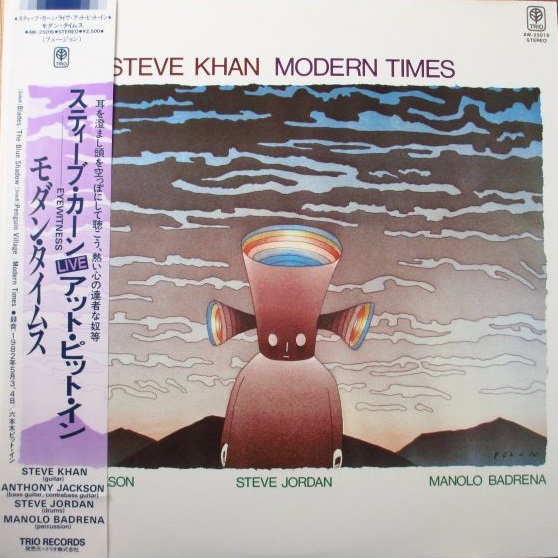
Steve Khan - 2016 (1981) "Eyewitness" - (1982) "Modern Times" - (1984) "Casa Loco"

Emerging on the New York scene in the mid-1970s, guitarist Steve Khan didn't long at all to develop a strong reputation as both chameleon-like session guitarist—comfortably crossing over from the jazz world into pop and rock and gracing albums by artists ranging from Esther Phillips, Freddie Hubbard and David Sanborn to Phoebe Snow, Billy Joel and Steely Dan—and valued member of the Brecker Brothers Band, playing on the seminal uptown group's sophomore effort, 1976's Back to Back, as well as 1977's Don't Stop the Music, both on Arista Records. Before long he was signed as a solo artist by Columbia Records, releasing three albums that, while intersecting stylistically with the Breckers' more funkified music, placed his sharp-toned Fender Telecaster—blues-inflected but with a more sophisticated harmonic bent that made him instantly recognizable—front and center.

Still, while the three albums Khan made for Columbia—1977's Tightrope, 1978's The Blue Man and 1979's Arrows—remain compelling on the two-disc 2015 BGO complication that brought these three albums back into print internationally for the first time in many years, by 1980, with the release of Khan's groundbreaking Arista debut, Evidence, it was clear that change was in the air. Khan's Columbia recordings were all exceptional recordings, but they were also, to some extent, obvious albums, where Khan's attention-grabbing writing laid the foundation for some aggressive, fusion-centric soloing that, clearly for the guitarist, had a limited shelf-life.

Evidence, on the other hand, was a true solo album, where Khan layered guitar upon guitar (upon guitar) in a setlist consisting completely of other peoples' writing. The first side of the original vinyl release collected compositions—some well-known, others more obscure—by jazz luminaries including Wayne Shorter, Joe Zawinul, Lee Morgan, Horace Silver and his previous employer, Randy Brecker. But it was the second side, an 18-minute medley of music by renegade composer/pianist Thelonious Monk, that was the knockout punch on a record that, from start to finish, demonstrated greater breadth—texturally, harmonically and conceptually—than any of Khan's previous recordings...and despite his more reductionist approach. More in service of the song than ever before, Khan also demonstrated greater attention to space and the idea that less can, indeed, oftentimes be more.

These changes were all the beginning of a paradigm shift for Khan, but it was with his next three albums, all featuring the same lineup, that the guitarist truly honed these changes as a guitarist and composer with the precision of a fine sculptor, but this time in the context of an empathic quartet featuring bassist Anthony Jackson, drummer Steve Jordan and ex-Weather Report percussionist Manolo Badrena.

The group's first album, Eyewitness (Antilles, 1981), was the subject of an extensive Rediscovery column at All About Jazz in early 2015, and it's flattering to learn that the column was one of a number of factors that led Khan to approach BGO Records with the idea of doing the same thing they'd done with his three Columbia recordings the previous year, but this time with the three albums released by the quartet that gained its name from that 1981 debut.

And so, BGO's reissue also includes the live Modern Times (Trio Records, 1982)—released in the USA as Blades (Passport Jazz)—and studio follow-up Casa Loco (Antilles, 1984) alongside Eyewitness: newly remastered (and approved by Khan) and spread across two CDs, with extensive liner notes by Matt Phillips. Eyewitness/Modern Times/Casa Loco rights a wrong by putting these albums back in print: three important records that truly redefined Khan as a guitarist, composer, interpreter and bandleader. They also set the stage for everything that was to follow, even if future albums ranged from the freely interpretive trio of The Green Field (Tone Center, 2006) to the guitarist's most recent Tone Centre releases—2007's Borrowed Time; 2011's Parting Shot; and 2014's Subtext—which more decidedly explored the guitarist's career-long interest in all things Latin and Afro-Cuban.

But in a career that's positioned Khan as a guitarist's guitarist, it's with these three Eyewitness albums that everything changed—and began again—for Khan. The Rediscovery column may, indeed, be amongst the final words on Eyewitness, describing the genesis of the group and how Khan applied a sparer, largely gentler approach that eschewed overt pyrotechnics and, instead, made deep grooves, group interplay and, most important, collective listening Eyewitness' significant modus operandi.

No group is worth its salt, however, if it doesn't continue to evolve, and this two-disc set demonstrates just how Eyewitness grew over the course of an eighteen-month timespan, from the November, 1981 recording of Eyewitness through the May, 1983 sessions that yielded the more provocative Casa Loco.

It also demonstrates how Khan had grown into an artist who felt ready to take real chances; Modern Times may possess the feel of a group that's spent some significant road time together, but this May, 1982 live date from Tokyo's The Pit Inn was, in fact, Eyewitness' first ever live date. Given the tenor of the times, with the emergence of the young lions and neoconservative jazz movement in full, well, swing, Modern Times represented a significant risk on many fronts, beyond being the group's first live performance. First, this was all-original music: three compositions by Khan and the closing title track—a collectively composed piece that moves from brooding, ethereal opening to four-on-the-floor theme, driven by Khan's whammy bar-driven chords, ultimately opening up to a solo section for Khan that's propelled by the reggae-inflected Jordan, Badrena's empathic punctuations, and Jackson's remarkable ability to completely anchor the group while, at the same time, altering the harmonic centre of the piece and acting as an near-telepathic melodic foil for the guitarist.

Second, this was a live album (then an LP) with four tracks all hovering near the 11-minute mark: a bold move (and, truthfully, a hard sell for Khan) made all the bolder still when taking into account that some significant editing had to be done in order to get the tunes down to that length. More than anything else, this was a playing band that also applied judicious editing in the studio (considering the number of fade-outs on Eyewitness and Casa Loco), but which applied absolutely no restrictions on how and where the music took it in either context.

Third, while these aren't what could be called "fusion" records in any way or at any time—though they're certainly both electric and electrifying—there's little to place Eyewitness in the context of the backwards-looking neocon movement of its time. While every piece on Modern Times swings in its own way, for the most part they don't swing the way the Marsalises of the world were asserting as the only way at the time. That said, while "The Blue Shadow" opens up with a bass/drums duet that, more backbeat-driven, clearly demonstrates the mitochondrial connection shared by Jackson and Jordan, it ultimately unfolds into a solo middle section that swings in a more decidedly jazz-like fashion. Jordan makes clear that, as much as his future would be more focused on other arenas—recording with artists ranging from The Rolling Stones' Keith Richards and soulful blues guitarist Robert Cray to country crooner/guitar wizard Vince Gill—at least some of his roots were unmistakably in the jazz sphere, as both he and Badrena bolster Jackson's walking bass lines and Khan's lean phrasing and sophisticated voicings.

It's unlikely that Khan ever crossed paths with Allan Holdsworth, but there's something indescribably Holdsworthian about the construction of "Penguin Village," though once Khan winds his way through the composition's primary theme, it becomes all Eyewitness—the guitarist's sinewy melody driven relentlessly by Jordan's rimshot snare, Jackson's staggered bass lines and Badrena's pulsating congas.

But more than any individual component, that Modern Times was taken from Eyewitness' first live performance only serves to show how astute Khan was in putting this particular group of players together in the first place. The entire album bristles with excitement, even when the mood is more subdued, and there's an overriding sense, throughout its entire 46-minute duration, of a group hanging on for dear life. Still, despite every nanosecond feeling imbued with risk there is, nevertheless, a feeling of confidence amongst Khan and his bandmates; no matter where anyone chooses to go, there's a feeling of certainty that the others will always manage to be there—either to follow the lead...or to grab the reins and drive the music in even more unexpected directions.

Following a paradigm shifter like Eyewitness and a live album like Modern Times may have represented a challenge for some but, if anything, Casa Loco represents a group continuing to evolve...and may well be the best amongst a group of albums where every single one offers something unique and appealing.

Some of Casa Loco's six compositions are more concise. The opening, Simmons drum-driven "The Breakaway"—also featuring Badrena's idiosyncratic vocal utterings—barely cracks the three-minute mark. But if "The Breakaway" and closing "The Suitcase"—also the title of a subsequent live album that, culled from a 1994 German show with Jackson and drummer Dennis Chambers and released by Tone Centre in 2008—are relatively brief, the twelve-minute title track and nine-minute "Uncle Roy" provide plenty of stretching space.

Somewhere in-between, there's the metrically challenging "Some Sharks," and a completely unexpected look at Steve Leonard's 1964 surf hit with The Pyramids, "Penetration," that manages to be both reverent and thoroughly modern. Both tracks flesh out a record that differs significantly from what came before in many ways, if for no other reason than only one of its six songs being written by Khan.

Beyond the guitarist's "Uncle Roy" and "Penetration," Casa Loco's four other tracks are all co-credited to the entire group, making this an even more collaborative effort than what came before. The more pervasive inclusion of Badrena's vocals is another significant differentiator, as is Jordan's fairly liberal use of the then-relatively new Simmons electronic drums, which allowed him to inject a variety of electronic colors throughout the record---surprisingly, thirty years later, weathering time far better than many of those early electronic drum experiments. And though Khan's tone is largely clean, warm and occasionally chorused, he also injects some unexpectedly jagged overdrive on "The Suitcase" and "Penetration," and leans a little more heavily towards the overtly virtuosic...delivering rapid-fire lines that, nevertheless, never come at the expense of either the collective group sound or the heart of the music.

But while all the definers of previous Eyewitness records remain, Casa Loco is overall a more hard-driving record, with a more aggressive stance. Despite Khan's ongoing commitment to creating distinctive chord voicings and a general eschewal of "look at me" pyrotechnics, Casa Loco lights a fire that even the undeniably incendiary Modern Times failed to light...or, more fairly, lit in an entirely different way. Casa Loco is also an edgier record, with Jackson and Jordan creating a more unsettling foundation, and Badrena's improvised vocals, at times, quirkily idiosyncratic.

Taken together, Eyewitness, Modern Times and Casa Loco represent something all too rare in most musicians' discographies, defining, as they do, a very specific point in time where everything changed. Providing the opportunity to hear and feel Khan redefine both himself and his bandmates to freer possibilities—and with all three albums largely out of print for many years—credit must also go to Britain's BGO Records for being amenable to the reissue of these three important titles. As Khan prepares for a Subtext followup, Eyewitness/Modern Times/Casa Loco not only fills the gap nicely, it should act as a major eye-and ear-opener to Khan fans who've never had the opportunity—and the pleasure—to hear these three absolutely seminal and groundbreaking recordings.

Track Listing:

 CD1:
Eyewitness: 1. Where's Mumphrey? 2. Dr. Slump 3. Auxiliary Police 4. Guy Lafleur 5. Eyewitness.
Modern Times: 6. Blades 7. The Blue Shadow.

 CD2:  
Modern Times (con't): 1. Penguin Village 2. Modern Times.
Casa Loco: 3. The Breakaway 4. Casa Loco 5. Penetration 6. Some Sharks 7. Uncle Roy 8. The Suitcase.

Personnel:

Steve Khan: guitar; Anthony Jackson: bass guitar, contrabass guitar (CD1#6-7, CD2); Steve Jordan: drums, Simmons drums (CD2#3-8) ; Manolo Badrena: percussion, vocals (CD2#3-8).