Wednesday, August 17, 2016

Allan Holdsworth - 1987 "Sand"

Sand is the fifth studio album by guitarist Allan Holdsworth, released in 1987 through Relativity Records (United States) and JMS–Cream Records (Europe).

Brit guitar hero Allan Holdsworth, ex of the Soft Machine, Gong, U.K., and Bill Bruford and Annette Peacock's solo projects, has been wildly inconsistent when it comes to his solo projects. Completely bonkers for technology, he's employed every gadget he can get his hands on own records, and has gotten results that range from the near sublime to the kind of dross one usually associates with prog excess. But Sand is a different animal, a respite from the relentless kitchen sink approach Holdsworth was mired in through much of the late '70s and early '80s. Utilizing a new contraption, the "Synthaxe," a guitar that has the tonal and sonic possibilities of the synthesizer but can be played straight as well, it seems to satisfy the artist's technology jones, and allows him to compose sensitively for the instrument while not forgetting he's a guitarist first. Guitar fans might be a little put off by the sounds and textures of the synthaxe, which allows for a guitarist to subvert its limited range of tones and colors for rounded off keyboard sounds and warm textural aspects. In other words, the traditional sound of the electric guitar -- and, in particular, Holdsworth's trademark sound -- is nearly absent. In place is a near keyboard sound played in the same way he plays guitar. The six compositions here range from the knotty, mixed tempo, arpeggio-rich title track to the reflective, near pastoral grace of "Distance Vs. Desire" to the electronically astute, fast and furious jazz-rock fusion of "Mac Man." The only time a keyboard actually appears is Alan Pasqua's solo in "Pud Wud," where the guitarist wields his traditional instrument and rips free of the constraints of his own composition for some truly fiery pyrotechnics. The rhythm section of bassist Jimmy Johnson (a killer electric jazz bassist who has also played with Percy Jones and Brand X) and drummer Gary Husband are more than equal to the task of accompaniment, and, in fact, are creative foils for Holdsworth, who allows his sidemen plenty of room to shine -- also unlike many of his earlier projects. Is Sand the mark of a new contentment and refined aesthetic for Holdsworth? Only time will, but it is safe to say that this is one of his most innovative and texturally beautiful to date.

Aside from Holdsworth's obvious guitar virtuosity, any person with any kind of musical training or background MUST appreciate this innovator's unique approach to chord progression and musical (as opposed to avant garde) application of modal scales. This man travels where few dare tread with a true gift of "melody" soloing. Also pleasing to the curious ear is his use of the Synthaxe and other synth rythm instruments.

I am guessing on the length of this CD. In my mind, Sand is one of Allan's best works ever! There is excellent use of the Synthaxe guitar with the encasings of a dynamite band. Allan, at the time of its release, explores new territory just outside of hard prog... but not really a commercial effort such as Avachron. This album stands out from his many wonderful records as being one of the most inventive releases with excellent flows and textures... and of course, AWESOME playing by ALL! Fantastic spin!

People who are not into jazz music often talk of this genre going round in circles, that its artists play self-indulgent and tuneless noodlings which are unpalatable for fans of rock and pop music. Those people usually find Allan Holdsworth's '80s output and his work with prog-rock supergroup U.K. very interesting and innovative, mainly because Holdsworth managed to avoid empty musical gymnastics and overlong guitar solos in favor of kicking riffs and a completely new style which sounded unlike anything that preceded it. Now, 1987's "Sand" sees Holdsworth leaning more towards abstract electronica and giving up the vocal material and jazz-rock arrangements of earlier albums, a not unexpected thing, perhaps, since "Atavachron" certainly hinted at the things to come by introducing the Synth-axe guitar, an instrument whose sound appears more like a cross between violin and keyboard. That said, it's still difficult to pin down "Sand" stylistically -- Holdsworth's best records always seem to exist outside of any accepted musical formulas while providing a minimum of accessibility even for the uninitiated listener -- yet this album ends up sounding very fresh and kind of cool at the same time. The way all the tracks on "Sand" build is rather similar to much electronic music (imagine a jazzy version of Tangerine Dream), but in place of the monochrome, slow-motion style usually associated with this musical avenue, a dynamic and unpredictable impetus predominates. 

 Holdsworth's spacious production is dynamic and relaxing at the same time, so this album works very well as something either concentrated on or left running as background music. The 5 1/2-minute title track sets the scene with its synth-like, airy chords which are suddenly joined by dense drum patterns, ominous bass pulses and dark-sounding undercurrents of electronic washes -- a fascinating demonstration of 'urban cyber-jazz' with a variety of instrumental touches and imaginative melodies. In contrast to most other tracks here, "Distance vs. desire" totally ignores traditional rhythms and relies of layers of peaceful Synth-axe soundscapes; it's the least impressive and most repetitive piece on the album, but nevertheless has something to offer. Thankfully, things become much more abstract and compelling with the 7-minute "Pud Wud", which opens with field recordings taken from a playground, then alternating several instrumental sections and solos for the individual musicians before one instrument after the other is stripped away and the piece disappears. The path changes again with the heavily echoed, industrial drum loops and subharmonic touches of "Clown", mixing that with incredible chords and solo sections by Holdsworth before abruptly returning to massive drum patterns and light atmospherics. "Bradford Executive" also manages to hold attention during its 8 1/2-minute length; it begins with bell-like signals and crackling static, adding mimicked vibraphones and rather carnivalesque elements which provide a launching pad for the longest guitar solo on the album. The playful "Mac Man" closes the album on a more rhythm-heavy note by using some sequences which were generated by a Mac Computer, later accompanied by strong guitar screams/washes from Holdsworth and some melodic Synth-axe chords. Some of the these sounds bring to mind Tangerine Dream's mid-'80s work. In conclusion, if you have a predilection for music which is excitingly different from the run-of-the-mill modern jazz, there isn't a better place to go than "Sand": It features explorations to see what can be done with a guitar/bass/drum arrangement, pushing forward into previously unknown territories and avoiding conventional approaches to melody and rhythm with remarkable dexterity. 

"Sand" features guitarist Holdworth's experiments with the Synthaxe instrument--kind of a cross between a guitar and a synthesizer. "Sand" also includes Jimmy Johnson on bass and Chad Wackerman on drums and percussion, among other artists. Featured are beautiful compositions and fiery guitar solos - well, what else would you expect from the legato master?

Interview: http://www.fingerprintsweb.net/ah/press/gui1187.html


Track listing:

All music composed by Allan Holdsworth, except where noted. 


1.     "Sand"       5:25
2.     "Distance vs. Desire"       5:16
3.     "Pud Wud"       6:45
4.     "Clown"       5:14
5.     "The 4.15 Bradford Executive" (Holdsworth, Chad Wackerman)     8:28
6.     "Mac Man"       4:01


Total length: 35:09


Personnel:


Allan Holdsworth – guitar, SynthAxe, engineering, mixing, production
Alan Pasqua – keyboard
Gary Husband – drums (tracks 1, 3)
Chad Wackerman – drums (tracks 4, 5), percussion (track 6)
Jimmy Johnson – bass (except track 6)
Biff Vincent – Roland Octapad bass (track 6)
John England – sound effects
Francois Bardol - Artwork 

Sunday, August 7, 2016

Frank Zappa - 1986 [2003] "Jazz From Hell"

Jazz from Hell is an instrumental album whose selections were all composed and recorded by Frank Zappa. It was released in 1986 by Barking Pumpkin Records on vinyl and by Rykodisc on CD. This is Official Release #47.

All compositions were executed by Frank Zappa on the Synclavier DMS with the exception of "St. Etienne", a guitar solo excerpted from a live performance Zappa gave of "Drowning Witch" during a concert in Saint-Étienne, France, on his 1982 tour.
"While You Were Art II" is a Synclavier performance based on a transcription of Zappa's improvised guitar solo on the track "While You Were Out" from the album Shut Up 'n Play Yer Guitar (1981). The unreleased original Synclavier performance was done using only the unit's FM synthesis, while the recording found here was Zappa's "deluxe" arrangement featuring newer samples and timbres.
"Night School" was possibly named for a late-night show that Zappa pitched to ABC; the network did not pick it up. A music video was made for the song.
"G-Spot Tornado", assumed by Zappa to be impossible to play by humans, would be performed by Ensemble Modern on the concert recording The Yellow Shark (1993).

Zappa won a 1988 Grammy Award for Best Rock Instrumental Performance for this album.

Though Jazz from Hell is an entirely instrumental album, there is an unconfirmed report that the Fred Meyer chain of stores sold it in their Music Market department featuring an RIAA Parental Advisory sticker. This could have been the result of Zappa's feud with the Parents Music Resource Center (which had also inspired the 1985 Frank Zappa Meets the Mothers of Prevention), an objection to the use of the word "hell" in the album title, or in reference to the track "G-Spot Tornado", describing the erogenous zone in human anatomy commonly known as the G-Spot.

While Frank Zappa had ostensibly been "on his own" since the dissolution of the Mothers of Invention in 1969, never before had he used the term "solo artist" as literally as he does on the Grammy Award winning (in the "Best Rock Instrumental Performance by an orchestra, group or soloist" category) Jazz from Hell (1986). After two decades of depending on the skills, virtuosity, and temperament of other musicians, Zappa all but abandoned the human element in favor of the flexibility of what he could produce with his Synclavier Digital Music System. With the exception of the stunning closer "St. Etienne" -- which is a guitar solo taken from a live performance of "Drowning Witch" at the Palais des Sports in St. Etienne, France on May 28, 1982 -- the remaining seven selections were composed, created, and executed by Zappa with help from his concurrent computer assistant Bob Rice and recording engineer Bob Stone. Far from being simply a synthesizer, the Synclavier combined the ability to sample and manipulate sounds before assigning them to the various notes on a piano-type keyboard. At the time of its release, many enthusiasts considered it a slick, emotionless effort. In retrospect, their conclusions seem to have been a gut reaction to the methodology, rather than the music itself. In fact, evidence to the contrary is apparent as it brims throughout the optimistic bounding melody and tricky time-signatures of "Night School." All the more affective is the frenetic sonic trajectory coursing through "G-Spot Tornado." Incidentally, Zappa would revisit the latter -- during one of his final projects -- when the Ensemble Modern worked up Ali N. Askin's arrangement for the Yellow Shark (1993). Another cut with a bit of history to it is "While You Were Art II," which is Zappa's Synclavier-rendered version of the Shut Up 'N Play Yer Guitar (1982) entry "While You Were Out." Speaking of guitar solos, as mentioned briefly above, "St. Etienne" is the only song on Jazz from Hell to feature a band and is a treat specifically for listeners craving a sampling of Zappa's inimitable fretwork. The six-plus minute instrumental also boats support from Steve Vai (rhythm guitar), Ray White (rhythm guitar), Tommy Mars (keyboards), Bobby Martin (keyboards), Ed Mann (percussion), as well as the prominent rhythm section of Scott Thunes (bass) and Chad Wackerman (drums). Zappa-philes should similarly note that excellent (albeit) amateur-shot footage of the number was included by Zappa on the companion Video from Hell (1987) home video. 

Jazz From Hell may not be one of Frank's most popular albums and I'm sure it's one of the lowest sellers, but it's also one of his finest.
Frank had announced his intention of quitting the liva arena in 1982 and then again in 1984 ( he would be tempted back in 1988 ) but by 1986 he was composing solely on his Synclavier within the comfort of his recording studio, and the results are amazing.
Night School and G-Spot Tornado are among his best ever compositions, nobody else to this day writes such odd and yet beautiful music, it's ironic to note that the title track ( one of the weaker tracks ) won Frank a Grammy !
Probably to placate the fans of his guitar solos he choose to include one very fine ( and delicate ) solo.
This album rewards repeated listenings and and it's great insight into what made the man really tick .

On this solo digital-synth excursion, the indefatigable Zappa takes a breather from R-rated satire and battling the PMRC dragons to cook up one of his periodic classical-jazz-boogie stews. There is nothing particularly hellish about the eight pieces on the album, though it may have been a bitch to program these densely packed parcels of subdivided rhythms and Chinese-checker themes. But while most of Jazz from Hell employs now-standard Zappa compositional devices — abrupt tempo changes, harmonic broad jumps and volcanic polyphonic clusters — there is a deviant playfulness and almost affable melodic resolution about these tracks that is unique in Zappa's serious instrumental canon.

"The Beltway Bandits," for example, is a nifty piece of electronic fun, an imaginary rush-hour auto chase enacted with agitated jungle noises and a synthetic muted car horn. Even more whimsical are "Night School," a typically serpentine air underscored with rich lyric chording and lively street-corner finger popping, and the altered-states funk-up "Massaggio Galore," which sounds like Zappa's "Dancin' Fool" on Planet Claire. Make no mistake: this album is not easy listening. The complexity of a score like the extended "While You Were Art II" would confound a stadiumful of Human Leagues. Yet its sly humor and lighter tonal palette make Jazz from Hell more easily digestible, if no less demanding, than the abrasive orchestral sawing on Zappa's past concertos, like the classic Lumpy Gravy.

It would have been nice to hear Zappa tear up his digital soundscape here and there with a little more real-sound guitar. Jazz from Hell's only fuzz 'n' fusion showcase is the slow, brooding alien blues "St. Etienne," an in-concert Zappa-band recording of unspecified vintage. Nevertheless, Jazz from Hell is the Present Day Composer's most engaging and accessible serving of his singular serio-pop vision since Hot Rats. Listeners who deserted Zappa after his hard turn into scatological social protest should have no trouble putting aside their prejudices for this thirty-five-minute trip down Avant-Classical Lane, while MTV teens will be surprised to learn there's more to this old Mother than just being Dweezil's dad.

Tracks Listing

1. Night School (4:47)
2. The Beltway Bandits (3:25)
3. While You Were Art II (7:17)
4. Jazz From Hell (2:58)
5. G-Spot Tornado (3:17)
6. Damp Ankles (3:45)
7. St. Etienne (6:26) *
8. Massaggio Galore (2:31)

* Recorded 1982 at Palais des Sports, St. Etienne, France.

Total Time: 34:26

Personnel:

Frank Zappa – lead guitar, Synclavier, keyboards, production
On "St. Etienne":
Steve Vai – rhythm guitar
Ray White – rhythm guitar
Tommy Mars – keyboards
Bobby Martin – keyboards
Scott Thunes – bass guitar
Chad Wackerman – drums
Ed Mann – percussion

Steve Hackett - 1978 [2016] "Please Don't Touch" (Deluxe 2 CD)

Steve Hackett left Genesis in June 1977 (following the tour that would be documented on Seconds Out), and started his solo career in earnest with Please Don't Touch. Unlike Voyage of the Acolyte, which was a largely instrumental concept album steeped in the progressive rock idiom, this record is primarily a collection of songs featuring guest vocalists Richie Havens, Randy Crawford, and Kansas' Steve Walsh (their Phil Ehart also chips in here on drums). Although the sum effect is something of a patchwork, the individual pieces are often lovely. Over his career, Hackett has shown a propensity for extremes, in this case letting the jazzy and sentimental "Hoping Love Will Last" segue into the musical maelstrom of "Land of a Thousand Autumns" and "Please Don't Touch" (which will delight fans of Hackett's first record, although the Caroline CD inexplicably pauses too long between the two). In a nod to King Crimson (specifically Lizard), the title track is quickly cut off with the quirky carousel sounds of "The Voice of Necam," which itself dissolves into a mix of airy voices and acoustic guitar. The best tracks belong to Richie Havens: "How Can I?" ("Hackett"'s take on Peter Gabriel's "Solsbury Hill") and the conclusive "Icarus Ascending." Hackett is no singer, so he wisely masks his voice in a "laughing gnome" effect on the delightful "Carry on Up the Vicarage" and hides behind Walsh's lead on "Narnia" and "Racing in A." Perhaps taking his cue from Gabriel (whose debut had appeared in 1977), Hackett seems eager to show his range as a songwriter. While he clearly has a closet full of good ideas and a genuine knack for interesting arrangements, Hackett is too much the eccentric Englishman to appeal to broad commercial tastes. Please Don't Touch remains a uniquely effective amalgam of progressive rock and pop; like his first album, he never made another one quite like it, perhaps because he again taps the concept's full potential here. [Please Don't Touch! was released as a deluxe, two-CD, one-DVD set in 2016.]

Limited three disc (two CDs + NTSC/Region 0 DVD) edition of this 1978 album by the British guitar legend. Please Don't Touch was Steve Hackett's second solo album, his first following his departure from Genesis. The sessions saw Steve work with various guest musicians including drummer Chester Thompson (a member of Genesis for live concerts). Vocal duties were shared by Steve Walsh of the American band Kansas, Richie Havens and Randy Crawford. This deluxe edition includes new stereo and 5.1 surround sound mixes by Steven Wilson and also features the original stereo mix remastered. A further three bonus tracks are also included.

This album was recommended to me by a number of people who like progressive rock. I have to admit I bought it because Steve Walsh of Kansas sings on it. I was absolutely floored by the entire album - not a single bad track.
"Narnia" is the single most inspired vocal performance by Steve Walsh I have EVER heard. It was as though Steve Hackett wrote that song with Walsh in mind. It blends perfectly with his style, even though it is definitely more lighthearted than anything he ever did in Kansas. This album is worth buying just for this single song.
Richie Havens' Icarus Ascending is another soul-shaker - I didn't know what to expect from him having only heard his "Here Comes the Sun" previously. His voice is so profound - so moving, so deep - makes you yearn for more. I'm always sorry knowing there is no more at the end.
Randy Crawford's voice is like pure honey and light! So rich, so earnest. She was a magic choice for this album.
All in all, this is one of my favorite albums of all time - you MUST listen to it.

This release holds a lot of emotional value for me. I first heard this album in my friend's brother's basement room back in 1979 when I was the tender age of fifteen. He had a fantastic stereo system and cranked the title cut. I can still see the back of the album cover in my young hands as I read it while listening. During that memorable evening, I listened to the entire record (yes, record... music was mostly on vinyl back then) and vowed to purchase it, when I had the cash to do so. I was only a kid, at the time.

And I did, not very long after. I played that album to death, almost literally. I bought a second copy because I literally wore it out, over time. This album was one of the musically defining releases of my teen life. When I listen to it, I'm transported back in time to my own listening room, with its large Altec-style speakers and burgeoning record collection.

This particular release motivated me to take classical guitar in the early `80s. I started my education on the guitar taking classical, then moved to jazz a few years later. I recall playing for my teacher one of the short classical pieces on this record, which I had on tape in the car. He panned it, calling it a poorly contrived classical hack job. The respect I had for this teacher dropped several notches. I left his tutelage not long after.

Hackett takes all directions on this album, and it's a unique release for him due to all the guest appearances. The writing is first rate, guitar work innovative and captivating (fabulous use of the Roland guitar synth), and he never lost his progressive edge after leaving Genesis. Like most artists who follow their own creative direction, not the direction of external forces, Hackett's career has taken many twists and turns over the decades, some arguably good, others questionable. What he has never done is sat complacent. He's a true musician who remains true to his craft and to himself.

For anyone interested in exploring the early releases of Steve Hackett, Please Don't Touch is a must listen.

This album is like a master class in guitar orchestration. Every line and texture is incredibly well thought out, and not a note is waisted. But far from being just a "guitar album", Please Don't Touch really demonstrates Hackett's genius as a composer. Just terrific writing!! And while it's easy to describe the album as "eclectic", there are common threads that bring the pieces together and make it the perfect CD to listen to in it's entirety. A wonderful, wonderful album!

Tracks Listing:

CD 1
01. Narnia (4:06)
02. Carry On Up the Vicarage (A Musical Tribute To Agatha Christie) (3:11)
03. Racing In A (5:07)
04. Kim (2:14)
05. How Can I? (4:40)
06. Hoping Love Will Last (4:09)
07. Land of a Thousand Autumns (1:57)
08. Please Don't Touch (3:39)
09. The Voice of Necam (3:11)
10. Icarus Ascending (6:21)
11. Narnia (3:35)
12. Seven Of Cups (Alternative Version) (3:33)
13. Narnia (Alternative Version) (4:30)


CD 2
01. Narnia (4:11)
02. Carry on Up the Vicarage (3:12)
03. Racing in A (5:06)
04. Kim (2:13)
05. How Can I? (4:39)
06. Hoping Love Will Last (4:12)
07. Land of a Thousand Autumns (1:48)
08. Please Don't Touch (3:39)
09. The Voice of Necam (3:11)
10. Icarus Ascending (6:20)

Line-up / Musicians:

- Steve Hackett / electric, acoustic & Roland synth guitars, lead (2) & backing (1,3,9,10) vocals, keyboards (Mellotron), percussion, tape-loops, Fx, NECAM "The Computer", arranger & co-producer
With:
- Steve Walsh / vocals (1,3,13)
- Richie Havens / vocals (5,10), percussion
- Maria Bonvino / soprano vocals (6)
- Randy Crawford / vocals (6)
- Feydor / vocals (9)
- Dan Owen / alto vocals (10)
- Dale Newman / vocals (10)
- John Perry / vocals (11)
- John Hackett / flute, piccolo, bass pedals, keyboards
- Dave LeBolt / keyboards
- John Acock / keyboards, co-producer
- Tom Fowler / bass
- Chester Thompson / drums, percussion
- Phil Ehart / drums, percussion
- James Bradley / percussion
- Graham Smith / violin
- Hugh Malloy / cello

Sorry for not including the DVD, here's a link for purchase:

https://www.amazon.com/Please-Dont-Touch-STEVE-HACKETT/dp/B01B5GM1T0

Saturday, August 6, 2016

Birds Of A Feather - 1994 "Above The Clouds"

Over the course of fifteen solo albums since 1980, Dan Siegel has set a melodic standard for the smooth jazz genre. His only problem each time out seems to be topping and challenging himself. Fronting the supergoup Birds of a Feather for a freewheeling pop-fusion adventure Above the Clouds finds the keyboardist energetically resolving that dilemma. The multi faceted rhythmically eclectic project--somewhat of a sequel to a 1987 all star album--gives Siegel the opportunity to compose and produce for other lead instruments like guitar (Allen Hinds, Carl Verheyen), and sax (Boney James), and the result is a lively ensemble date which brews hefty doses of spontanaeity in a base of radio ready song craft. Siegel allows himself a few glistening solo spots but is mostly content to be one of the guys, as Hinds, James, bassist Larry Kimpel, and percussionist Lenny Castro fire away. The name warrants one corny cliche--these birds certainly fly high.

Solid contemporary pop/jazz project produced in 1994 by keyboardist Dan Siegel. Band members include Siegel, Boney James (sax), Allen Hinds (guitar), Carl Verheyen (guitar), Larry Kimpel (bass), Roberto Vally (fretless bass), Randy Drake (drums) and Lenny Castro (percussion). Standout songs include See You Soon, Head To Toe, Moonlight Drive and Old San Juan. 

This time around it's Dan Siegel with Boney James, Allen Hinds, Carl Verheyen, Larry Kimpel, Roberto Vally, Randy Drake and Lenny Castro on eleven great Siegel originals. Most of these cats played on his solo albums as well.

I had never heard of this group, saw some references to them and read some good reviews, and took a chance. Well worth the gamble! They sound very much like some of the earlier Rippingtons stuff. If you like the Rips, you'll love this album. 

I took a chance on buying this CD in the shop, not having heard of this band before and now it's one of the best smooth jazz albums in my collection. Listening to the first track 'See You Soon',really makes you appreciate what good music is all about and the recording is excellent. Perfect tempo, rhythm,and composition come through each track. Dont hesitate, go out and buy it!

 Track Listings

  1. See You Soon
  2. Head To Toe
  3. Moonlight Drive
  4. Old San Juan
  5. Above The Clouds
  6. When Truth Speaks
  7. Phoenix Rising
  8. Big Sky
  9. Westward
  10. Hopscotch
  11. Durango

Personnel:

Dan Siegel (vocals, keyboards);
Allen Hinds, Carl Verheyen (guitar);
Boney James (saxophone);
Randy Drake (drums);
Lenny Castro (percussion).

Sunday, July 31, 2016

Kenny Burrell - 1967 [1999] "Midnight Blue"

Midnight Blue is a 1963 album by Jazz guitarist Kenny Burrell featuring Stanley Turrentine on tenor saxophone, Major Holley on double bass, Bill English on drums and Ray Barretto on conga, and is one of Burrell's best-known works for Blue Note. Jazz Improv Magazine lists the album among its top five recommended recordings for Burrell, indicating that "[i]f you need to know 'the Blue Note sound', here it is". In 2005, NPR included the album in its "Basic Jazz Library", describing it as "one of the great jazzy blues records". The album has been re-issued by Blue Note and the French label Classics.

This album is one of guitarist Kenny Burrell's best-known sessions for the Blue Note label. Burrell is matched with tenor saxophonist Stanley Turrentine, bassist Major Holley, drummer Bill English, and Ray Barretto on conga for a blues-oriented date highlighted by "Chitlins Con Carne," "Midnight Blue," "Saturday Night Blues," and the lone standard "Gee Baby Ain't I Good to You." 

I have been searching for beautiful jazz guitar albums, and this is about as close to perfection as I have found. For an album recorded in 1963, it still sounds remarkably fresh today. Beautiful playing never goes out of style. How smooth can Jazz guitar get? Right here is the answer. Every song on this album is first rate and has some of the best guitar I've ever heard when it comes to Jazz. Five stars really isn't enough when it comes to this album. It should be the first stop when considering listening to Kenny Burrell.

In an era dominated by the glossy veneer of "Facebook blue," Kenny Burrell's Midnight Blue sets the mood for a brief return to a bygone era when the deep indigo of the Yves Klein version was more common. Darker hues ruled the night, and the pale moonlight of a lovelorn skyline meant it was past last call and all that remained of the day was an overwhelming air of what could only be called the blues. "The blues," Duke Ellington wrote, "the blues ain't nothin' but a cold gray day, and all night long it stays that way…the blues is a one-way ticket from your love to nowhere; the blues ain't nothin' but a black crepe veil, ready to wear."

Leonard Feather begins his liner notes for Burrell's seminal album with this quote, invoking one of the consummate jazz guitarist's greatest influences, and one of his greatest champions. Now 81, Burrell even teaches a course on Ellington at UCLA. Part Lawrence Lucie, part Charlie Christian, he has a steely, cool-under-pressure sound on the guitar that dovetailed perfectly with Blue Note’s prevailing blues-infused character.
Few albums capture the aesthetic of Blue Note's golden era better than Midnight Blue—a consistent set of original minor grooves meant to be experienced in its entirety, rather than padding for one standout track—and it justifiably occupies a place in the jazz canon, a common entry on countless essential listening lists. Recorded 50 years ago at Van Gelder studio in Englewood Cliffs with Burrell's pianoless quintet, the album still holds up to critical scrutiny, or to a pairing with a half-empty bottle of Scotch. Undoubtedly, 1963 was a high-water mark for jazz, in New Jersey and elsewhere.

One of Burrell's most enduring achievements, the album plumbs the depths of the blues for its harmonic subtleties and lyricism in a manner that can be readily accessible on its face yet challenging enough to reward repeated visits. As always with Burrell, though, never mistake brevity for simplicity; the fathomless 12-bar mantra has no two identical choruses, and Burrell doesn't rely on reflexive facility, the blues equivalent of fool's gold.
A true master, Burrell has internalized the form, giving him the sense of repose and restraint that is the cornerstone of any bluesman worth his salt. On this outing, he is joined by like-minded players who create the illusion of a loose blowing session within a tight framework: tenor saxophonist Stanley Turrentine, bassist Major Holley, drummer Billy Gene English, and conguero Ray Barretto, a highly regarded bandleader in his own right who injects a dash of Latin flavor into the mix.
Burrell got his start as a Detroit rhythm guitarist; as a result, his time is unerring and right in the pocket, he always spells out the chords and forecasts where he's going, but like a great bus driver, he doesn't draw attention to the underlying mechanics. The effect is a listener-friendly album with a tonally nuanced atmosphere easily shared between the jazz aficionado and the neophyte who just heard Kind of Blue for the first time; regardless of background, a smooth ride allows passengers to take in the scenic vistas.

The album opens with Burrell's classic minor blues, "Chitlins con Carne." Often covered by artists ranging from Horace Silver to Stevie Ray Vaughan, this is the low-key original that set the standard for this now standard Latin-tinged blues.  The eight-bar intro lays down a pulsing Latin clave, with Holley pedaling the bass as Barretto takes liberties on the congas. Turrentine's matter-of-fact statement of the melody establishes his by turns lugubrious and diaphanous sound.
Burrell's sparse comping sets the album's precedent for succinctness, one of his hallmarks. His deceptively clean guitar solo walks a tightrope between endless space and airtight rhythmic motifs; a devil-may-care attitude in the face of death that comes from having been down and out and having lived to tell about it. Turrentine plays foil, Captain Kirk to Burrell's Spock, singing the blues right out of the gate, but the two show their psychic connection when seamlessly trading not fours, but ones, until the blistering out chorus.

"Mule" recalls Howlin' Wolf sideman Hubert Sumlin's feel and precision, a slow-marinating, soft blues that the band works over like a bomb squad that has seen it all. Unlike other jazz subgenres, the key to the blues is to never let the bomb go off, and the five demonstrate an unwavering focus, keenly aware of this urgent fact. Punctuated by Holley's downward bass slide riff and English's ambling hi-hat, Turrentine and Burrell stretch out on this quintessential slow jam.
Burrell keeps it mellow on the crepuscular "Soul Lament," a solo minor groove that departs from the blues form but nevertheless retains its spirit. Though under three minutes, this represents some of Burrell's most sensitive playing, replete with embellishments, a rhythmic elasticity, and complex inversions. The pace picks up abruptly on the title track, which reintroduces the rhythm section, but not Turrentine. Taking another departure from the 12-bar blues, Burrell shows his prodigious bebop chops here, cutting loose on some extended lines juxtaposed with subtler rhythm guitar, employing technique that carries his characteristic fullness despite its comparatively fewer notes.
Turrentine returns on "Wavy Gravy," a smoldering mid-tempo blues waltz that brings the minor groove to a new tension point. Holley establishes the groove with a well-articulated bass line, which Burrell glides over sparsely, until the saxophonist comes in to state the head in unison with the guitar. Turrentine’s and Burrell's solos are the epitome of cool, a relaxed but structured call-and-response that typifies the album's eponymous color.

"Gee Baby, Ain't I Good to You," the album's sole non-original, is a lazy, schmaltz-free meditation on love. Burrell uses it as a springboard for his effortless, behind-the-beat bebop phrasing, playing off English's sultry brushwork. Burrell closes the album with "Saturday Night Blues," a driving nightcap to a bottomless evening that shifts the blues from minor to major. Turrentine simply wails; his style contrasts perfectly with Burrell's cavalier detachment. The two continue riffing over each other until it all starts to fade out—the blues are never finished, merely abandoned at dawn—as Saturday night palpably fades into Sunday morning.   

Track listing

Except where otherwise noted, all songs composed by Kenny Burrell.

    "Chitlins con Carne" – 5:30
    "Mule" (Burrell, Major Holley, Jr.) – 6:56
    "Soul Lament" – 2:43
    "Midnight Blue" – 4:02
    "Wavy Gravy" – 5:47
    "Gee, Baby, Ain't I Good to You" (Andy Razaf, Don Redman) – 4:25
    "Saturday Night Blues" – 6:16
    "Kenny's Sound" (reissue bonus track) – 4:43
    "K Twist" (reissue bonus track)– 3:36

Personnel:

    Kenny Burrell – guitar
    Stanley Turrentine – tenor saxophone
    Major Holley – bass
    Billy Gene English – drums
    Ray Barretto – conga

Saturday, July 23, 2016

Andrea Marcelli - 1990 "Silent Will"

Silent Will (Andrea Marcelli, Verve).

If you`re partial to high wattage, synthetic jazz, this is a crackling example. It features Andrea Marcelli on percussion throughout and the likes of saxophonist Wayne Shorter, guitarist Mike Stern and bassist John Patitucci on selected cuts. The result is strong on energy but short, to my ear at least, on subtlety, making it difficult to distinguish from dozens of efforts by other collections of performers.

In 1990, with the participation of Bob Berg (Tenor Sax), Mitch Forman (Piano & Midi), John Patitucci (Electric Bass), Wayne Shorter (Soprano Sax), Alex Acuna (Percussions), Mike Stern (Guitar), Allan Holdsworth (Guitar & Synthaxe) and the percussionist Andrea Marcelli, this album presents a great modern Jazz Fusion musical concept.

Although all the tracks are compositions of Andrea Marcelli, the melodies are well driven and supported by the saxes and the electric guitars... this kind of jazz reminds the groups like the Elektric Jazz Band of keyboardist Chick Corea; the good and tasty guitar phrasing of Mike Stern in his interpretations reminds me the participations of guitarist Carlos Rios with Gino Vannelli in the "Brother To Brother" album from 1978; Allan Holdsworth, still hooked on the Synthaxe at this stage of his career, shows his expertise and guitar wisdom in the tracks: "Final Project", "Love Remembered" and "Lights"

Tracklist:

1     Exit     4:38
2     Silent Will     6:46
3     Final Project     6:35
4     Different Moments     6:15
5     Love Remembered     9:00
6     Three Small Dreams     2:37
7     Everyday     7:03
8     Lights     5:00

Personnel:

    Acoustic Bass – John Patitucci (tracks: 5,8)
    Clarinet – Andrea Marcelli (tracks: 5,8)
    Drums – Andrea Marcelli (tracks: 2,3,4,5,6,7,8)
    Electric Bass – John Patitucci (tracks: 1,2,3,4,6,7)
    Electric Guitar – Allan Holdsworth (tracks: 3,5), Mike Stern (tracks: 6,7)
    Grand Piano – Mitch Forman (tracks: 1,3,4,5,6,8)
    Guitar – Mike Stern (tracks: 1,2,4)
    Percussion – Alex Acuna* (tracks: 2,4,5,6,7), Andrea Marcelli (tracks: 1,4,7)
    Soprano Saxophone – Wayne Shorter (tracks: 3,5)
    SynthAxe – Allan Holdsworth (tracks: 3,5,8)
    Synthesizer – Andrea Marcelli (tracks: 2,3,4,5,6,7,8)
    Tenor Saxophone – Bob Berg (tracks: 1,2,4,7)

Thursday, July 21, 2016

Steve Hackett - 1979 "Spectral Mornings"

Spectral Mornings is the third release and the second post-Genesis album by British guitarist Steve Hackett.
The album is the first recording to feature Hackett's first true touring band, consisting of his brother John Hackett on flute, guitar and bass pedals, long-time collaborator keyboardist Nick Magnus, bassist/vocalist Dik Cadbury, drummer John Shearer and vocalist Peter Hicks.
In 2005, Spectral Mornings was remastered and re-released on Virgin Records. The new edition features updated liner notes and seven bonus tracks.

After the release of his previous album, Please Don't Touch!, in 1978, Hackett wished to tour the material from the album along with material from his previous solo album, Voyage of the Acolyte. This meant that he needed to assemble a touring band since the personnel on Please Don't Touch! had essentially consisted of guest musicians. The band that he created for this purpose became the band that he used in the studio for Spectral Mornings and the following album, 1980's Defector. Members of Genesis had contacted Hackett to say how much they really liked this and previous albums, since it was material Hackett felt he could have used with the band.
This is the second album for which Hackett used a Roland GR-500 Guitar Synthesizer. It can be heard on two tracks: "The Virgin and the Gypsy" and "Tigermoth".
Lead vocals on most of the album were provided by Peter Hicks, which were very often backed with harmonies by Steve Hackett and Dik Cadbury. Cadbury arranged the harmony vocals, having been trained as a counter tenor (falsetto) singer. Hackett himself sings lead on "The Ballad of the Decomposing Man".

To his credit, Steve Hackett learned from the mistakes made on Please Don't Touch, and delivered a much-improved mix of songs and instrumentals on 1979's Spectral Mornings. With a workable backing band that includes John Shearer, Nick Magnus, and former Decameron bassist Dik Cadbury, the ex-Genesis guitarist exploits his strengths: progressive instrumentals that skip between heaven and hell, pastoral pop songs, and a healthy dose of English humor. Vocalist Peter Hicks takes the lead on a few tracks, and as the honey-fied "The Virgin and the Gypsy" makes clear, his voice is much better suited to the material than Richie Havens. Hackett's lone vocal cameo, "The Ballad of the Decomposing Man," is a Pythonesque treat. The guitar work is typically top-notch, equally effective in acoustic sections that feature John Hackett's flute and in tempestuous arrangements where Steve's trademark electric guitar pierces through the chaos. The guitarist also extends his range to the Cantonese koto (presumably a variation on the Japanese koto) for the delicate instrumental "The Red Flower of Tachai Blooms Everywhere"; in typically mischievous fashion, it lulls the listener into a false sense of relaxation for the sonic onslaught of "Clocks -- The Angel of Mons." For many, Voyage of the Acolyte is the definitive Hackett record, but Spectral Mornings is more indicative of his range as a solo artist. The music is true to progressive rock in sound if not in scope, a trait which endears Hackett to Genesis fans who found that band's subsequent commercialization distasteful.

From the day I was introduced to this remarkable album (yes, in vinyl) when it was released in 1979, I have had shivers go up and down my spine every time I listen to Every Day, and the closing title track. And nothing in between disappoints, either. Rather, the other tracks lay the groundwork for future releases. Although I became rather enamored of the vocal deliveries of Pete Hicks, I missed him less and less as Hackett sang more and worked on his own delivery. This release stands as one of his absolute premiere recordings.

 Track Listings

  1. Every Day
  2. The Virgin And The Gypsy
  3. The Red Flower Of Tachai Blooms Everywhere
  4. Clocks-The Angel Of Mons
  5. The Ballad Of The Decomposing Man (Featuring...)
  6. Lost Time In Cordoba
  7. Tigermoth
  8. Spectral Mornings

  Personnel

    Steve Hackett – acoustic and electric guitars, Roland guitar synthesizer, vocals on "The Ballad of the Decomposing Man", koto on The Red Flowers of Tachai Blooms Everywhere", harmonica
    John Hackett – flute, bamboo flute, Taurus Moog bass pedals
    Dik Cadbury – bass, Taurus Moog bass pedals, vocals
    Peter Hicks – vocals except on "The Ballad of the Decomposing Man"
    Nick Magnus – keyboards, Vox String Thing, Novatron, Clavichord, clavinet, Fender Rhodes electric piano, Mini Moog, Roland string
    John Shearer – drums, percussions


Monday, July 18, 2016

Tony Levin - 2000 "Waters Of Eden"

Waters of Eden is Tony Levin's second solo record, released in 2000. Most songs feature the basic quartet of Levin, Larry Fast, Jerry Marotta and Jeff Pevar. Additional guest musicians appear on most songs.

Tony Levin's Waters of Eden is an eclectic, sophisticated instrumental music album. He draws on his personal experience from spending decades in the forefront of progressive rock and art rock as well as the jazz and classical music inspiration that gave rock such lofty goals. Not only does this recording reveal Tony Levin as a cellist, but it also continues to prove he is adept at and highly creative in exploring the melodic possibilities of the bass guitar, his primary instrument. Levin, along with other musicians, adds synth to the recording. Often this seems incongruously bright in the murky, bass-led compositions. Still, this is an excellent album overall. 

Tony Levin, the legendary bassist of King Crimson who has also anchored such art-rock luminaries as Peter Gabriel and Robert Fripp, offers a look at his own complex musical canvases on Waters of Eden (Narada 70876-15224-2-6; 54:37). Not surprisingly, considering the company he's kept over the years, composer Levin crafts meticulously layered, complex works encompassing a range of influences, from the tribal-drum tension of "Pillar of Fire" to the ambient, jarring "Bone & Flesh," which builds and develops in unexpected directions. No one quite captures the emotion inherent in a singing, resonant bass tone like Levin, who utilizes the unique voice as the emotional center of the graceful, hauntingly wistful "Belle," and the elegant "Boulevard of Dreams," which builds on a straightahead piano figure. Levin's bass can convey disappointment, nostalgia, rhapsody and mystery in a single turn of the phrase. He takes advantage of that versatility on pieces ranging from the keyboard pulsing, suspense-filled "Icarus," full of longing and foreboding, to the brash, distorted rock-funk hooks of "Gecko Walk." "Utopia" is a full-blown epic-rock charged, constantly evolving and finally, uplifting-but the album's most telling highlight may be its stirring, awe-struck title track, with a circular piano figure and long-bowed cello setting up Levin's deceptively simple melody. Throughout, Levin chooses his colors carefully and deliberately, providing immense rewards for the attentive listener.

Over the last half dozen years, King Crimson bassist Tony Levin has produced a small but impressive body of work on his own Papa Bear Records, including World Diary (1995), a collection of collaborations with players such as Bill Bruford, Jerry Marotta, Shankar, and many others, and From the Caves of the Iron Mountain (1997), an atmospheric project involving Levin with drummer Jerry Marotta and flutist Steve Gorn, recorded in the location of the title. Levin's latest effort is released not through his own label, but New Age independent Narada, known more for meditative acoustic guitar music than progressive rock. But fear not. While Waters of Eden is prettier and more meditative than King Crimson, it is by no means lacking fire. The closest comparison is to Levin's work with Peter Gabriel, and this recording in fact reunites the core of Gabriel's band of the late 70s and early 80s: Levin with drummer Jerry Marotta and synthesist Larry Fast. A couple of tracks ("Bone and Flesh" and "Pillar of Fire") feature Fast's expansive synth pads and Marotta's throbbing toms. Think of what might have happened in a rehearsal for Security when Gabriel wasn't around and Levin decided to take the lead. This core trio is augmented by some special guests. The California Guitar Trio joins in for the title track; David Sancious provides keyboards and a credible virtual soprano sax on "Icarus;" guitarist Jeff Pevar soars over many cuts. Throughout, the melodic lead is centered on Levin's sensitive playing, on fretless electric, electric upright bass, and electric cello. In general, the music is fairly simple, sweeping melodies with chordal accompaniment, but the passion and craft of the players lifts it above mere New Age drivel.

Track listing:

    "Bone & Flesh" – 6:46
    "Waters of Eden" – 4:50
    "Icarus" – 5:35
    "Gecko Walk" – 4:58
    "Belle" – 4:00
    "Pillar of Fire" – 6:44
    "Boulevard of Dreams" – 6:47
    "Opal Road" – 6:23
    "Utopia" – 8:03

The Japanese release contains a bonus track entitled "From Here to the Stars" and features different cover artwork.

Personnel:

    Tony Levin – Music Man electric bass (tracks 3, 6), fretless bass, NS electric upright bass (track 6), NS electric cello (tracks 1, 2), engineer
   Warren Bernhardt – piano on track 7, engineer
    California Guitar Trio – acoustic guitars on track 2
    Larry Fast – synthesizer (tracks 1, 4, 6, 8, 9), engineer
    Steve Gorn – bansuri flute (tracks 1, 8), engineer
    Pete Levin – synthesizer (track 5)
    Jerry Marotta – percussion, drums, Taos drum, engineer
    Jeff Pevar – acoustic guitar (tracks 3, 8), electric guitar (tracks 3, 4, 6, 9), engineer
    David Sancious – synthesizer (tracks 2, 3), piano (track 2), virtual soprano saxophone
    David Torn – acoustic and electric guitars (track 1), electric oud, loops (track 1), drum processing (track 4)

California Guitar Trio - 1993 "Yamanashi Blues"

For lovers of superb instrumental music, the debut by the California Guitar Trio, Yamanashi Blues, is one of the best of the '90s. Recorded strictly on amplified acoustic guitars (supplied by Bert Lams, Hideyo Moriya, and Paul Richards), the band touches upon a wide variety of musical genres, as they cover easily identifiable classical, surf, pop, and jazz tunes, with a few originals mixed in as well. Interestingly, all the songs on Yamanashi Blues were recorded in Bert Lams' living room. Great versions of '60s surf standards like "Walk Don't Run," "Pipeline," and "Sleepwalk" are included, as well as a few J.S. Bach pieces ("Prelude In C Minor," "Chromatic Fugue In D Minor," and others). The originals fit in perfectly with the cover material, such as Lams' "Carnival," Richards' "Blockhead," and Moriya's "Kan-non Power." Unlike most other instrumental albums, the California Guitar Trio stresses the importance of songwriting over instrumental technicality.

I lack the energy to research these guys, but the CGT makes for some entertaining listening.
This is basically three guys, playing only guitars. The eclectic collection of pieces on this disc range from the Surfaris "Walk, Don't Run" to Bach's Prelude in C Minor.
Most odd. Yet oddly compelling. There is something magic about classical attention being paid to an old surf standby.
Hard to explain, fun to listen to. 

These three guitarist are fantastic artist. The songs are simply beautiful. You don't have to be a guitar enthusiast to love this CD, just a music lover. However if you play the guitar you NEED this CD to know what is possible. This will inpsire you like no other band will.

 This is a LIVE PERFORMANCE. This album was recorded during a concert directly from the guitars. No voice miking -so there's not audience applause- and most important: NO STUDIO MIXING. They sound on the record as they did at the gig.
A real masterpiece from those kind of guitarist one expect to see live at least once in his life. 

An eclectic mix of jazz, pop and classical tunes performed on amplified acoustic guitars. The debut album from this wholly un-californian threesome, Bert Lams (Belgium), Hideyo Moriya (Japan) and Paul Richards (USA).

Track listing:

1. Yamanashi Blues
2. Melrose Avenue
3. Corrente
4. Walk Don't Run
5. Ricercar
6. Pipeline
7. Beeline
8. Chromatic Fugue in D minor
9. Tenor Madness
10. Sleepwalk
11. Carnival
12. Prelude in C minor
13. Ciaccona
14. Blockhead
15. Kan-non Power

The California Guitar Trio : Bert Lams, Paul Richards, Hideyo Moriya

Saturday, July 16, 2016

Various Artists - 1993 Gold Encore Series - "Guitar Fire!"

Being a huge fan of Larry Carlton, Special EFX, Acoustic Alchemy and The Rippingtons, I was already familiar with several of the tunes on this compilation. The smooth, even flow from one song to the next was mostly upbeat and relaxing. My favorites on this album were the adventurous "Essence" by Kevin Eubanks and the Larry Carlton/B. B. King duet "Blues for TJ" written by Larry for his son, bassist Travis James Carlton. The inclusion of "The Chief" was a bit of a head scratcher since it was taken from the album "Reunion" by vibraphonist Gary Burton. Although the song was written by Pat Metheny, it features Burton on vibraphone with a short, tasteful solo by Metheny. Minor complaints aside, this disc would be an excellent addition to any smooth jazz collection.

This very well-balanced group of nine tracks from many different contributing artists is a worthy addition to the libraries of those seeking nonthreatening guitar-oriented smooth jazz/fusion background music. It's a very even mix, with some standout numbers. Acoustic Alchemy's reading of Paul Desmond's "Take Five" has a strong funk component while not losing sight of the comfortable five-beat meter. Chieli Minucci's "Jamaica, Jamaica" (guesting the composer and George Jinda) is very nicely rendered by Special EFX in a quite frankly enticing effort. I bought the CD for that track alone, and it's well worth it. Kevin Eubanks contributes the self-penned "Essence." It's a medium tempo burner with a smoky edge. The fine "Blues for TJ" track, featuring Larry Carlton and B.B. King, closes out slightly over 45 minutes of worthy ear candy. If you buy it and don't like it, somebody you know will. 

Track Listing:

1. Smiles and Smiles to Go - Larry Carlton 5:47
2. Take Five - Acoustic Alchemy 4:38
3. Early A.M. Attitude - Dave Grusin/Lee Ritenour 4:58
4. Affair in San Miguel - Russ Freeman/The Rippingtons 5:09
5. Jamaica - Chieli Minucci/George Jinda/Special EFX Jamaica 4:04
6. The - Gary Burton Chief 4:16
7. South Beat - Rene Toledo 5:23
8. Essence - Kevin Eubanks 5:37
9. Blues for TJ - Larry Carlton/B.B. King 5:18

Personnel:

Larry Carlton (guitar, keyboards);
Greg Carmichael , Lee Ritenour , Nick Webb , Pat Metheny, Rene Toledo, B.B. King (guitar);
Russ Freeman (acoustic guitar, electric guitar, keyboards, drums, keyboard programming);
Chieli Minucci (acoustic guitar, electric guitar);
Kevin Eubanks (acoustic guitar);
Michael Bearden (flute, string synthesizer);
Brandon Fields (saxophone);
Ludwig G”tz (trombone);
Michael Orta (piano);
Joe Sample (Fender Rhodes piano);
Brian Mann (organ);
Dave Grusin, Mitchel Forman, Richard Eddy, Terry Disley (keyboards);
Terry Trotter (synthesizer);
Gary Burton (vibraphone);
Marcus Miller (electric bass, fretless bass);
Will Lee (electric bass);
Steve Bailey (fretless bass);
Orlando Jr. Hernandez, Peter Erskine (drums, percussion);
Dave Weckl, Jeff Porcaro, Rick Marotta, Carlos Vega (drums);
Tony Morales (cymbals, hi-hat);
George Jinda (cymbals, tambourine, bells, chimes);
Steve Feid, Anselmo Febles, Errol Crusher Bennett, Mario Argandona, Michael Fisher, Ralph MacDonald (percussion)

Friday, July 15, 2016

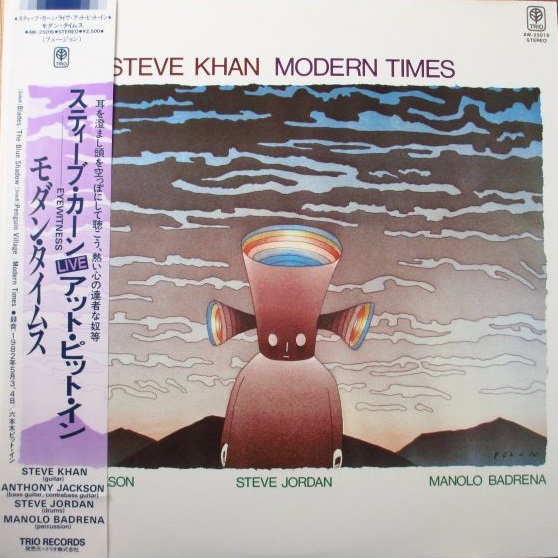
Steve Khan - 2016 (1981) "Eyewitness" - (1982) "Modern Times" - (1984) "Casa Loco"

Emerging on the New York scene in the mid-1970s, guitarist Steve Khan didn't long at all to develop a strong reputation as both chameleon-like session guitarist—comfortably crossing over from the jazz world into pop and rock and gracing albums by artists ranging from Esther Phillips, Freddie Hubbard and David Sanborn to Phoebe Snow, Billy Joel and Steely Dan—and valued member of the Brecker Brothers Band, playing on the seminal uptown group's sophomore effort, 1976's Back to Back, as well as 1977's Don't Stop the Music, both on Arista Records. Before long he was signed as a solo artist by Columbia Records, releasing three albums that, while intersecting stylistically with the Breckers' more funkified music, placed his sharp-toned Fender Telecaster—blues-inflected but with a more sophisticated harmonic bent that made him instantly recognizable—front and center.

Still, while the three albums Khan made for Columbia—1977's Tightrope, 1978's The Blue Man and 1979's Arrows—remain compelling on the two-disc 2015 BGO complication that brought these three albums back into print internationally for the first time in many years, by 1980, with the release of Khan's groundbreaking Arista debut, Evidence, it was clear that change was in the air. Khan's Columbia recordings were all exceptional recordings, but they were also, to some extent, obvious albums, where Khan's attention-grabbing writing laid the foundation for some aggressive, fusion-centric soloing that, clearly for the guitarist, had a limited shelf-life.

Evidence, on the other hand, was a true solo album, where Khan layered guitar upon guitar (upon guitar) in a setlist consisting completely of other peoples' writing. The first side of the original vinyl release collected compositions—some well-known, others more obscure—by jazz luminaries including Wayne Shorter, Joe Zawinul, Lee Morgan, Horace Silver and his previous employer, Randy Brecker. But it was the second side, an 18-minute medley of music by renegade composer/pianist Thelonious Monk, that was the knockout punch on a record that, from start to finish, demonstrated greater breadth—texturally, harmonically and conceptually—than any of Khan's previous recordings...and despite his more reductionist approach. More in service of the song than ever before, Khan also demonstrated greater attention to space and the idea that less can, indeed, oftentimes be more.

These changes were all the beginning of a paradigm shift for Khan, but it was with his next three albums, all featuring the same lineup, that the guitarist truly honed these changes as a guitarist and composer with the precision of a fine sculptor, but this time in the context of an empathic quartet featuring bassist Anthony Jackson, drummer Steve Jordan and ex-Weather Report percussionist Manolo Badrena.

The group's first album, Eyewitness (Antilles, 1981), was the subject of an extensive Rediscovery column at All About Jazz in early 2015, and it's flattering to learn that the column was one of a number of factors that led Khan to approach BGO Records with the idea of doing the same thing they'd done with his three Columbia recordings the previous year, but this time with the three albums released by the quartet that gained its name from that 1981 debut.

And so, BGO's reissue also includes the live Modern Times (Trio Records, 1982)—released in the USA as Blades (Passport Jazz)—and studio follow-up Casa Loco (Antilles, 1984) alongside Eyewitness: newly remastered (and approved by Khan) and spread across two CDs, with extensive liner notes by Matt Phillips. Eyewitness/Modern Times/Casa Loco rights a wrong by putting these albums back in print: three important records that truly redefined Khan as a guitarist, composer, interpreter and bandleader. They also set the stage for everything that was to follow, even if future albums ranged from the freely interpretive trio of The Green Field (Tone Center, 2006) to the guitarist's most recent Tone Centre releases—2007's Borrowed Time; 2011's Parting Shot; and 2014's Subtext—which more decidedly explored the guitarist's career-long interest in all things Latin and Afro-Cuban.

But in a career that's positioned Khan as a guitarist's guitarist, it's with these three Eyewitness albums that everything changed—and began again—for Khan. The Rediscovery column may, indeed, be amongst the final words on Eyewitness, describing the genesis of the group and how Khan applied a sparer, largely gentler approach that eschewed overt pyrotechnics and, instead, made deep grooves, group interplay and, most important, collective listening Eyewitness' significant modus operandi.

No group is worth its salt, however, if it doesn't continue to evolve, and this two-disc set demonstrates just how Eyewitness grew over the course of an eighteen-month timespan, from the November, 1981 recording of Eyewitness through the May, 1983 sessions that yielded the more provocative Casa Loco.

It also demonstrates how Khan had grown into an artist who felt ready to take real chances; Modern Times may possess the feel of a group that's spent some significant road time together, but this May, 1982 live date from Tokyo's The Pit Inn was, in fact, Eyewitness' first ever live date. Given the tenor of the times, with the emergence of the young lions and neoconservative jazz movement in full, well, swing, Modern Times represented a significant risk on many fronts, beyond being the group's first live performance. First, this was all-original music: three compositions by Khan and the closing title track—a collectively composed piece that moves from brooding, ethereal opening to four-on-the-floor theme, driven by Khan's whammy bar-driven chords, ultimately opening up to a solo section for Khan that's propelled by the reggae-inflected Jordan, Badrena's empathic punctuations, and Jackson's remarkable ability to completely anchor the group while, at the same time, altering the harmonic centre of the piece and acting as an near-telepathic melodic foil for the guitarist.

Second, this was a live album (then an LP) with four tracks all hovering near the 11-minute mark: a bold move (and, truthfully, a hard sell for Khan) made all the bolder still when taking into account that some significant editing had to be done in order to get the tunes down to that length. More than anything else, this was a playing band that also applied judicious editing in the studio (considering the number of fade-outs on Eyewitness and Casa Loco), but which applied absolutely no restrictions on how and where the music took it in either context.

Third, while these aren't what could be called "fusion" records in any way or at any time—though they're certainly both electric and electrifying—there's little to place Eyewitness in the context of the backwards-looking neocon movement of its time. While every piece on Modern Times swings in its own way, for the most part they don't swing the way the Marsalises of the world were asserting as the only way at the time. That said, while "The Blue Shadow" opens up with a bass/drums duet that, more backbeat-driven, clearly demonstrates the mitochondrial connection shared by Jackson and Jordan, it ultimately unfolds into a solo middle section that swings in a more decidedly jazz-like fashion. Jordan makes clear that, as much as his future would be more focused on other arenas—recording with artists ranging from The Rolling Stones' Keith Richards and soulful blues guitarist Robert Cray to country crooner/guitar wizard Vince Gill—at least some of his roots were unmistakably in the jazz sphere, as both he and Badrena bolster Jackson's walking bass lines and Khan's lean phrasing and sophisticated voicings.

It's unlikely that Khan ever crossed paths with Allan Holdsworth, but there's something indescribably Holdsworthian about the construction of "Penguin Village," though once Khan winds his way through the composition's primary theme, it becomes all Eyewitness—the guitarist's sinewy melody driven relentlessly by Jordan's rimshot snare, Jackson's staggered bass lines and Badrena's pulsating congas.

But more than any individual component, that Modern Times was taken from Eyewitness' first live performance only serves to show how astute Khan was in putting this particular group of players together in the first place. The entire album bristles with excitement, even when the mood is more subdued, and there's an overriding sense, throughout its entire 46-minute duration, of a group hanging on for dear life. Still, despite every nanosecond feeling imbued with risk there is, nevertheless, a feeling of confidence amongst Khan and his bandmates; no matter where anyone chooses to go, there's a feeling of certainty that the others will always manage to be there—either to follow the lead...or to grab the reins and drive the music in even more unexpected directions.

Following a paradigm shifter like Eyewitness and a live album like Modern Times may have represented a challenge for some but, if anything, Casa Loco represents a group continuing to evolve...and may well be the best amongst a group of albums where every single one offers something unique and appealing.

Some of Casa Loco's six compositions are more concise. The opening, Simmons drum-driven "The Breakaway"—also featuring Badrena's idiosyncratic vocal utterings—barely cracks the three-minute mark. But if "The Breakaway" and closing "The Suitcase"—also the title of a subsequent live album that, culled from a 1994 German show with Jackson and drummer Dennis Chambers and released by Tone Centre in 2008—are relatively brief, the twelve-minute title track and nine-minute "Uncle Roy" provide plenty of stretching space.

Somewhere in-between, there's the metrically challenging "Some Sharks," and a completely unexpected look at Steve Leonard's 1964 surf hit with The Pyramids, "Penetration," that manages to be both reverent and thoroughly modern. Both tracks flesh out a record that differs significantly from what came before in many ways, if for no other reason than only one of its six songs being written by Khan.

Beyond the guitarist's "Uncle Roy" and "Penetration," Casa Loco's four other tracks are all co-credited to the entire group, making this an even more collaborative effort than what came before. The more pervasive inclusion of Badrena's vocals is another significant differentiator, as is Jordan's fairly liberal use of the then-relatively new Simmons electronic drums, which allowed him to inject a variety of electronic colors throughout the record---surprisingly, thirty years later, weathering time far better than many of those early electronic drum experiments. And though Khan's tone is largely clean, warm and occasionally chorused, he also injects some unexpectedly jagged overdrive on "The Suitcase" and "Penetration," and leans a little more heavily towards the overtly virtuosic...delivering rapid-fire lines that, nevertheless, never come at the expense of either the collective group sound or the heart of the music.

But while all the definers of previous Eyewitness records remain, Casa Loco is overall a more hard-driving record, with a more aggressive stance. Despite Khan's ongoing commitment to creating distinctive chord voicings and a general eschewal of "look at me" pyrotechnics, Casa Loco lights a fire that even the undeniably incendiary Modern Times failed to light...or, more fairly, lit in an entirely different way. Casa Loco is also an edgier record, with Jackson and Jordan creating a more unsettling foundation, and Badrena's improvised vocals, at times, quirkily idiosyncratic.

Taken together, Eyewitness, Modern Times and Casa Loco represent something all too rare in most musicians' discographies, defining, as they do, a very specific point in time where everything changed. Providing the opportunity to hear and feel Khan redefine both himself and his bandmates to freer possibilities—and with all three albums largely out of print for many years—credit must also go to Britain's BGO Records for being amenable to the reissue of these three important titles. As Khan prepares for a Subtext followup, Eyewitness/Modern Times/Casa Loco not only fills the gap nicely, it should act as a major eye-and ear-opener to Khan fans who've never had the opportunity—and the pleasure—to hear these three absolutely seminal and groundbreaking recordings.

Track Listing:

 CD1:
Eyewitness: 1. Where's Mumphrey? 2. Dr. Slump 3. Auxiliary Police 4. Guy Lafleur 5. Eyewitness.
Modern Times: 6. Blades 7. The Blue Shadow.

 CD2:  
Modern Times (con't): 1. Penguin Village 2. Modern Times.
Casa Loco: 3. The Breakaway 4. Casa Loco 5. Penetration 6. Some Sharks 7. Uncle Roy 8. The Suitcase.

Personnel:

Steve Khan: guitar; Anthony Jackson: bass guitar, contrabass guitar (CD1#6-7, CD2); Steve Jordan: drums, Simmons drums (CD2#3-8) ; Manolo Badrena: percussion, vocals (CD2#3-8).

Richie Kotzen & Greg Howe - 1995 "Tilt"

Tilt is a collaborative studio album by guitarists Greg Howe and Richie Kotzen, released in 1995 through Shrapnel Records. The collaboration was organized by Shrapnel founder Mike Varney due to his enthusiasm for both guitarists' stylistic similarities, and as a result of good sales a second album, Project, was released in 1997.

After Richie Kotzen was kicked out of Poison, he teamed up with fellow shred-guitarist Greg Howe to record Tilt, an album that was nearly half-a-decade behind the times. Filled with fretboard heroics in the vein of Eddie Van Halen and Allan Holdsworth.

"Tilt" features the twin talents of super guitar shredders Greg Howe and Richie Kotzen on a CD released in 1995, when it seemed Shrapnel Records was releasing a new fusion oriented CD every week. The songwriting on "Tilt" was more or less evenly divided between Howe and Kotzen, with a cover of Stevie Wonder's "Contusion" thrown in for good measure. If you're not a fan of vocal songs, don't worry about the lone vocal number "I Wanna Play" - the vocals are quite sparse - the song being dominated by funked-up guitar and clavinet. A phine phunky phusion effort pheaturing two of progressive fusion's stalwarts.

Since Kotzen and Howe were notable guitar virtuoso's, this album packs killer jazz melodies. They do it the shred way. Only the track "I Wanna Play" is a bit different because of its funky tempo, but is good in its form. If you want to put some variation on your shredding collection this album won't disappoint you. A must have for connoisseurs of instrumental rock.

First of all I am the great fan of guitar instrumental music.In Japan,sadly enough GREG is so underrated among guitar DIEHARDS.This CD showcases the fine prowess and outstanding versatility of these guitar players.These two guys play their guitar like the two heavy weight champions of the boxing match.They never compromise against commercial music.They did what they wanted to do.So If you hear this CD you will surely be knocked down to the ground and forced to bite the dust.They really had a fierce competition from start to end.This CD never lets you down.

The best shreders in town play together in this fusion tour-de-force. The 1st track, "Title", gives the tone of the record and is absolutely killer. Richie showcases his usual fast runs throughout the album, while Greg mixes lightning chops with unexpected, cool jazzy licks. A must buy.

Track listing:

1.     "Tilt"       Greg Howe     5:27
2.     "Chase the Dragon"       Richie Kotzen     4:59
3.     "Tarnished With Age"       Howe     5:10
4.     "Outfit"       Kotzen     4:14
5.     "Contusion"       Stevie Wonder     6:25
6.     "I Wanna Play"       Kotzen     5:42
7.     "Seventh Place"       Howe     6:26
8.     "O.D."       Kotzen     4:52
9.     "Full View"       Howe     5:57

Total length: 49:12

Personnel:

Greg Howe – guitar (left stereo channel), keyboard, bass (tracks 1, 3, 5, 7, 9), engineering, mixing, production
Richie Kotzen – guitar (right stereo channel), vocals, clavinet, bass (tracks 2, 4, 6, 8), engineering, mixing, production
Jon Doman – drums (tracks 1, 3, 5, 9)
Atma Anur – drums (tracks 2, 4, 6, 8)
Kevin Soffera – drums (track 7)

Wednesday, July 13, 2016

Richie Kotzen - 1991 "Electric Joy"

Electric Joy is the third studio album by guitarist Richie Kotzen, released in 1991 through Shrapnel Records.

"Electric Joy" was Richie Kotzen's third album for Shrapnel Records and documents his incredible growth as a musician. The album delivered a collection of original instrumental compositions rich in tasteful melodies and contemporary guitar techniques, that further cemented hs position in the music world as a guitarist's guitarist. For the first time, Kotzen was in the studio producing himself with complete creative control. Since he was preparing a vocal record for Interscope around the same time, he chose to make this an all instrumental record. Kotzen's favorite songs from "Electric Joy" are "Slow Blues" and "Electric Toy".

His debut album was a hit with the shredders, but three albums in, Kotzen had already delivered three completely different pieces of work.  Electric Joy has some of the playfulness of the debut, but is mostly a jaw-dropping collection of intricately composed pieces that skirt multiple genres including funk, country, bluegrass, jazz, fusion, and blues.  If I had to pick out an influence, I would say that Electric Joy sounds like Richie had been listening to a lot of the “two Steves”:  Vai and Morse.  His technique is top-notch.

“B Funk” opens the album with some light-speed bluegrass-y licks, but it keeps changing, from a funked up rocker with shredding, to a melodic “chorus” section.  Then it’s back to the bluegrass from space.
At this point I’ll point out that Kotzen plays all the instruments except drums, himself.  That’s Richie’s standby Atma Anur on drums.  What this means is, that incredibly dexterous bassline you’re hearing on “B Funk” is also performed by Kotzen!  And it’s almost every bit as stunning as the guitar!
“Electric Toy” begins ballady, with some lyrical Vai-like moments.  Of course, Kotzen can’t help but do what he does, so there are different sections, some at lickity-split tempos.  This is followed by “Shufina”, which is essentially a blues jam.  Kotzen’s deep bends are appropriate, but before too long he’s harmonizing with himself on some unconventional melodies.
A smoking hot riff ignites “Acid Lips”, little lightning licks flicker in and out, but this one has a solid groove.  (It can’t be easy grooving with yourself on bass.)  “Slow Blues” contains some of Richie’s most lyrical lead work.  If you can imagine the lead guitar taking on the role of a singer, then “Slow Blues” is probably the most accessible song on the album.
The next song “High Wire” is uncatagorizable, suffice to say that like all of Electric Joy it combines quirky notes with shreddery, funk and groove.  My favourite song is “Dr. Glee”.  It sounds like it seems it should – gleeful.  I find this pleasant melody to be very summery.  Kotzen guitar has so many different sounds and shades, even just within this one song.

“Hot Rails” is another one that sounds like advertized…a train racing down the track.  Kotzen’s slide work is anything but simple.  This one’s so fast it’s hard to keep track of all the cool different guitar parts.  It almost sounds like Kotzen wrote a blues shuffle, and then decided to hit fast forward on his tape deck and learn it at that speed!
Electric Joy closes with “The Deece Song”, which thankfully is mid-tempo allowing us to catch our collective breath.  It’s another great performance, similar in style to “Dr. Glee”.  It has its sweeping Satriani moments as well.

This one is by far the best Richie Kotzen instrumental album to date. The opener Shufina and the following song Electric Toy are enough to put this album in the wish list of every guitar lover. The entire album by the way is extremely consistent from its beginning to its end. The music is a sort of blues fusion type of thing. There are true songs, Richie doesn't show off here for the sake of. He plays his trademark legato licks with heart and mind and the music in the end is truly gratifying. There is only one song that I don't like which it happens to be the one before the last one. Too confused. But apart from this one, a perfect brilliant album. 

I'm a huge fan of technical music. I love Allan Holdsworth, Frank Gambale, Shawn Lane, Steve Morse, etc. The problem with some of the shredders out there is the music is boring. Not so with this album. Richie sheds his previous neoclassical stylings for a bluesy funk fusion. His tone on here is superb, and the melodies are great. If you like high calibre guitar playing with good TASTE, buy this.

Recorded at Richie`s House and Prarie Sun Studios, Cotati, CA. This material was originally recorded on 1/4 inch 8 track and later transferred to 24 track for all drum overdubs and mix.

Track listing

All songs written and composed by Richie Kotzen.

1.     "B Funk"       4:18
2.     "Electric Toy"       5:01
3.     "Shufina"       5:02
4.     "Acid Lips"       4:45
5.     "Slow Blues"       4:21
6.     "High Wire"       5:41
7.     "Dr. Glee"       4:11
8.     "Hot Rails"       3:34
9.     "The Deece Song"       5:12

Total length: 42:05

Personnel:
Richie Kotzen – guitar, bass, tubular bell, arrangement, engineering, mixing, production
Atma Anur – drums, percussion